
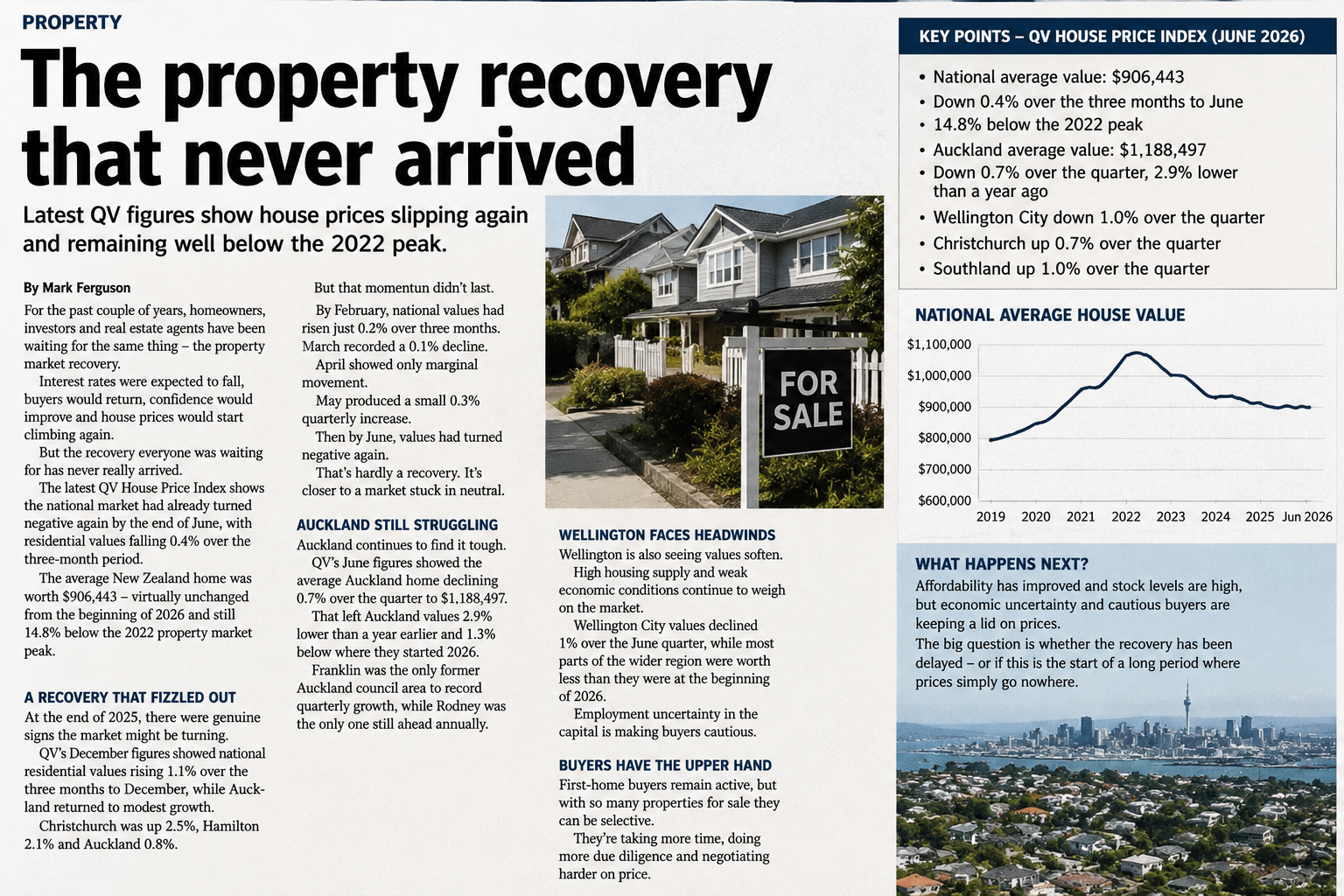
PHOTO: For the past couple of years, New Zealand homeowners, investors and real estate agents have been waiting for the same thing.
The property market recovery.
Interest rates were expected to fall. Buyers would return. Confidence would improve. House prices would start climbing again.
Except something appears to have gone wrong.
The recovery everyone was waiting for has never really arrived.
The latest QV House Price Index shows the national market had already turned negative again by the end of June, with residential values falling 0.4% over the three-month period.
The average New Zealand home was worth $906,443 – virtually unchanged from the beginning of 2026 and still a whopping 14.8% below the 2022 property market peak.
NZ Housing Stock Hits 12-Year High – Buyers Now Hold the Cards
Remember When the Property Market Was Supposed to Recover?
At the end of 2025, there were genuine signs that New Zealand’s housing market might finally be turning.
QV’s December figures showed national residential values rising 1.1% over the three months to December, while Auckland returned to modest growth.
Christchurch was up 2.5%, Hamilton 2.1% and Auckland 0.8%.
After years of falling or stagnant house prices, it looked like the long-awaited recovery might finally be underway.
But that momentum didn’t last.
By February, national values had risen just 0.2% over three months.
March recorded a 0.1% decline.
April showed only marginal movement.
May produced a small 0.3% quarterly increase.
Then by June, values had turned negative again.
That’s hardly a housing recovery.
It’s closer to a property market stuck in neutral.
The Average Kiwi Home Is Still Nearly 15% Below the Peak
Perhaps the most striking number in QV’s latest data is how far New Zealand property values remain below their previous highs.
The average home value of $906,443 is 14.8% below the 2022 market peak.
For homeowners who bought before the boom, that may simply represent the unwinding of some enormous paper gains.
But it’s a very different story for people who purchased close to the top.
Some buyers who entered the market during 2021 and early 2022 have now owned their properties for four or five years – and may still be looking at values below what they originally paid.
That helps explain another trend we’ve recently reported on: increasing numbers of properties being resold at a loss.
Auckland Is Still Struggling
If there’s one major market where the recovery has been particularly difficult to find, it’s Auckland.
QV’s June figures showed the average Auckland home declining 0.7% over the quarter to $1,188,497.
That left Auckland values:
2.9% lower than a year earlier and 1.3% below where they started 2026.
Franklin was the only former Auckland council area to record quarterly growth, while Rodney was the only one still ahead annually.
For a market that once seemed almost incapable of going backwards, that’s a remarkable change.
Wellington Isn’t Looking Much Better
Wellington continues to face its own challenges.
QV described the region as undergoing a slow but steady softening, with high housing supply and relatively weak economic conditions weighing on the market.
Wellington City values declined 1% over the June quarter, while most parts of the wider region were worth less than they had been at the beginning of 2026.
Employment uncertainty is particularly relevant in the capital.
When households aren’t confident about their jobs or future income, buying a million-dollar property suddenly becomes a much less attractive proposition.
So Where Are All the Buyers?
They’re still there.
But today’s buyer behaves very differently from the buyer of 2021.
During the pandemic property boom, buyers worried that if they didn’t purchase a house immediately, someone else would.
Today, many buyers can afford to wait.
QV says first-home buyers remain active, but elevated stock levels mean they can be selective and feel little urgency to purchase until they find exactly what they want.
That’s an enormous psychological change.
FOMO has largely disappeared.
And without buyers competing aggressively against each other, it’s difficult for house prices to rise significantly.
Too Many Houses, Not Enough Urgency
This ties directly into another major feature of the 2026 property market: the amount of housing stock available to buyers.
More choice gives purchasers leverage.
If the vendor won’t negotiate?
Look at another house.
If the building report isn’t satisfactory?
Walk away.
If the asking price looks optimistic?
Wait.
That’s great for buyers.
It’s considerably more difficult for sellers.
QV says an abundance of properties for sale, economic uncertainty and cost-of-living pressures are helping keep downward pressure on prices.
But New Zealand Isn’t One Property Market
There is an important qualification.
Not everywhere is struggling.
The national numbers disguise an increasingly divided property market.
Canterbury and Southland have been among the stronger performers, helped by comparatively better affordability and more balanced supply and demand.
In the June quarter, Southland values increased 1%, while Gore recorded particularly strong growth.
Christchurch also continued to outperform Auckland and Wellington.
So perhaps the story isn’t simply that the NZ property recovery failed.
It’s that some parts of New Zealand are recovering while others remain stuck in the downturn.
First-Home Buyers Could Be the Real Winners
There is one group that may not be particularly disappointed about the missing property boom.
First-home buyers.
They’ve spent years being told they needed to rush into the market before prices escaped them again.
Instead, prices have largely remained subdued.
Buyers now have more properties to choose from, more time to conduct due diligence and considerably more negotiating power.
For someone with secure employment, a deposit and mortgage approval, that’s not necessarily a bad market at all.
What Does This Mean for Real Estate Agents?
The market also presents an interesting challenge for agents.
In a rapidly rising market, achieving a sale can be relatively straightforward.
In today’s market, getting the listing isn’t enough.
The crucial conversation may be the one agents have with vendors about price.
A seller who remains anchored to a 2021 valuation could find their property sitting on the market while buyers simply move on.
Agents who can get vendors to understand the reality of the current market may ultimately be the ones getting properties sold.
What Happens Next?
The obvious question is whether the recovery has merely been delayed.
It’s possible.
Affordability has improved substantially compared with the market peak, and property values have already undergone a significant correction.
But the ingredients for another major property boom don’t appear obvious right now.
Buyer confidence remains fragile.
Economic uncertainty remains.
There is plenty of housing stock available.
And buyers know they don’t have to rush.
That doesn’t necessarily mean another property crash is coming.
It could mean something much less dramatic – but potentially much more frustrating for homeowners.
House prices simply going nowhere.
After one of the greatest property booms New Zealand has ever experienced, followed by a substantial correction, perhaps the next chapter isn’t another boom or another crash.
Perhaps it’s just a long, slow grind.
And for everyone who has spent the last couple of years waiting for the great New Zealand property recovery…
they may be waiting a little longer yet.