

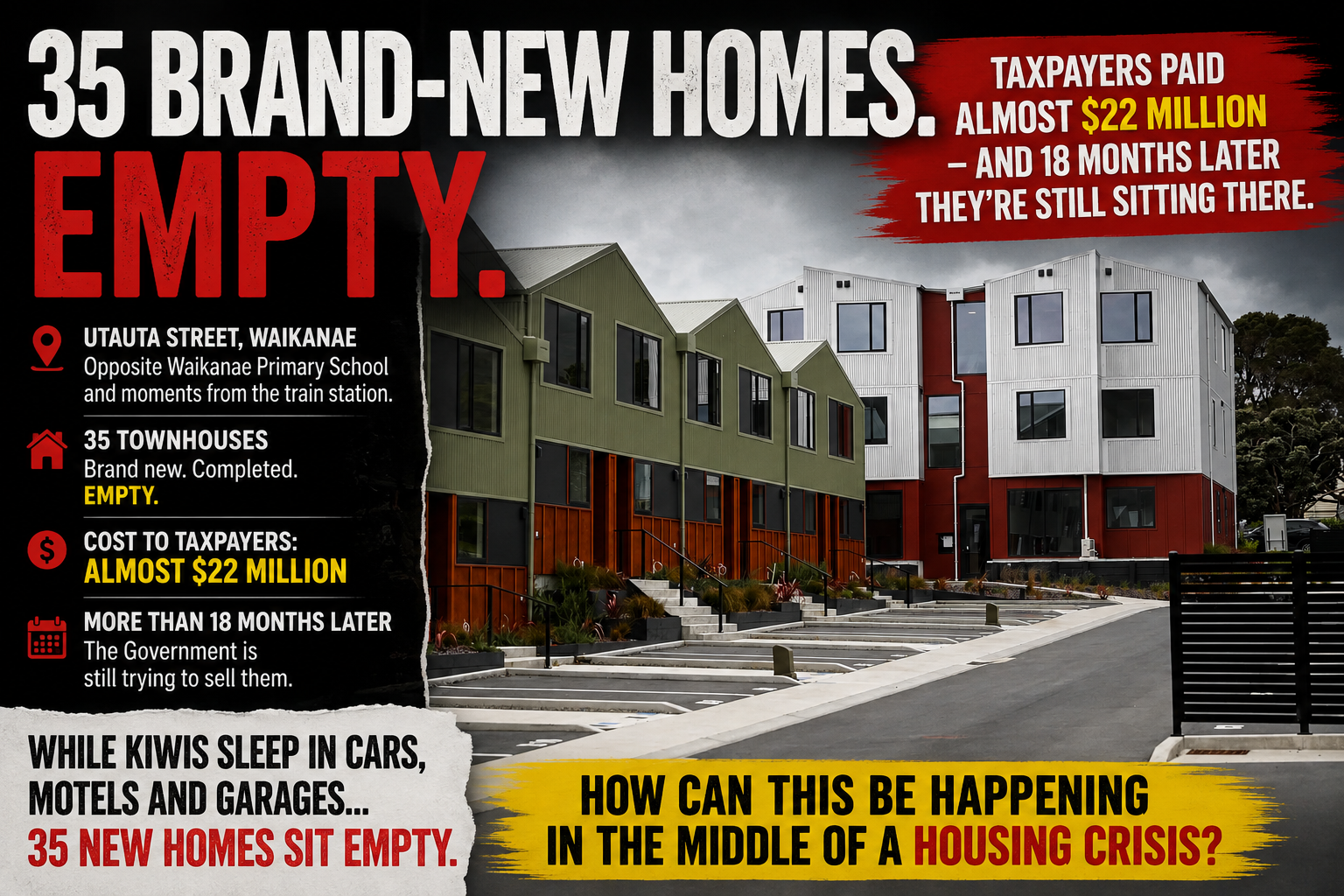
PHOTO: Thirty-five brand-new townhouses in Waikanae are sitting empty. MART PRODUCTION
While New Zealand grapples with homelessness and families desperate for housing, the Government is still holding 35 brand-new townhouses on the Kāpiti Coast that it bought for almost $22 million.
There are housing stories that make you question policy.
Then there are stories that make you wonder how the system can possibly operate like this.
Thirty-five brand-new townhouses in Waikanae are sitting empty.
Not derelict houses.
Not earthquake-damaged buildings.
Not homes waiting to be constructed.
Finished. Brand-new. Homes.
And according to reporting by Local Democracy Reporting, the Government is still trying to sell them more than 18 months after purchasing the properties for almost $22 million.
Meanwhile, New Zealand continues to wrestle with homelessness, housing insecurity and families struggling to find somewhere affordable to live.
The optics are extraordinary.
Unlock 1.2 Million+ Aussie Business Contacts — No Subscriptions, No Limits
Taxpayers ended up owning 35 houses
The story begins with the Build Ready Development Pathway, a programme established by the previous Labour government to help get housing developments moving in areas where homes were needed.
The development is on Utauta Street in Waikanae, directly opposite Waikanae Primary School and only a short distance from the railway station.
On paper, it sounds like exactly the sort of location where new housing should work.
The then Ministry of Housing and Urban Development agreed in 2022 to pre-purchase 10 houses from developer Utauta Development.
But that wasn’t the extent of the Crown’s exposure.
The Government also agreed to underwrite another 25 homes.
Then the housing market weakened, development costs rose and the project stalled.
A government briefing reportedly concluded that the development “will not proceed with Crown support” because of the weak housing market and high costs.
In early 2025, the developer triggered the underwrite.
And suddenly taxpayers weren’t backing 25 houses.
They owned them.
Combined with the 10 pre-purchased properties, the Crown ended up with 35 of the townhouses, reportedly costing almost $22 million.
That’s an average Crown purchase cost approaching $630,000 per property.
Kāpiti Coast’s Growing Attraction Reflected In Latest Property Revaluations
And they’re STILL empty
This is where the story becomes difficult to comprehend.
More than 18 months later, the Government is reportedly still trying to dispose of the properties.
The Ministry of Cities, Environment, Regions and Transport (MCERT) says it is negotiating with a prospective buyer for some of the homes and remains hopeful of selling the remainder.
The Ministry says current property-market conditions are contributing to delays.
But here’s the uncomfortable question:
How can 35 brand-new houses sit empty for 18 months in a country constantly being told it has a housing problem?
There may be perfectly legitimate contractual, financial and policy reasons why these houses cannot simply be handed over to people needing accommodation.
But that’s almost the point.
If our housing system can produce an outcome where taxpayers own 35 completed homes and those homes remain unoccupied for this long, surely the system itself deserves scrutiny.
Almost $22 million tied up in empty property
There is another side to this story that shouldn’t be ignored.
The Government understandably wants to recover taxpayers’ money.
Selling the properties too cheaply could crystallise a substantial loss.
Flooding 35 properties onto a relatively small local market could potentially affect prices.
Holding out for purchasers may therefore make commercial sense.
But governments aren’t property investment companies.
And taxpayers aren’t property speculators.
Every month these properties remain unsold potentially means additional holding, maintenance, insurance and opportunity costs — while nearly $22 million of Crown capital remains tied up in houses apparently producing no housing outcome at all.
That deserves an explanation.
Could community housing providers use them?
MCERT says it has been working with potential purchasers including community housing providers, iwi and private buyers.
That raises another obvious question.
If community housing organisations are potential purchasers, could an arrangement have been found much earlier that actually put people into these properties?
Could some have been leased?
Could they have been used as transitional accommodation?
Could a rent-to-buy programme have been considered?
Could first-home buyers have been offered some of the properties through a structured Crown programme?
Maybe there are good reasons why those options aren’t viable.
But 18 months is a very long time to have 35 new houses without residents.
Then look at what else is happening in New Zealand
The contrast is particularly uncomfortable given the wider housing debate.
Only recently, government officials acknowledged there is no guarantee that shelter can be provided to every rough sleeper in every circumstance and location.
We have people sleeping in cars.
People sleeping in garages.
People couch surfing.
Families struggling to find rentals they can afford.
Community housing providers facing demand.
And people sleeping rough on our streets.
Yet in Waikanae:
35 brand-new homes sit empty.
It is difficult to think of a better illustration of the disconnect that can exist between housing policy and actually housing people.
Labour created the deal. The current Government inherited the problem.
There also needs to be some political fairness around this.
The original Crown commitments were made under the previous Labour government.
The Build Ready Development Pathway was designed to support developments that might otherwise struggle to proceed, and the Crown agreed to both purchase and underwrite properties.
When the development ran into difficulty, taxpayers were consequently exposed.
But the current National-led Government has now inherited those houses — and the responsibility for determining what happens to them.
After more than 18 months, saying the Government remains “optimistic” about selling them is unlikely to satisfy everyone.
At some point the question changes from:
“How did the Crown end up owning these houses?”
to:
“Why are we still allowing them to sit empty?”
The great New Zealand housing contradiction
Perhaps this story exposes something much bigger.
New Zealand doesn’t simply have a shortage of houses.
We have a problem connecting houses, money, policy and people.
Because when a country can simultaneously have people desperately needing secure accommodation and 35 taxpayer-owned, brand-new homes sitting empty, something clearly isn’t connecting.
The Government may eventually sell every townhouse.
It may even recover most or all of the Crown’s investment.
From a balance-sheet perspective, officials might ultimately call that a good result.
But housing isn’t just numbers on a government spreadsheet.
Houses are built for people to live in.
And after almost $22 million of taxpayer money and more than 18 months of waiting, New Zealanders are entitled to ask one remarkably simple question: