
PHOTO: This is not the sort of league table any real estate brand wants to top. FILE
Bayleys and Quinovic have emerged at the wrong end of a new renters’ survey — and the findings raise a bigger question: how can New Zealand have a professional industry managing people’s homes while the people doing the managing still aren’t properly regulated?
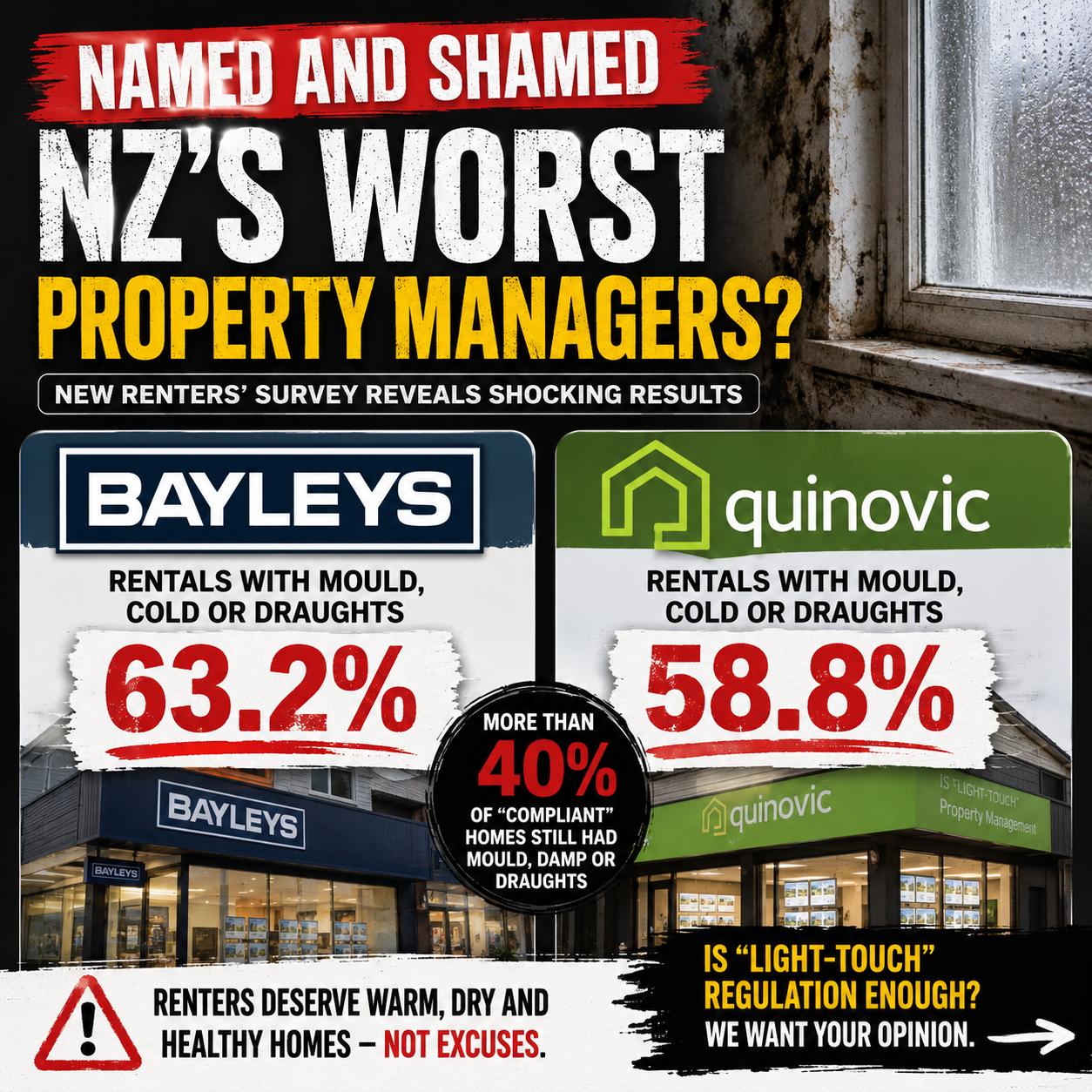
This is not the sort of league table any real estate brand wants to top.
Some of New Zealand’s biggest names in property management have been identified in the 2026 Aotearoa Renters’ Survey, with renters reporting disturbing levels of mould, cold and draughts in homes managed by major agencies.
And sitting at the top of the table is one of the country’s most recognisable property brands:
BAYLEYS
According to the survey data reported by RNZ, 63.2 percent of respondents in Bayleys-managed properties reported mould, cold or draught issues.
Next came Quinovic at 58.8 percent.
Then Crockers at 53.8 percent.
Barfoot & Thompson: 52.6 percent.
LJ Hooker: 50 percent.
Oxygen: 50 percent.
These aren’t obscure operators running a handful of rentals from somebody’s spare bedroom.
These are some of the names New Zealanders see on real estate signs, websites and advertising every single day.
And that makes the findings extremely uncomfortable.
The numbers property managers won’t want on their advertising
The survey compared renter-reported experiences across ten property management brands.
Here is the percentage of respondents reporting mould, cold or draughts:
| Property Manager | Mould, cold or draughts |
|---|---|
| Bayleys | 63.2% |
| Quinovic | 58.8% |
| Crockers | 53.8% |
| Barfoot & Thompson | 52.6% |
| LJ Hooker | 50.0% |
| Oxygen | 50.0% |
| Harcourts | 40.7% |
| Ray White | 37.7% |
| Property Brokers | 35.3% |
| Wolfbrook | 33.8% |
And then there is another set of figures that should concern both landlords and tenants.
The percentage reported as not Healthy Homes compliant was:
Bayleys – 16.7%
Quinovic – 15.2%
Crockers – 9.5%
Barfoot & Thompson – 14.4%
LJ Hooker – 28%
Oxygen – 13%
Harcourts – 14.9%
Ray White – 12.5%
Property Brokers – 13.6%
Wolfbrook – 2.8%
On that measure, LJ Hooker recorded the highest percentage at 28 percent.
Those are extraordinary numbers.
They should also be interpreted carefully: this was a renter survey, not an independent physical audit of every property managed by these companies. More than 3000 renters participated overall, but only around 500 respondents identified their property manager.
So it would be wrong to claim that 63.2 percent of every Bayleys-managed rental in New Zealand is mouldy.
But the responses are still a serious warning signal — particularly when similar complaints appear across multiple major brands.
Even supposedly compliant homes had problems
Perhaps the most damning finding isn’t actually the company rankings.
It’s this:
More than 40 percent of respondents who had been told their homes complied with Healthy Homes standards still reported problems involving mould, dampness or draughts.
Read that again.
A house can apparently carry the reassurance of Healthy Homes compliance while the person actually living inside it is still reporting mould, damp or cold.
If that’s happening at scale, surely New Zealand needs to ask whether the current certification system is doing what tenants reasonably assume it does.
Because a compliance box on a form doesn’t keep a child’s bedroom warm.
A certificate doesn’t remove mould from a wall.
And paperwork doesn’t make a damp house healthy.
‘Quite revolting’
Healthy Homes adviser Jessica Keltie told RNZ she had encountered property managers allowing extremely poor housing conditions to continue.
One example involved a single mother with three high-needs children whose bathroom had deteriorated dramatically because of severe dampness.
That is where this discussion needs to move beyond statistics.
These are people’s homes.
Children sleep in them.
Families cook in them.
People spend winter nights in them.
Tenants pay hundreds — and sometimes well over $700 or $800 — every week for the privilege of living in them.
The idea that serious mould and dampness can simply become another maintenance item waiting in somebody’s property-management inbox should be unacceptable.
So who is actually responsible?
There is an important distinction here.
Property managers generally don’t own the houses.
Landlords do.
A property manager cannot necessarily force an owner to spend unlimited amounts of money upgrading a property.
And some property management companies say they have actually walked away from landlords who refused to bring properties up to standard.
Property Brokers told RNZ it stopped managing 168 properties where owners were unwilling to undertake the work necessary to meet requirements.
That deserves recognition.
If an owner refuses to provide a lawful rental property, a professional property manager shouldn’t simply keep collecting management fees and shrug.
They should be prepared to say:
Fix it — or find another manager.
But that also exposes the enormous influence property managers have.
They are not powerless intermediaries.
They inspect properties.
They communicate maintenance requests.
They advise landlords.
They collect rent.
They organise contractors.
They document condition.
They understand — or should understand — tenancy legislation.
And they are paid to professionally manage the property.
With that role comes responsibility.
Quinovic responds
Quinovic chief executive Parrish Wong told RNZ he was disappointed by his company’s result.
That is understandable.
Quinovic ranked second-highest for reported mould, cold or draught problems.
But Wong’s response contained something particularly important.
He said Quinovic already uses independent Healthy Homes certifiers and supports making that approach compulsory.
His reasoning was refreshingly straightforward: property managers aren’t builders or specialist Healthy Homes assessors.
Get an expert to assess it.
Exactly.
So why isn’t that simply the standard?
Stop marking your own homework
This may be the biggest issue exposed by the survey.
New Zealand still allows landlords and property managers to effectively self-certify aspects of Healthy Homes compliance.
That should make people uncomfortable.
Imagine buying a car where the seller conducts the Warrant of Fitness.
Imagine a restaurant performing its own independent food-safety inspection.
Imagine a construction company issuing its own independent building certification.
We recognise conflicts in countless other industries.
Yet when it comes to the condition of a home somebody may rent for years, we continue to tolerate a system in which those with a commercial interest in the property can play a significant role in determining compliance.
An independent rental warrant of fitness deserves serious consideration.
Not because every landlord is dishonest.
Not because every property manager is incompetent.
But because genuinely independent certification protects good landlords and good property managers too.
And here’s the extraordinary part: property managers STILL aren’t properly regulated
For an industry responsible for billions of dollars of residential property and the homes of hundreds of thousands of New Zealanders, this is remarkable.
Renters United president Luke Somervell argues the sector lacks adequate registration, oversight and accountability mechanisms.
And the strange thing is that significant parts of the real estate industry apparently agree that regulation is needed.
Ray White and Harcourts told RNZ they invest in additional education for property managers.
Several businesses pointed to their membership of REINZ, which has advocated for higher professional standards and regulation.
Quinovic supports independent Healthy Homes certification.
Property Brokers wants regulation focused more strongly on the actual performance of a property.
So renters want regulation.
Industry bodies have called for regulation.
Major property management companies appear open to regulation.
Why, then, has New Zealand taken so long to properly do it?
The Government’s answer? ‘Light touch’
The Government announced plans in March for what it described as a “light-touch” regulatory approach.
Proposals include:
A public register of property managers.
Minimum education and conduct standards.
A formal complaints and disciplinary system.
A requirement for client money to be held separately from operating funds.
All perfectly reasonable.
But after looking at the findings in this survey, New Zealanders might reasonably ask:
Why are we aiming for “light-touch”?
Property management isn’t an insignificant side hustle.
A manager can be responsible for dozens or hundreds of homes.
They can handle enormous amounts of rent and bond-related administration.
Their decisions can affect whether repairs happen promptly.
Their advice can influence landlords.
Their conduct directly affects people’s homes.
This is exactly the sort of occupation where clear professional standards and meaningful accountability make sense.
And nothing will happen before the election
Here’s perhaps the most frustrating part.
The proposed legislation is reportedly still being drafted and is not expected to be completed before the end of the current government’s term.
Meaning meaningful change may ultimately become a job for the next government.
We’ve been here before.
A previous property-manager regulation bill was abandoned in 2024.
Now another government is working on another proposal.
Meanwhile tenants keep paying rent.
Property managers keep managing properties.
And New Zealand keeps debating whether the people professionally responsible for rental homes should be properly regulated.
It shouldn’t be this difficult.
No-cause evictions make the imbalance even harder to ignore
The timing matters.
Renters United argues that with no-cause tenancy terminations again available to landlords under certain circumstances, renters need corresponding protections.
Whatever your political view on tenancy law, there is a legitimate issue of power here.
A tenant reporting mould or demanding repairs is dealing with the person or company responsible for their continued occupation of the property.
That can create fear.
The survey found 25 percent of respondents reported experiencing discrimination from a landlord or property manager, commonly involving family status or being a beneficiary.
Again, these are self-reported survey responses rather than adjudicated findings against individual companies.
But a quarter of respondents reporting discrimination should not simply be brushed aside.
Good property managers should WANT the cowboys gone
There is another side to this debate which deserves far more attention.
Regulation isn’t necessarily anti-property-manager.
It could be one of the best things that happens to professional property managers.
The competent operators already invest in training.
They understand tenancy law.
They maintain proper trust accounting.
They document inspections.
They chase maintenance.
They challenge landlords when necessary.
They care about their professional reputation.
Those businesses are competing against operators who may have far lower standards.
Why should they?
Proper licensing, training, independent compliance and disciplinary procedures create a floor beneath the entire industry.
As Somervell essentially argues, lift the standard and the operators doing things properly benefit while the cowboys struggle to survive.
That should appeal to renters, landlords and reputable property managers.
Bayleys at 63.2% should trigger questions
For Bayleys, the survey result is particularly uncomfortable.
Again, it cannot fairly be extrapolated to every rental the company manages.
But when 63.2 percent of respondents identifying Bayleys as their manager report mould, cold or draughts, the company should surely want to understand why.
The same applies to Quinovic at 58.8 percent.
Crockers at 53.8 percent.
Barfoot & Thompson at 52.6 percent.
LJ Hooker and Oxygen at 50 percent.
The appropriate response isn’t defensiveness.
It’s investigation.
How many properties are affected?
Are maintenance requests being acted on?
Are particular offices producing poorer outcomes?
Are landlords refusing work?
Are inspections identifying problems?
Are Healthy Homes assessments accurate?
What can be improved?
Big brands sell themselves partly on professionalism, systems and accountability.
Those advantages should extend to tenants as well as vendors and landlords.
Landlords should be asking questions too
This report isn’t simply a warning for tenants.
It’s a warning for property owners.
If you’re paying an agency 7, 8 or 9 percent of your rental income to professionally manage your investment, you should expect more than rent collection.
A poor property manager can expose an owner to:
Tenancy Tribunal proceedings.
Compensation claims.
Exemplary damages.
Maintenance costs that become worse through delay.
Unhappy tenants.
Higher turnover.
Reputational damage.
A landlord may own the property.
But when they’ve appointed a professional manager, they’re paying that person to help ensure the property is being managed properly.
So landlords should ask:
When was my property last inspected?
Is it independently Healthy Homes certified?
What maintenance has the tenant requested?
Has it been completed?
Are there recurring moisture issues?
Would I be comfortable having my own family live there?
That final question might be the best test of all.
A rental isn’t just an investment
Perhaps this is where New Zealand’s housing conversation repeatedly loses its way.
To an investor, a rental property is an asset.
It has a yield.
A mortgage.
Expenses.
Capital value.
Insurance.
Tax implications.
To the tenant?
It’s home.
It’s where their children sleep.
It’s where they recover when they’re sick.
It’s where they eat dinner.
It’s where they wake up on a freezing July morning.
That doesn’t mean landlords should be demonised.
Most landlords aren’t villains.
Most property managers aren’t cowboys.
And tenants have responsibilities too.
But there should be one incredibly low bar everyone can agree on:
If somebody is paying to live in a house, that house should be safe, dry and reasonably warm.
New Zealand has talked about this for long enough
The property management industry has had years to know regulation was coming.
Politicians have debated it.
Industry groups have supported it.
Tenant advocates have demanded it.
Bills have appeared.
Bills have disappeared.
New proposals have emerged.
And now another survey has produced another set of disturbing findings.
At some point, consultation needs to become action.
Because if major professional brands can appear in a survey where half or more of their responding tenants report mould, cold or draughts, then simply trusting the market to sort itself out doesn’t look particularly convincing.
Nor does another “light-touch” promise that may not even become law before the Government’s term ends.
New Zealand doesn’t need regulation designed to punish every landlord or property manager.
It needs regulation that protects the reputable ones and makes life increasingly difficult for the bad ones.
Independent Healthy Homes certification.
Mandatory registration.
Minimum education standards.
A meaningful complaints process.
Real disciplinary consequences.
Transparent standards.
None of that seems radical.
For an industry entrusted with people’s homes, it looks like the bare minimum.
Because in 2026, renters shouldn’t still be paying professional property managers to professionally manage cold, damp and mouldy homes.
SOURCE: RNZ