
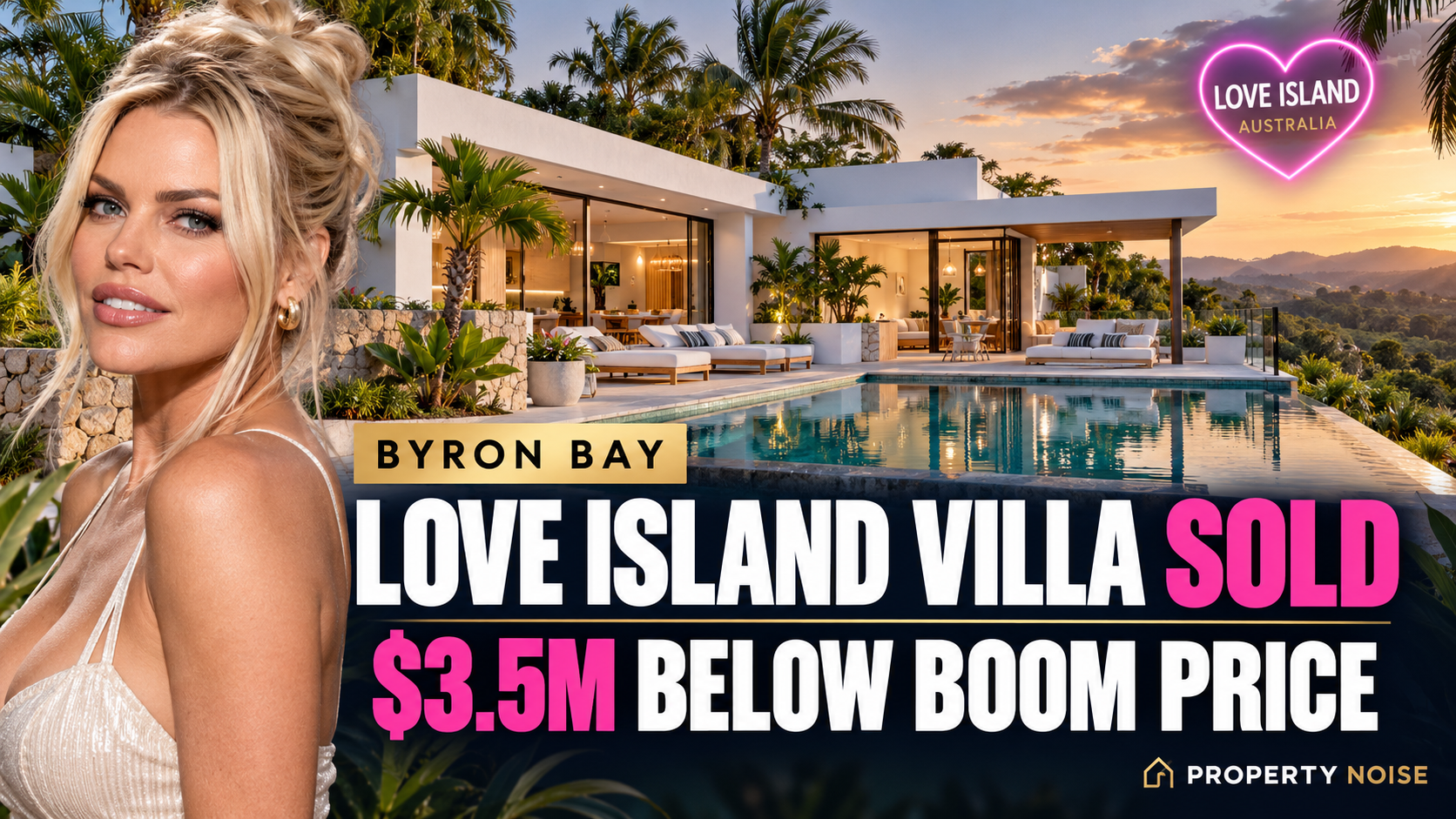
A spectacular Byron Bay hinterland estate made famous by Love Island Australia has reportedly sold for about $6 million—roughly $3.5 million less than its 2022 purchase price.
Amileka, the striking white minimalist residence used during the 2021 season of the Sophie Monk-hosted reality show, had all the ingredients normally associated with prestige property success: architectural design, television exposure, celebrity connections, enormous grounds and one of Australia’s most desirable locations.
But even that combination could not reproduce the extraordinary prices reached during the pandemic property boom.

The Byron Bay hinterland house was the villa in the 2021 series of the Sophie Monk-hosted Love Island Australia.
The numbers behind the Byron Bay sale
Technology industry couple Mikaela Lancaster and Mark Britt purchased the Federal property for $9.5 million in 2022, close to the peak of the pandemic-driven rush into Byron Bay and its surrounding hinterland.
The estate was placed on the market in October 2024 with an initial price guide reportedly between $8 million and $9 million. Expectations were subsequently lowered, with the most recent guidance sitting at approximately $6 million.
Its sale around that level represents a headline difference of about $3.5 million from its previous purchase price.
That calculation does not include stamp duty, selling commission, marketing expenses, maintenance or any improvements made during the owners’ tenure. The real financial difference could therefore be greater.
| Amileka property timeline | Reported figure |
|---|---|
| Purchased during 2022 property boom | $9.5 million |
| Initial 2024 asking range | $8 million–$9 million |
| Most recent price guidance | About $6 million |
| Difference from 2022 purchase price | About $3.5 million |
The precise final sale price has not been publicly confirmed, making the widely reported $6 million figure an approximate result rather than a formally disclosed settlement amount.
Inside the Love Island Australia villa
Situated on approximately 10 hectares in Blackbean Lane, Federal, Amileka was designed by architect Sharon Fraser and completed in 2008.
The residence is immediately recognisable for its long, low profile, bright white exterior and stripped-back contemporary architecture.
Its secluded hinterland setting made it an ideal filming location for Love Island Australia, giving contestants privacy while providing producers with the glamorous poolside environment expected from the reality television franchise.
The 2021 season was hosted by Sophie Monk, turning the already distinctive home into one of Australia’s best-known reality television properties.
Yet television fame does not guarantee a premium sale.
Celebrity exposure can generate attention and enormous online reach, but prestige buyers ultimately make decisions based on land, location, construction quality, privacy and price. A property’s entertainment history may attract clicks without necessarily producing a buyer willing to pay millions more.
Property Noise has previously examined how celebrity property can attract huge attention while still facing the realities of the market. Amileka is an especially dramatic example of that divide.

An aerial shot of the home.

Inside the Love Island Australia home.

The fire pit.

The perfect place at the end of a long day. Source: realestate.com.au
Byron Bay’s pandemic premium is being tested
The reported result is about much more than a reality television villa.
Byron Bay became one of the defining property markets of the pandemic era. Wealthy buyers, entertainers, entrepreneurs and executives competed for coastal homes and private hinterland estates as remote work changed where Australians believed they could live.
Limited stock and intense demand sent prices surging. In some cases, properties changed hands again within short periods at extraordinary increases.
That environment has changed.
Higher borrowing costs, economic uncertainty and more cautious prestige buyers have created a market in which ambitious vendors can no longer assume that another wealthy purchaser will automatically validate a boom-time price.
The wider warning signs have been building. Property Noise has reported on concerns that Australia’s property market is cracking as bank forecasts become more pessimistic, while weakening conditions have also emerged in markets previously considered exceptionally strong.
Even Brisbane has shown evidence of a slowdown, with tens of thousands of dollars reportedly wiped from some property values as its boom loses momentum.
Auction results have added to that sense of caution. Falling clearance rates can indicate a widening gap between what sellers expect and what buyers are willing—or able—to pay. Property Noise has examined the implications of Australian auction clearance rates falling below 50 percent.

Sophie Monk during her time presenting Love Island. Supplied by Channel 9
Another Byron Bay prestige estate resets its expectations
Amileka is not the only luxury holding in the Byron Bay hinterland to undergo a major repricing.
The Ranch at Talofa, a 14-hectare Bangalow Road estate, also reportedly sold after its vendor expectations were sharply reduced.
The property was initially marketed with hopes above $18 million but is understood to have sold for approximately $10 million before auction. Its promotional campaign reportedly generated around 500,000 social-media views.
That is a striking demonstration of the difference between attention and genuine buying power.
Half a million views may produce visibility, enquiries and headlines, but a prestige property still requires one financially capable buyer prepared to meet the vendor’s expectations.
The Ranch includes a four-pavilion, log-cabin-style residence overlooking open paddocks, along with a 25-metre lap pool, spa, tennis court, barn and creek frontage featuring a swimming hole and waterfall.
Despite those attributes, the reported sale price remained considerably below the original expectation.
Is this a warning for Australia’s luxury property market?
Two heavily discounted hinterland sales do not prove that every Byron Bay property is crashing. Prestige real estate is highly individual, and results can vary dramatically depending on architecture, location, land usability and vendor motivation.
However, they do show what happens when properties purchased or priced during an exceptional boom meet a more disciplined market.
Buyers are taking their time. They have more negotiating power, finance is more expensive and the fear of missing out has weakened.
Australian households are also confronting growing mortgage pressure. Property Noise has reported on the financial squeeze facing Australian homeowners as mortgage stress intensifies.
Prestige owners may not experience mortgage stress in the same way as an ordinary household, but they are exposed to the same changing market psychology. When buyers become cautious, optional multimillion-dollar purchases can be delayed indefinitely.
What does the sale mean for Love Island Australia?
The sale has inevitably generated speculation about the future of Love Island Australia, but the transaction alone does not establish that the programme is ending.
Reality television productions frequently change locations, hire properties temporarily and redesign sets between seasons. The sale of Amileka simply means any future production wanting to use the property would need to negotiate with its new owner—or choose another villa.
The bigger story is the property result.
A nationally recognised Byron Bay estate, once purchased for $9.5 million and promoted through one of Australia’s most visible television franchises, appears to have changed hands for approximately $6 million.
Property Noise view
Amileka’s reported sale is a brutal reminder that a famous address, architectural pedigree and television profile cannot protect a property from market timing.
The buyers entered near the height of an extraordinary Byron Bay boom. Several years later, the property reportedly sold into an environment defined by expensive credit, selective purchasers and dramatically lower urgency.
This may not be the collapse of Byron Bay—but the days when almost any luxury hinterland property could command a pandemic-sized premium appear to be over.
Source acknowledgement: This article is based on original reporting by Jonathan Chancellor for news.com.au.