
PROPERTY NOISE | OPINION & ANALYSIS
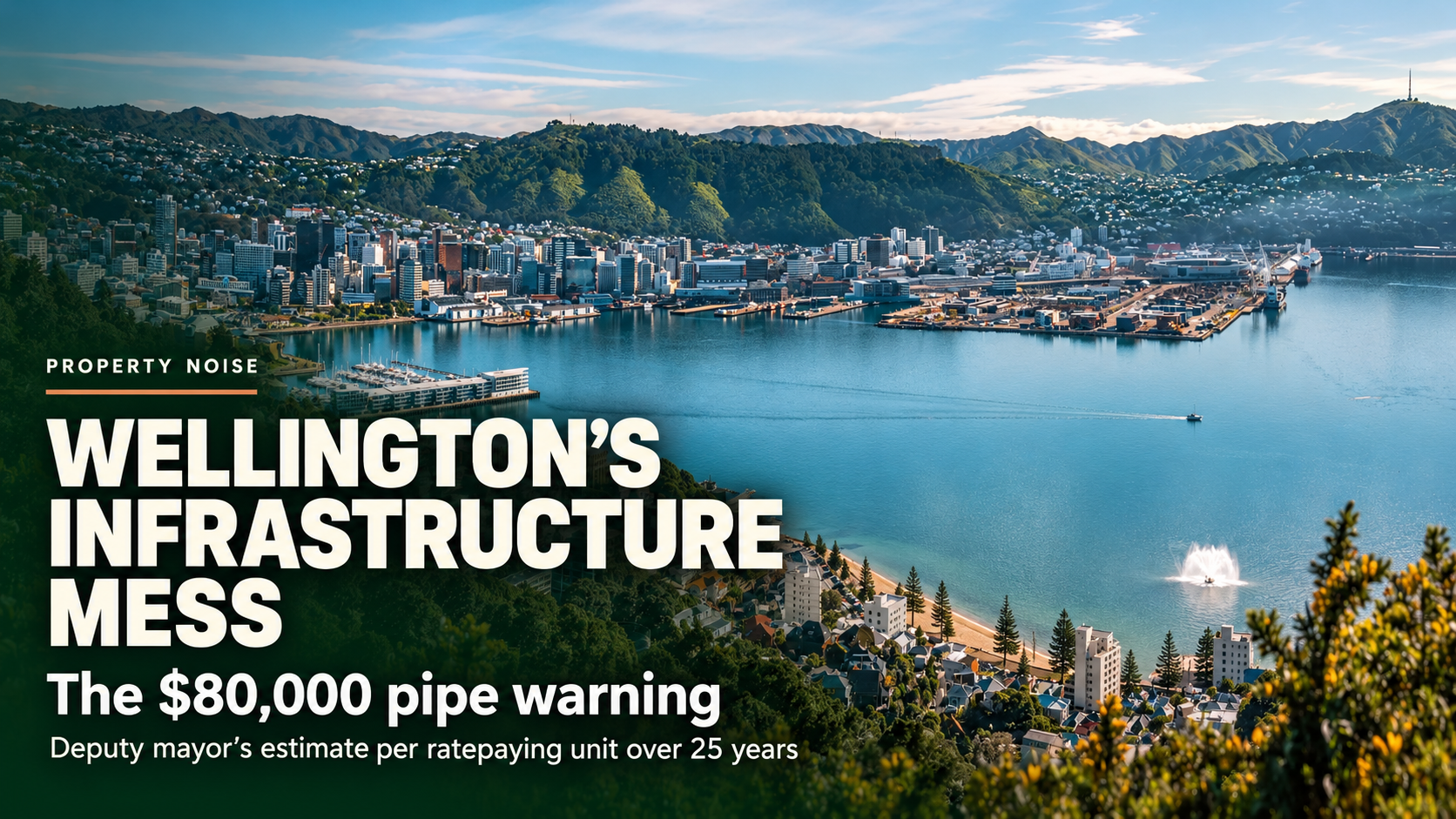
Wellington’s infrastructure crisis has reached an extraordinary point: its deputy mayor is warning that repairing the city’s worst pipes could represent more than $80,000 per ratepaying property over 25 years.
That is not an issued bill. It is Ben McNulty’s estimate of the scale of the burden facing the capital.
But the warning exposes a problem that residents cannot dismiss as another distant council forecast.
Essential infrastructure needs enormous investment. Households and businesses have limited capacity to pay. And the longer the city struggles to reconcile those realities, the harder it becomes to offer confidence about Wellington’s future.
In reporting by RNZ’s Ellen O’Dwyer, McNulty argues that the cost of fixing poor and very poor pipes alone is beyond what ordinary Wellingtonians can reasonably fund.
His assessment is blunt:
“It’s just not affordable. It is beyond the capacity of ordinary people to pay.”
For a city trying to attract residents, investment and business, that is a deeply uncomfortable message.
PHOTO: Wellington deputy mayor Ben McNulty has warned about the affordability of repairing the capital’s deteriorating pipes. RNZ / Baz Macdonald.
THE $80,000 WARNING NEEDS TO BE UNDERSTOOD CORRECTLY
McNulty’s estimate draws on a repair cost of more than $6 billion and approximately 81,000 residential and business ratepaying units, according to the supplied RNZ report.
There is an important numerical distinction.
Exactly $6 billion divided by 81,000 produces approximately $74,074 per unit. A total of $6.48 billion would produce $80,000 per unit.
The precise underlying cost therefore matters. “More than $6 billion” does not, by itself, establish the exact $80,000 result.
The estimate also does not tell each property owner what they will actually pay. Future charges depend on funding arrangements, borrowing, the allocation of costs, growth in the customer base and the programme ultimately delivered.
Nevertheless, the scale is confronting.
| Illustrative calculation | Amount |
|---|---|
| $6 billion divided by 81,000 units | Approximately $74,074 per unit |
| Cost required to equal $80,000 across 81,000 units | $6.48 billion |
| $80,000 spread evenly over 25 years | $3,200 a year |
| Equivalent weekly amount | Approximately $61.54 |
These are arithmetic illustrations, not forecasts of individual bills. They do not include financing assumptions or establish how charges would be distributed.
The warning deserves scrutiny rather than exaggeration. Even with those qualifications, it points to an enormous affordability challenge.
WELLINGTON HAS AN ESSENTIAL-SERVICES PROBLEM
A functioning capital needs dependable water, wastewater and stormwater systems.
These are basic services that support homes, workplaces, schools, hospitality businesses and public health.
When the cost of restoring them becomes a multidecade financial problem, the city has moved beyond ordinary maintenance pressure.
McNulty told RNZ that the poor-pipe estimate does not capture every requirement, including ongoing maintenance, leak repairs, storage and other network needs.
That makes the distinction between catching up and keeping up crucial.
Replacing badly deteriorated assets addresses yesterday’s backlog. Operating the network, accommodating growth and improving resilience require further decisions and funding.
Wellington needs both.
THE REGIONAL $25 BILLION FIGURE IS A DIFFERENT NUMBER
The wider Tiaki Wai investment estimate is approximately $25 billion over 30 years.
That is a regional programme, not a Wellington City-only pipe bill. It must not be added casually to McNulty’s city estimate as though the two were separate, non-overlapping liabilities.
Official information describes the regional challenge as including historic underinvestment, growth, regulatory requirements and reliable water services. Upper Hutt City Council
Separating those figures helps residents understand the argument.
It also prevents a frightening headline from becoming an inaccurate one.
The city’s problem is serious enough without combining incompatible measures.
THE CURRENT BILL IS ALREADY A HOUSEHOLD ISSUE
Tiaki Wai’s published strategy states that the average water-services bill across the four cities for 2026/27 is $2,390, describing this as a 13.3% increase over the amount previously collected through council rates.
Actual property charges vary. tiakiwai.co.nz
Residents also need to compare their combined costs carefully.
Water charges moving out of council rates and into a separate bill does not mean every dollar of the new invoice is an additional cost. Equally, a reduction in one council bill does not automatically mean the household is better off.
The meaningful comparison is:
What did this property previously pay in total, and what does it pay now for the same collection of services?
That is the number homeowners and businesses need to budget for.
It should be easy to find and explain.
A PROPERTY CAN BECOME CHEAPER TO BUY AND HARDER TO OWN
For Wellington’s property market, the implications extend beyond the council chamber.
Purchase price is only one part of affordability. Buyers also consider recurring costs, financing, insurance and maintenance.
If essential-service charges rise, they absorb income that could otherwise support mortgage repayments, savings or spending.
That does not establish a particular reduction in property values. It does create another cost for buyers to assess.
A lower asking price can look attractive while the total cost of ownership remains demanding.
Property Noise’s analysis of Auckland’s weaker sales and greater buyer choice examines why headline prices and market activity need to be considered separately. Wellington’s infrastructure costs add another dimension: what it costs to remain an owner after settlement.
BUSINESSES FACE THE SAME AFFORDABILITY QUESTION
Commercial ratepayers are part of McNulty’s calculation.
For businesses, infrastructure charges sit alongside wages, rent or mortgage costs, insurance, energy and other expenses.
Some can absorb increases. Others may have little room.
Passing costs to customers is not always possible. Nor can a business assume that a landlord, tenant or property owner will carry the burden without consequences elsewhere.
The economic issue is cumulative.
Money committed to essential infrastructure cannot simultaneously fund expansion, new equipment or additional staff.
That does not make the infrastructure spending unnecessary. It makes efficient delivery and credible funding more important.
RENAMING THE ORGANISATION DOES NOT REPAIR THE NETWORK
Tiaki Wai has inherited a substantial challenge.
The fair test is what it delivers, rather than whether it can instantly reverse decades of deterioration.
According to its published strategy, it plans almost $800 million of spending in 2026/27, with approximately half directed towards replacing and upgrading pipes and critical assets, and the remainder towards service delivery. tiakiwai.co.nz
That is substantial activity. Residents should be able to see what it achieves.
A spending total is an input. The outcomes include assets renewed, reliability improved and risks reduced.
Those are the measures that should determine whether the new arrangements are working.
INDEPENDENT SCRUTINY IS ALREADY PART OF THE RESPONSE
McNulty’s call for Commerce Commission price-quality control should not be confused with an absence of regulation.
On 29 August 2026, the Government announced that Tiaki Wai would face performance requirement regulation for 10 years, following a Commerce Commission recommendation.
The announcement describes binding requirements concerning delivery and performance. That is not the same as establishing comprehensive price-quality control over every charge. Beehive.govt.nz
The distinction matters because residents need to know what protection actually exists.
Who checks the spending? Who can require improvements? What happens when projects fall behind? How are charges assessed?
Accountability should be understandable without requiring residents to navigate a specialist regulatory vocabulary.
GOVERNMENT MONEY IS NOT FREE—BUT THE FUNDING DEBATE IS LEGITIMATE
McNulty wants government co-investment and support to reduce financing costs.
The supplied RNZ reporting describes support for various funding approaches among Wellington candidates, while Local Government Minister Simon Watts says Crown contributions are not National Party policy.
These are different positions, not an agreed rescue package.
Central-government funding would shift some costs towards taxpayers nationally. Borrowing support could change financing costs and risk allocation, depending on its design.
Neither removes the underlying need to pay for construction and service delivery.
However, questioning whether the existing local funding base can carry the burden is legitimate.
The capital has national functions. Whether that warrants additional national support is a policy argument requiring transparent criteria—and consideration of other communities facing their own infrastructure backlogs.
THE CITY NEEDS A DELIVERY PLAN PEOPLE CAN BELIEVE
Residents deserve more than competing claims about who should pay.
A credible response should make several things clear:
- Which assets present the greatest risks?
- What must be completed first?
- What will each stage cost?
- How will procurement and delivery efficiency be tested?
- How will household affordability influence the programme?
- What consequences follow missed commitments?
These are practical questions about spending large amounts of public money.
They also help distinguish necessary investment from inefficient expenditure.
A hardship arrangement may help someone manage an immediate bill. It does not resolve the long-term question of whether the funding trajectory is sustainable.
WELLINGTON CANNOT AFFORD MORE DEFERRED DECISIONS
It would be easy to respond to the scale of the estimates by demanding that spending stop.
That would leave the underlying assets and service risks in place.
The harder task is to decide what needs doing, establish a defensible sequence and fund it in a way people can carry.
Delay can create its own costs. But urgency should not become an excuse to approve expenditure without scrutiny.
Wellington needs an approach that takes both infrastructure condition and household capacity seriously.
Treating either as secondary will produce another failure.
THE PROPERTY NOISE VIEW
Calling Wellington’s infrastructure situation a mess is a judgement. The reported repair burden and official investment programme provide substantial grounds for making it.
The city faces a basic-services backlog large enough to raise serious questions about affordability, confidence and the cost of owning property.
Residents are entitled to be angry about reaching this position.
They are also entitled to accurate numbers, a realistic programme and evidence that the money collected is improving services.
An $80,000 warning is not an $80,000 invoice. A $25 billion regional programme is not a Wellington City-only bill. Those qualifications matter.
But they do not make the central problem disappear.
New Zealand’s capital needs to repair essential infrastructure while keeping itself affordable to live and do business in. That is a test of governance Wellington cannot afford to fail again.
Should the Government help fund Wellington’s water recovery—or should local ratepayers carry the cost?
Property Noise — Real news. Real views. No spin.
Related: The housing policies behind New Zealand’s election battle · NZ building costs and housing affordability
Sources: Supplied RNZ reporting by Ellen O’Dwyer; Tiaki Wai water-services strategy; Government announcement on independent scrutiny; Upper Hutt City Council’s regional water-services explanation.