
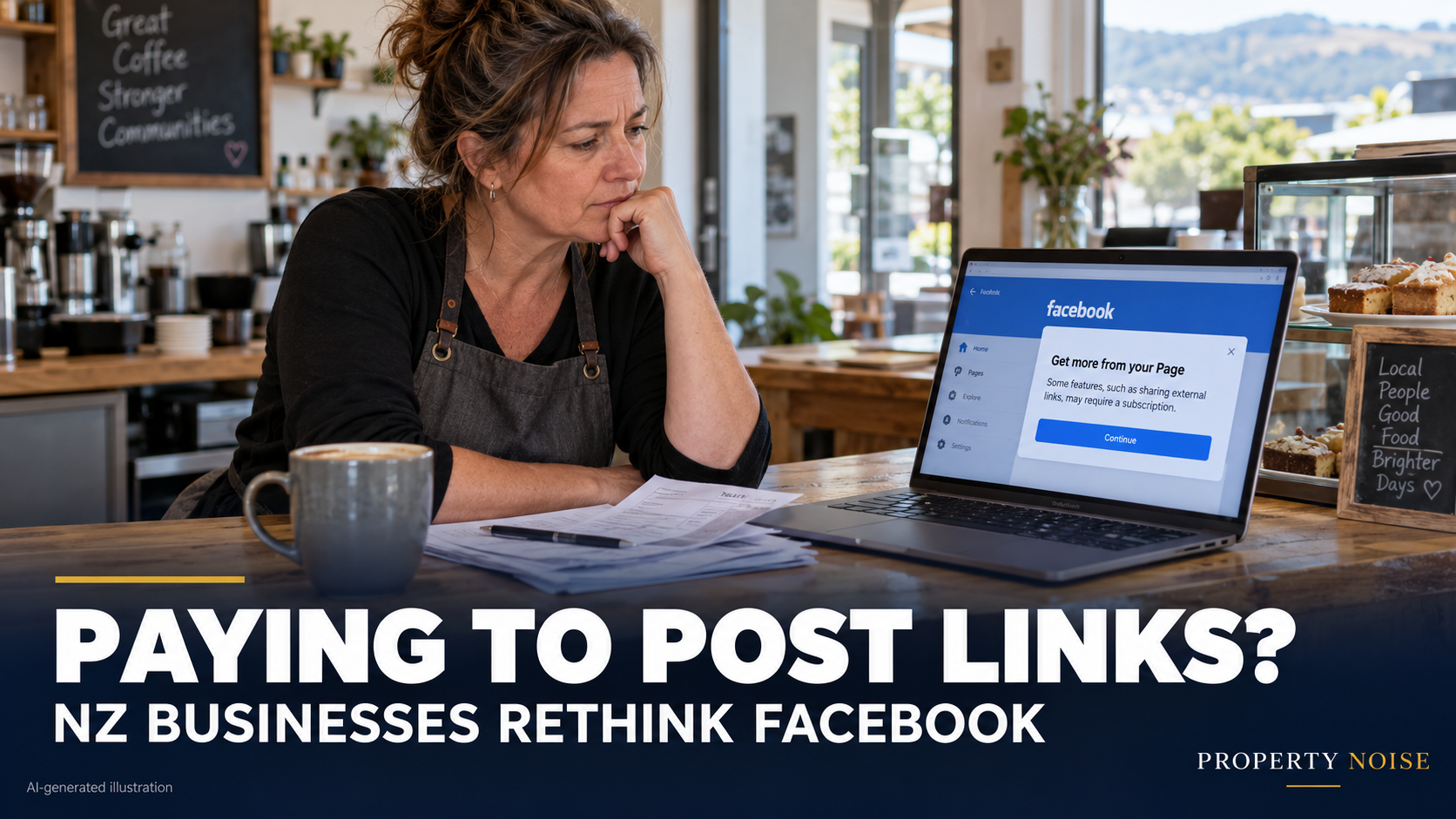
Some New Zealand businesses are facing a new cost for sharing website links on Facebook – prompting a wider question about whether their marketing budgets could work harder through their own websites, customer relationships and specialist news publishers.
RNZ’s explainer by Nik Dirga reports that Meta’s subscription rollout is restricting external-link posting for affected business pages, with unlimited links attached to a plan costing approximately NZ$883 a month.
The restrictions are not affecting every business page at once. Nor is Facebook charging every business simply to maintain a page or publish ordinary content.
But for businesses that regularly send customers to product pages, booking systems or property listings, the reported changes could alter the economics of a channel they once considered largely free.
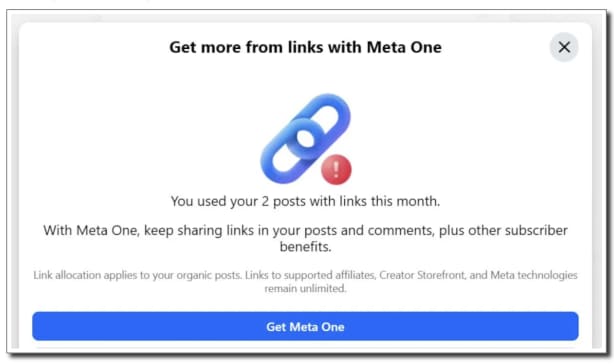
The pop-up that business pages on Facebook are starting to see promoting the subscription service Meta One.
Supplied
What are Facebook businesses being charged for?
Meta announced Meta One in September 2026, introducing subscription bundles containing business tools, AI features and account benefits. Meta presents the service as a way to help businesses manage and grow their presence across its platforms.
According to RNZ’s supplied reporting, affected Facebook pages can publish links in only two organic posts or comments each month without upgrading to a higher allowance.
“Organic” means ordinary, unpaid content. These subscription charges are separate from the money a business might spend boosting posts or buying advertising.
RNZ reports the following allowances and indicative prices:
| Reported plan | Monthly link allowance | Approximate monthly cost |
|---|---|---|
| Free | Two link-bearing posts or comments | Free |
| Essential | Two link-bearing posts or comments | NZ$26 |
| Advanced | Eight | NZ$88 |
| Expert | Twenty | NZ$265 |
| Max | Unlimited | NZ$883 |
These are the approximate NZ-dollar equivalents reported by RNZ, rather than a personalised quote. Businesses should check the price, account coverage, allowances and applicable charges displayed in their own subscription offer.
RNZ also reports that putting a link in the comments does not avoid the restriction for affected pages.
Facebook’s existing link restrictions and Instagram’s paid clickable-link features should not be assumed to work identically. Businesses need to check the rules applying to each account and platform.
Why the change matters for small New Zealand businesses
A business publishing occasional photographs or videos may notice relatively little difference.
A retailer sharing product links several times a week faces a different calculation. So does an accommodation provider directing people to bookings, or a real estate business regularly linking to listings.
At RNZ’s reported approximate price, NZ$883 a month becomes NZ$10,596 over a year — before any separate advertising spend.
That calculation is not a prediction of what every business will pay. Many will choose a cheaper plan, change their posting habits or avoid subscribing.
Nevertheless, it gives business owners a useful figure against which to compare alternatives.
The decision is about the value of the whole subscription package, including its other features, and whether those features generate worthwhile results for that particular business.
Posting a link is only the beginning
Permission to publish a link does not guarantee that customers will see it, click it or buy anything.
That distinction is central to assessing marketing value.
A business may pay for additional publishing capability and still need to invest in content, advertising and a website that converts visits into enquiries.
The same principle applies to publisher advertising: buying a placement does not guarantee sales.
The useful comparison is therefore what a channel delivers for its total cost, rather than how many posts it allows.
Why advertising directly with news publishers can be a better option
For some businesses, booking advertising directly with a relevant publication offers a clearer alternative.
The advertiser can discuss the placement, campaign duration, destination link and reporting before committing.
A specialist publisher also provides a defined editorial context. A business selling property-related services can appear alongside articles its intended customers are already choosing to read.
That makes publications such as Property Noise worth considering for:
- Real estate agencies and property service providers.
- Mortgage advisers and finance businesses.
- Builders, renovators and trades.
- Property management, maintenance and inspection services.
- Businesses supplying products to homeowners and investors.
Property Noise’s advertising information describes website placements linked to an advertiser’s chosen destination, with monthly viewing statistics. Businesses should request current terms, placement availability and reporting definitions before booking.
The potential advantage is relevance and an agreed placement. Whether it provides better value than Facebook must be assessed against the advertiser’s audience, offer and results.
Choose the publication that fits your customers
A property news website will not be the right choice for every advertiser.
A local café might find a community publication more relevant. A specialist supplier could benefit from an industry newsletter. A business serving homeowners may want a combination of local news and property coverage.
The principle is the same: find where your prospective customers already pay attention.
For businesses targeting the housing sector, Property Noise’s New Zealand property coverage provides a focused setting. Those operating across the Tasman can also explore its Australian property news.
Before spending, ask any publisher about audience geography, placement visibility, mobile presentation and how campaign performance will be measured.
Your website and customer relationships still matter
A publisher placement is another distribution channel. It does not replace the value of a business’s own website and customer relationships.
Sending visitors to a useful landing page gives them a clear next step: enquire, book, request a quote or make a purchase.
A permission-based email list can then help a business maintain contact with people who want to hear from it.
These assets require work, but they give businesses more control over their customer journey than relying entirely on a social media page.
The strongest response to changing platform rules is usually a more balanced marketing mix.
Compare enquiries and sales, not just followers
A practical campaign comparison should examine:
- Total cost: subscription, advertising, creative work and management.
- Relevant visits: whether visitors match the intended audience.
- Enquiries: calls, bookings, forms and quote requests.
- Conversions: how many enquiries become customers.
- Customer value: whether the resulting business justifies the spend.
Tagged website links and a dedicated landing page can help separate traffic from different campaigns.
Where publisher reporting provides views rather than clicks or conversions, advertisers should make that distinction explicit. Visibility is useful, but it is not the same as a sale.
Property Noise’s view: make every marketing dollar justify itself
Facebook can remain a useful channel. A paid subscription may also make commercial sense for businesses that use its wider features effectively.
But a new recurring charge is a reasonable trigger to review the alternatives.
For businesses serving property buyers, homeowners, investors and industry professionals, advertising directly with Property Noise or another relevant news provider may offer a more focused placement and clearer campaign terms.
Before paying more simply to keep linking, compare what the same budget could achieve elsewhere.
Explore advertising with Property Noise and request a campaign proposal here.
Source attribution: Based on the supplied RNZ explainer by Nik Dirga and Meta’s September 2026 announcement. Prices and account restrictions may vary. This article includes Property Noise’s commercial perspective as a publisher that sells advertising; comparative performance is not guaranteed.