
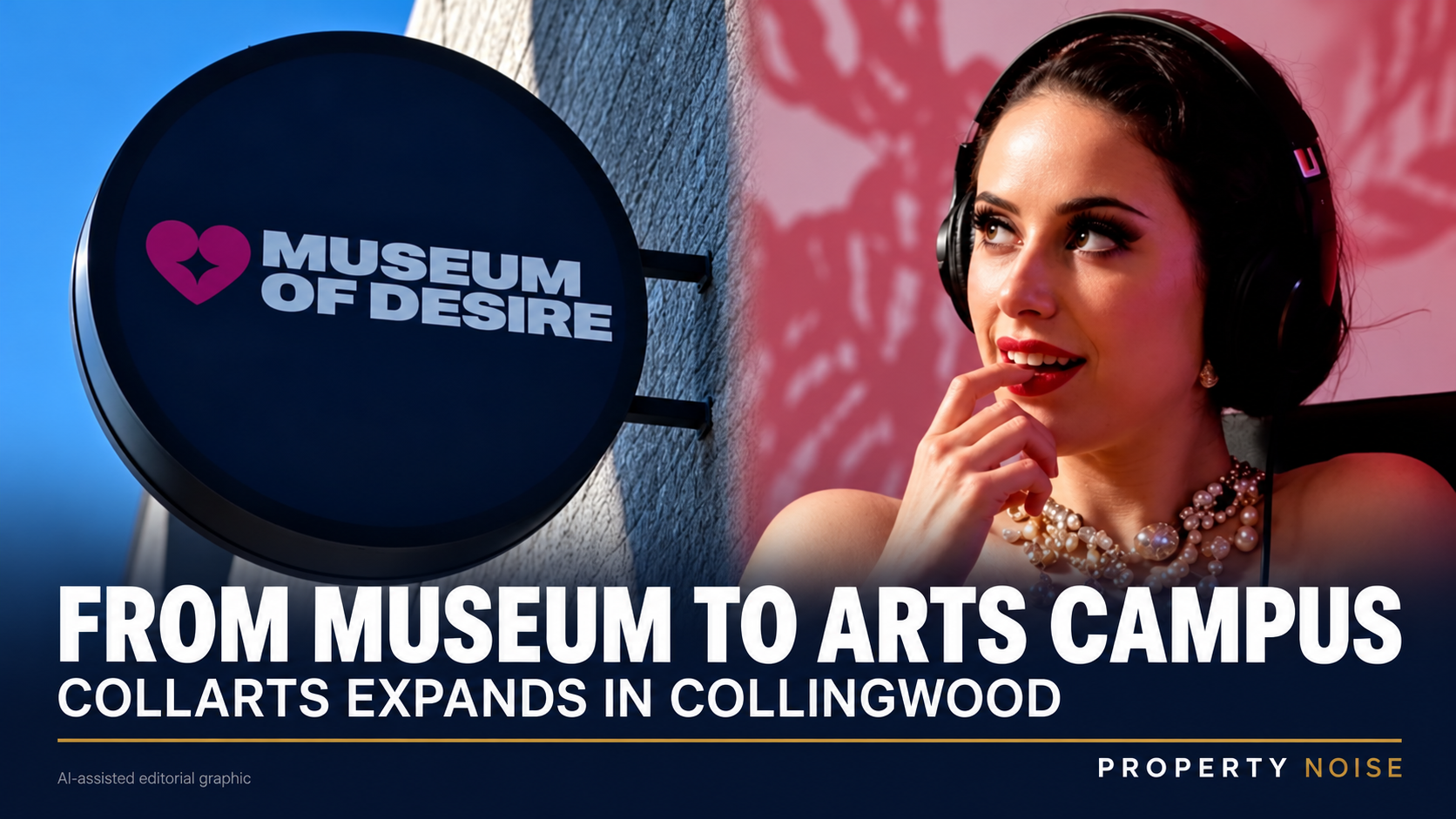
A Collingwood warehouse that recently hosted Melbourne’s adults-only Museum of Desire is preparing for another reinvention — this time as part of a creative arts college expansion.
Collarts has signed 10-year leases at 92 Rupert Street and 73 Cromwell Street, with combined annual rent reported at A$690,900.
The properties are set to accommodate facilities including a black box theatre, screening cinema, sound stage and rehearsal rooms.
Behind the unusual change of tenant is a substantial commercial property commitment: approximately A$6.9 million in rent over a decade at current rates, before increases.
All monetary figures are in Australian dollars.

The Museum of Desire opened in December 2024 and remained open for about 18 months, despite originally being planned as a six-month attraction.
A new audience for Melbourne’s former Museum of Desire
The Rupert Street property became known for its immersive exhibitions exploring intimacy and relationships.
According to David Bonaddio’s October 21 report for News Corp Australia, the Museum of Desire opened in December 2024 and closed on May 31, 2026.
Originally conceived as a six-month attraction, it ultimately operated for around 18 months. The report says it had welcomed more than 55,000 visitors by March.
Its next chapter will involve a different kind of performance.
Collarts intends to use the expanded premises for students studying performing arts, comedy, and screen and media.
The college already operates in Collingwood and Fitzroy. Its official campus information identifies existing creative education facilities in the area, including its Wellington Street campus.

Before becoming the Museum of Desire, the Rupert St warehouse housed The Hive coworking hub and was previously used as a lighting factory, according to venue operator Fever.
What is included in the Collarts leasing deal?
The two principal properties provide a combined 1,974 square metres, based on the reported individual building areas.
| Property | Reported area | Previous use |
|---|---|---|
| 92 Rupert Street, Collingwood | 1,243 sq m | Museum of Desire; previously coworking space and a lighting factory |
| 73 Cromwell Street, Collingwood | 731 sq m | OzDare Academy and Creative Studio |
| Combined | 1,974 sq m | Future Collarts facilities |
Commercial agency GrayJohnson negotiated the leases on behalf of the landlords.
The reported A$690,900 annual rental figure covers the two leases together, rather than the Rupert Street property alone.
Collarts has also secured additional space at 110 Cromwell Street. The supplied report does not disclose separate rental terms for that premises.
A decade-long commitment — not a building purchase
The distinction between leasing and buying matters here.
Collarts is securing occupation of the properties through leases. The reported A$6.9 million figure represents approximately ten years of combined rent at the current annual rate.
It is not a purchase price, property valuation or disclosed fit-out budget.
Actual rental payments over the term could be higher once any agreed increases apply. The report does not provide sufficient detail to calculate the full occupancy cost, including outgoings, incentives or other lease provisions.
What is clear is the duration: the college is planning around a much longer period of occupation than the temporary attraction that preceded it.
The warehouse has already lived several lives
The Rupert Street building’s appeal extends beyond its recent museum identity.
According to the supplied reporting, it previously operated as The Hive coworking hub and, earlier, a lighting factory.
Its industrial character includes exposed brickwork, timber-lined ceilings, polished concrete floors and sawtooth windows.
Those features help explain why former industrial buildings can attract occupiers seeking distinctive spaces. However, their suitability for specialised teaching and performance uses depends on the finished design and fit-out.
For this property, the sequence is striking: manufacturing, shared workspace, immersive entertainment and now creative education.
The building remains, while the activities inside it change.
Why education tenants matter to commercial property
The transaction illustrates how commercial buildings can find a new purpose without being replaced.
A former exhibition venue and a former hair-industry training space will become part of an expanding creative education network.
For a landlord, a long lease can provide greater visibility over contracted occupancy than a short-term arrangement. It does not, by itself, guarantee uninterrupted income or establish the investment’s value.
For the tenant, a longer term can support planning for specialised facilities, particularly where theatres, screening rooms and rehearsal spaces require substantial preparation.
The fit-out expenditure has not been disclosed, so the project’s total investment cannot yet be established.
Collingwood’s changing property identity
GrayJohnson director Brett Simpson describes Collingwood as having evolved into a significant centre for business, education, arts and culture during his three decades in the industry.
This deal provides a specific example of that transition.
Industrial premises are accommodating activities quite different from their original purpose, while the college is expanding within an area where it already operates.
That local connection matters. Additional facilities near existing campuses can potentially support collaboration and movement between courses, although the operational arrangements for the new spaces have not been detailed.
For more transactions and developments across the country, explore Property Noise’s Australian property news.
What remains unknown?
The leases establish the property commitment, but several practical details remain undisclosed.
The supplied report does not confirm:
- The cost of converting and fitting out the buildings.
- When the new facilities will open.
- The separate rental terms for 110 Cromwell Street.
- The detailed financial provisions within the two principal leases.
The facilities should therefore be described as planned, rather than already operating.
Readers can follow further commercial and residential developments through Property Noise.
Property Noise’s take: the tenant changes, the building finds another purpose
The Museum of Desire backstory will attract attention. The more enduring property story is the transition from a temporary attraction to a decade-long education tenancy.
Nearly 2,000 square metres of existing commercial space is being repositioned for a new use, backed by a substantial rental commitment.
For Collarts, the opportunity is additional room for creative training. For the properties, it is another chapter in a history of adapting to different occupiers.
The next test will be delivery: turning the leased spaces into the theatres, studios and rehearsal facilities envisaged by the expansion.
Source attribution: Based on David Bonaddio’s News Corp Australia report published October 21, 2026, with additional context from Collarts’ official campus information. Property analysis by Property Noise.