
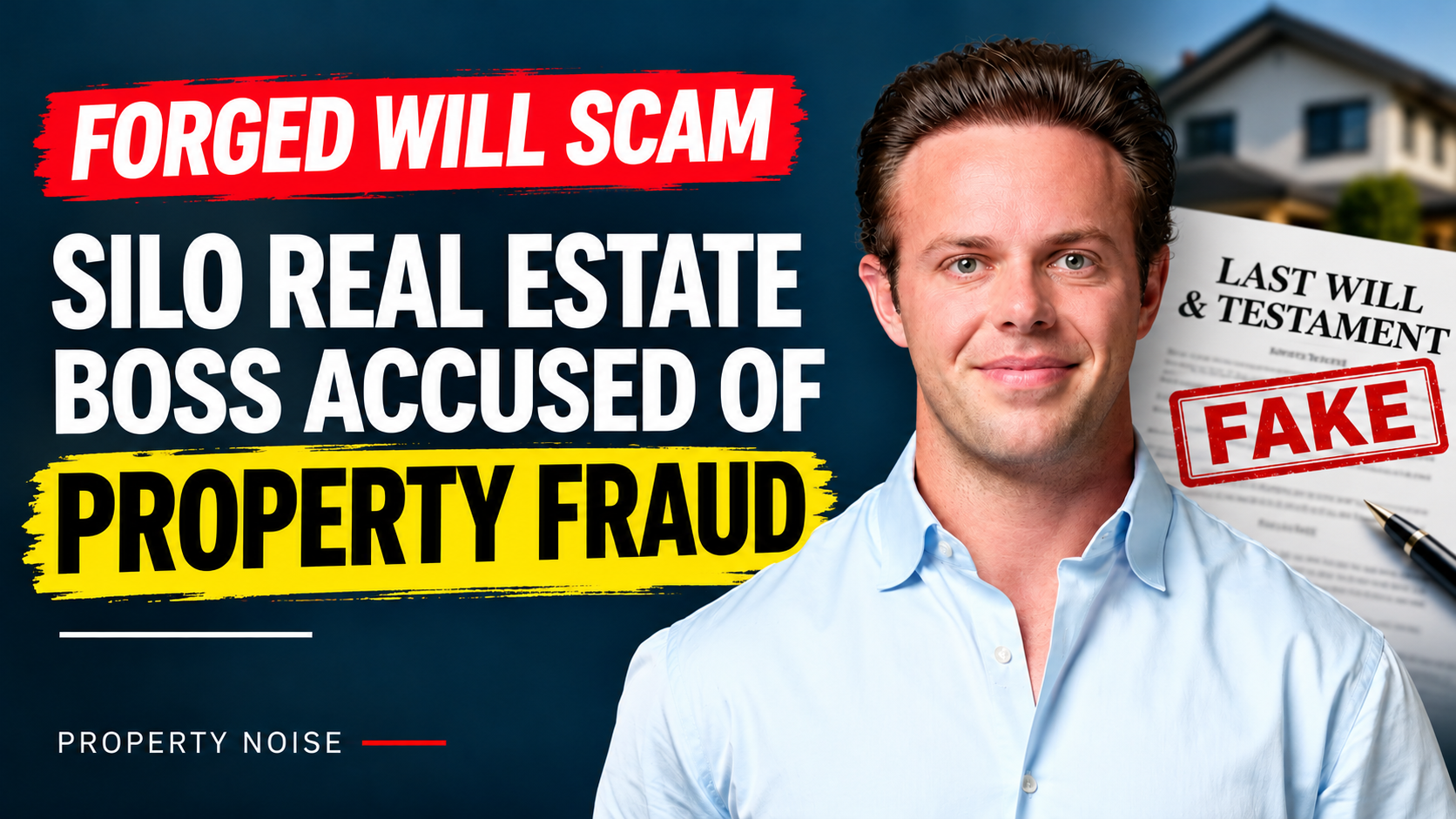
An Auckland landlord was left terrified after discovering her former tenant had used forged documents claiming she was dead and that he was entitled to inherit her property. The man behind the extraordinary case later established a real estate business.
An Auckland woman has revealed how a former tenant used a forged will and probate documents to claim she had died, setting in motion a property valuation that could have put her home and financial security at risk.
The man at the centre of the case is Connor Armstrong, also known as Connor Ryan and Connor Craigie, the founder of Silo Real Estate.
Armstrong, who has 27 previous fraud convictions, has pleaded guilty to eight charges of using forged documents arising from two separate police investigations.
The revelations add another chapter to the controversy surrounding Silo Real Estate, which PropertyNoise previously examined in Silo Real Estate Under Scrutiny: Founder’s Fraud Pleas and Questions Over New Recruit.
“WE THOUGHT YOU WERE DEAD”
It sounds like something from a television crime drama.
A landlord rents out her Auckland property to a seemingly successful tenant. He eventually moves overseas, and she assumes the relationship is finished.
Months later, strangers arrive at her property to carry out a valuation.
Their instructions? The owner has died, and her brother is arranging matters relating to the property.
There was just one problem.
The owner was very much alive — and the supposed brother was her former tenant.
According to an investigation by Stuff journalist Catrin Owen, the woman was horrified to discover that Armstrong had used forged inheritance documents in connection with her property.
The situation became even more alarming when a bank contacted her after encountering information suggesting she had died.
The woman reported that bank staff told her they had believed she was deceased.
A FLASHY TENANT WITH SIX MONTHS’ RENT UPFRONT
The story began in 2022 when Armstrong, then using the name Connor Ryan, rented the woman’s recently renovated central Auckland home.
He initially made a favourable impression, reportedly offering to pay six months’ rent in advance.
However, concerns soon emerged.
The landlord discovered he had advertised for flatmates without permission and was keeping two dogs at the property despite not having approval.
She also reported that two vehicles were repossessed while Armstrong was living there.
He eventually announced he was moving to Australia.
The landlord was relieved to see him leave.
But approximately six months later, her new tenant contacted her with an unexpected question.
Was she selling the house?
THE FORGED WILL AND THE PROPERTY VALUATION
Two valuers had reportedly arrived at the property claiming to be working for a man identified as Connor.
They understood that the property owner had died and that her brother was dealing with the estate.
The landlord immediately rejected the explanation.
Connor was not her brother, and she had never authorised him to act on her behalf.
According to the woman’s account, the valuers had been provided with a forged will and probate documents suggesting Armstrong would inherit the property.
Stuff also obtained correspondence showing that a property valuation had been requested for lending purposes.
That detail raises an obvious concern about what might have happened had the inconsistencies not been detected.
However, the reporting does not establish that Armstrong successfully transferred ownership, sold the property or obtained a loan secured against it.
POLICE ASKED THE LANDLORD TO PROVE SHE WAS ALIVE
The woman reported the matter to police.
In one of the most extraordinary details of the case, she said officers asked to photograph her to establish that she was alive.
She also told Stuff that she spent a considerable amount of money protecting her investments and assets.
For the landlord, the experience was deeply unsettling.
What began as an ordinary residential tenancy had turned into a fraud investigation involving her identity, her property and her financial security.
FROM FORMER TENANT TO REAL ESTATE COMPANY FOUNDER
Armstrong later established Silo Real Estate in Melbourne before returning to New Zealand in May 2025 and opening a local branch.
His business activities have attracted increasing scrutiny following investigations by Stuff.
As PropertyNoise previously reported, questions have been raised about Silo’s promotional material, Armstrong’s role and licensing status, and people associated with the business.
Read our earlier investigation: Silo Real Estate Under Scrutiny: Founder’s Fraud Pleas and Questions Over New Recruit.
The Real Estate Authority has also been investigating Silo Real Estate, according to Stuff.
That regulatory investigation is separate from Armstrong’s criminal proceedings, and an investigation should not be treated as a finding of wrongdoing by the agency.
EIGHT GUILTY PLEAS AND 27 PREVIOUS FRAUD CONVICTIONS
Police confirmed that a complaint involving an allegedly fraudulent will was received by Waitematā Police in late 2022.
That investigation resulted in five charges of using forged documents.
A separate investigation began in 2023 after allegations involving fraudulent grant applications in Wairarapa.
It resulted in three additional charges of using forged documents.
Armstrong has pleaded guilty to all eight charges and is awaiting sentencing.
Stuff has also reported that he had 27 previous fraud convictions before his time in Australia.
The case adds to wider concerns about honesty, accountability and public confidence in property-related transactions.
PropertyNoise has previously covered other cases involving falsified documents, including Former Real Estate Agent Sentenced for Doctoring LIM Report.
In that case, altered property information resulted in serious consequences for buyers and those responsible.
ARMSTRONG SAYS HE HAS CHANGED HIS LIFE
In response to questions from Stuff, Armstrong expressed regret for his past actions and said he had made significant personal changes.
He acknowledged that his conduct had affected other people and said his guilty pleas demonstrated his willingness to accept responsibility.
He also referred to difficulties with his mental health and requested privacy while preparing for sentencing.
Armstrong has previously said that the offending occurred before his time in Australia and that he is no longer the person he was during that period.
He is expected to be sentenced in December 2026.
A $239,999 MERCEDES ADVERTISEMENT ADDS ANOTHER TWIST
Stuff also reported that Armstrong had advertised a Mercedes for sale on Trade Me with an asking price of $239,999.
The listing, which was later removed, reportedly referred to plans to sell assets ahead of a possible overseas move.
Armstrong subsequently said that moving overseas could be a future goal, but noted that he was due to be sentenced in December.
HOW SAFE ARE NEW ZEALAND PROPERTY OWNERS FROM DOCUMENT FRAUD?
The case raises broader questions about the systems designed to protect homeowners from fraudulent property transactions.
Forged wills, false identities and misleading financial documents can create significant problems even when an attempted transaction does not succeed.
New Zealand has identity verification, legal and land registration safeguards, but those systems still depend on suspicious information being identified and properly investigated.
PropertyNoise has previously reported on the risks of deception in property finance, including Two Couples Guilty Over Roles in $8.7 Million Mortgage Fraud Case.
The use of false documents is not a new problem in the property industry.
But the circumstances of this Auckland case are particularly disturbing because the owner allegedly had no knowledge that someone was presenting her as deceased.
SHOULD REAL ESTATE INDUSTRY BACKGROUND CHECKS BE TOUGHER?
The story also raises a wider question about the standards expected of people establishing and promoting businesses connected to real estate.
Consumers reasonably expect transparency about who is involved in property transactions, what roles those individuals perform and whether they hold the necessary professional licences.
PropertyNoise has previously highlighted concerns about industry conduct in NZ Agent Misconduct: Husband’s Secret $1.285m Property Deal.
While the circumstances of each case are different, they reinforce the importance of professional accountability and consumer protection.
The public deserves confidence that the people involved in major property decisions are appropriately qualified, properly supervised and transparent about their roles.
PROPERTYNOISE VIEW: THIS SHOULD ALARM EVERY HOMEOWNER
There are bad tenancy experiences, and then there are situations that leave property owners questioning the security of everything they have worked for.
Discovering that a former tenant has used forged documents claiming you are dead falls firmly into the second category.
What makes this case particularly troubling is the combination of alleged identity manipulation, inheritance documents and an attempted property valuation.
And the fact that the individual involved later established a real estate business makes the story even more significant for the property industry.
Armstrong has pleaded guilty to the forged-document charges and will face sentencing.
The wider issue is whether existing safeguards are sufficient to prevent similar situations from developing in the first place.
For New Zealand homeowners, the question is simple: if someone can use forged documents to convince others you have died, how confident should you be that your property is protected?
Source: Stuff investigation by Catrin Owen, published 1 November 2026. PropertyNoise has independently rewritten and contextualised the reporting. The account of the landlord’s experience is attributed to Stuff; the criminal guilty pleas are reported as confirmed by police.