
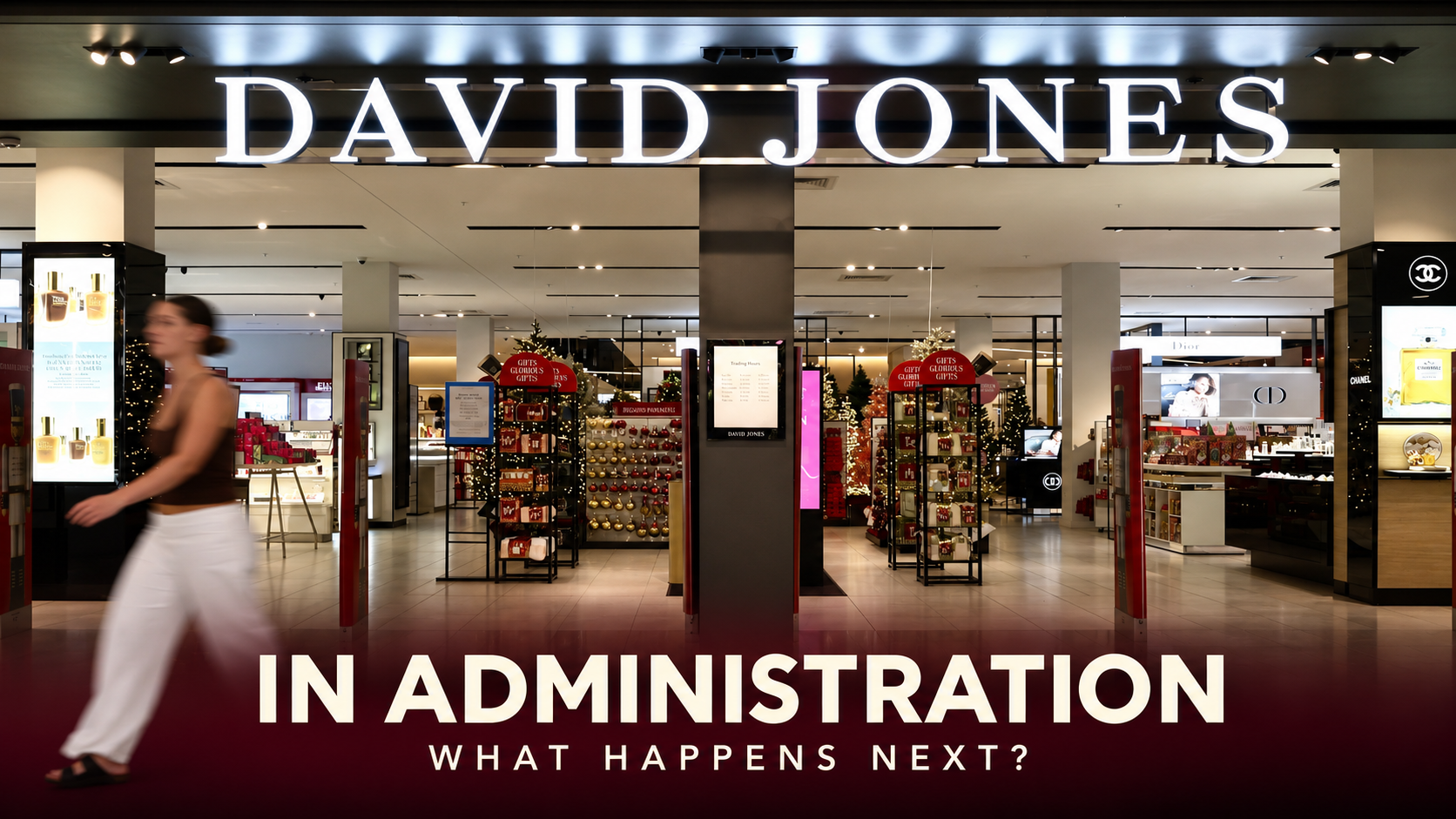
David Jones entered voluntary administration on 5 November, putting the future of an Australian retail institution and about 6,000 jobs in doubt. Its stores and website are still trading. The bigger question is whether this is an isolated corporate failure or an early warning of a much harder 2027.
A department store can survive changing fashions. It can survive a bad Christmas, a weak collection or a competitor stealing its customers. What it cannot survive indefinitely is a mismatch between the money coming in and the bills falling due.
That is the immediate crisis at David Jones. But the timing is what makes this a bigger Australian story. The Reserve Bank has just lifted the cash rate to 4.85%. Unemployment reached 4.7% in September. National home values are below their March peak. The department store crisis lands as borrowers, businesses and landlords are all being forced to reassess what they can afford.
Property Noise opinion: David Jones could be an early warning of a deeper downturn in the parts of the economy that depend on discretionary spending. Australia’s latest economic figures still show growth. The danger is what happens if employers start cutting hours and investment just as more households are forced to tighten their budgets.
What happened to David Jones?
McGrathNicol was appointed voluntary administrator to the companies involved, while the secured lender appointed FTI Consulting as receivers and managers. The stores and online business continued trading under the receivers while they reviewed operations. The administrators are seeking offers to recapitalise the business or sell it as a going concern.
The appointments followed a breakdown in talks with Scentre Group, which owns and operates Westfield shopping centres. Scentre said October rent had gone unpaid and that its proposed deal to keep the retailer trading was rejected by David Jones’ owner, Anchorage Capital Partners. The Daily Mail also reported an A$95.5 million pre-tax loss and an 8.7% fall in sales for the retailer’s 2026 financial year.
Those details matter because the latest RBA hike did not cause a financial problem that had been building for months. David Jones went into this crisis with its own trading losses, funding needs and lease commitments. Another rate rise makes the environment in which it needs to find a buyer or new capital more difficult.
Will David Jones close stores before Christmas?
Closures are possible, but a list of stores analysts consider vulnerable is not a confirmed closure schedule. The supplied reporting names locations across New South Wales, Queensland, Victoria, South Australia and Western Australia. Those locations were identified in analyst work, rather than announced as closures by the receivers.
For now, the confirmed position is that the business is still trading while its operations and options are reviewed. About 6,000 employees are affected by the uncertainty. That is the size of the workforce reported by Reuters, not the number of announced redundancies.
For shoppers with gift cards, deposits, outstanding orders or returns, the practical step is to check the retailer’s or receivers’ latest instructions before making a purchase or relying on a balance. The Daily Mail reported that gift cards were still redeemable at the time of its report. Trading status and customer arrangements can change during a restructuring.
Why Christmas makes the David Jones crisis more serious
A retailer heading into Christmas has to make spending commitments before it knows what customers will buy. Stock needs to be ordered and distributed, rosters filled and suppliers paid. A store can be busy in December and still have a cash problem if it has to meet those commitments before enough sales come through.
Now put yourself in the position of a supplier. A major customer has entered administration, and you have merchandise due for delivery. Do you extend the same payment terms, ask for payment upfront or redirect the stock? Each supplier has to make that call for its own business. If enough tighten their terms, the retailer may need more cash to stock its shelves at the most consequential point in the trading year.
The same uncertainty reaches concession operators, cleaners, security firms, logistics companies and casual staff. Some will be waiting to learn whether orders go ahead. Others will be deciding how much work or income to count on through Christmas. A department store’s troubles can move through that network well before a single shop shuts its doors.
The RBA is squeezing borrowers while retailers need them to spend
The RBA raised the cash rate by 25 basis points to 4.85% on 3 November. Three board members opposed the increase, according to NAB’s analysis of the decision. The central bank was responding to persistent inflation, with annual CPI at 4.3% in September and trimmed mean inflation at 3.6%.
There is a reason for the RBA’s concern. Persistent inflation wears away at household purchasing power. The problem for retailers is that the policy response works in part by making households less willing or able to spend. A family facing a higher variable mortgage payment may cut back on clothes, furniture or gifts before it cuts back on essentials.
Retailers then face a difficult choice. Discounting can bring shoppers through the doors and turn stock into cash, but it leaves less margin to cover wages, rent and other costs. Holding prices protects the margin on the products that sell, while risking that more stock sits on the shelves.
Property Noise explored the borrower side of that trade-off in our analysis of the RBA rate hike and the Australian property market. The David Jones crisis brings the same question to the shopping centre: how much can businesses absorb as households adjust to higher borrowing costs?
The housing downturn could make the retail squeeze worse
Cotality’s October data, analysed by Westpac, showed that national home values fell 1.2% in October and were 6.7% below their March peak. Estimated sales over the latest three months were down 22.5% from a year earlier.
That matters to retailers for two reasons. The first is confidence. An owner can keep making every mortgage payment and still rethink an expensive purchase after seeing nearby homes sell for less. The second is activity. When fewer people move, fewer households need to furnish a new living room, replace appliances or buy curtains on a deadline.
A weak property market therefore has consequences even without a surge in forced sales. Deals that never happen leave less work for agents, conveyancers and movers, and fewer occasions for households to spend. We’ve already looked at how a housing correction can put pressure on real estate agencies. The same drop in activity can reach businesses that never sell a house themselves.
Why Westfield’s exposure goes beyond the unpaid rent
Scentre said David Jones occupied around 200,000 square metres across 17 Westfield centres. The retailer represented about 1.8% of Scentre’s gross rent and 3.6% of its funds from operations on an annualised basis, according to its disclosure as reported by Ragtrader.
An anchor tenant’s role goes beyond its lease. People who come to visit a department store may also buy lunch, stop at a speciality retailer or pick up something on the way back to the car. If an anchor closes, the effect on that foot traffic depends on what else the centre offers and how quickly the space can be reused.
A large department store footprint can be hard to fill with one tenant. A landlord may have to subdivide it, change entrances or invest in a new fit-out before smaller tenants can move in. That can eventually give a centre a better mix of shops and services. In the meantime, it can mean vacancy, spending on redevelopment and uncertainty for neighbouring tenants.
The outcome won’t be the same everywhere. A well-located centre with strong demand for space could turn a departure into an opportunity. At a weaker centre, a dark anchor store may make it harder to persuade the next tenant to sign.
Is this a David Jones problem or an Australia problem?
It is both, in different ways.
David Jones had company-specific problems. The department store format has to justify a large footprint while customers can compare prices and shop online. Lease commitments limit how quickly the operator can shrink that footprint. A recognisable brand can help attract a buyer, but it cannot settle a rent bill or guarantee enough funding to get through Christmas.
The Australian risk is that the same pressure starts appearing at companies without David Jones’ particular history. A retailer doesn’t have to look anything like a department store to face weaker sales, a lease renewal, rising financing costs or a lender unwilling to extend more credit.
And an economy can still be growing while those problems accumulate. The ABS reported 0.4% real GDP growth in the June quarter and 0.7% growth in household spending volumes in the September quarter. Those figures weigh against a claim that Australia is already in an economy-wide collapse. They also leave room for weakness among businesses that depend on particular types of spending. In September, for example, spending on transport rose 1.5% in dollar terms while furnishings and household equipment fell 0.2%.
That distinction is easy to miss. More spending on getting to work doesn’t necessarily leave more money to spend on a sofa or a new wardrobe. The national spending figure can rise while the categories a particular retailer needs to sell are going backwards.
What would turn this into a much bigger economic downturn?
The clearest test is whether pressure spreads from company balance sheets to household incomes. The ABS reported that seasonally adjusted employment fell by 39,300 in September, with a drop in part-time employment outweighing a rise in full-time jobs. Trend unemployment remained at 4.6%, so a single month’s results should not be treated as proof of a lasting slide. But the distinction between full-time and part-time work is worth watching in a sector where shifts and rosters matter.
Over the next few months, four signals would tell us more than any one retailer’s fate:
- Christmas spending volumes: Are Australians buying more goods, or do higher prices and heavier discounting disguise weak trading?
- Jobs and hours: Are employers cutting shifts, freezing recruitment or closing locations after the holiday period?
- Supplier and credit pressure: Are businesses taking longer to pay, losing credit terms or going into administration across unrelated sectors?
- Housing and mortgages: Do weak sales and lower valuations start to coincide with rising arrears or a wider increase in forced sales?
These risks can reinforce each other. When a business cuts shifts to protect cash, those workers have less to spend elsewhere. When other businesses see sales slow, they may postpone investment or reduce staffing too. A housing downturn can make households even less willing to spend through that uncertainty.
There is a plausible path the other way. A buyer could preserve a smaller David Jones network, shoppers could keep spending through Christmas, and easing inflation could give the RBA room to stop tightening. Which path Australia takes depends on what happens across employers and households, rather than on the survival of a single brand.
Property Noise’s view: the real test comes after Christmas
David Jones is a warning because the problems are arriving together. A retailer with trading losses needed relief from its landlord and new funding. It ran out of room to negotiate just as the cost of borrowing rose again and the housing market was weakening.
A rescue would be welcome news for staff and suppliers. It would still leave a difficult question for the rest of the economy: how many businesses are entering 2027 relying on a strong Christmas to cover bills they can no longer comfortably afford?
The shop doors at David Jones remain open for now. Watch what happens to sales, shifts and supplier payments when the Christmas rush is over. That is when we’ll have a better idea whether this was the failure of one famous retailer or the first visible sign of a much broader shakeout.
Reporting credit: Kylie Stevens, Daily Mail, 5 November 2026. Administration and trading status corroborated by Reuters and Ragtrader. Economic analysis and commentary by Property Noise.