
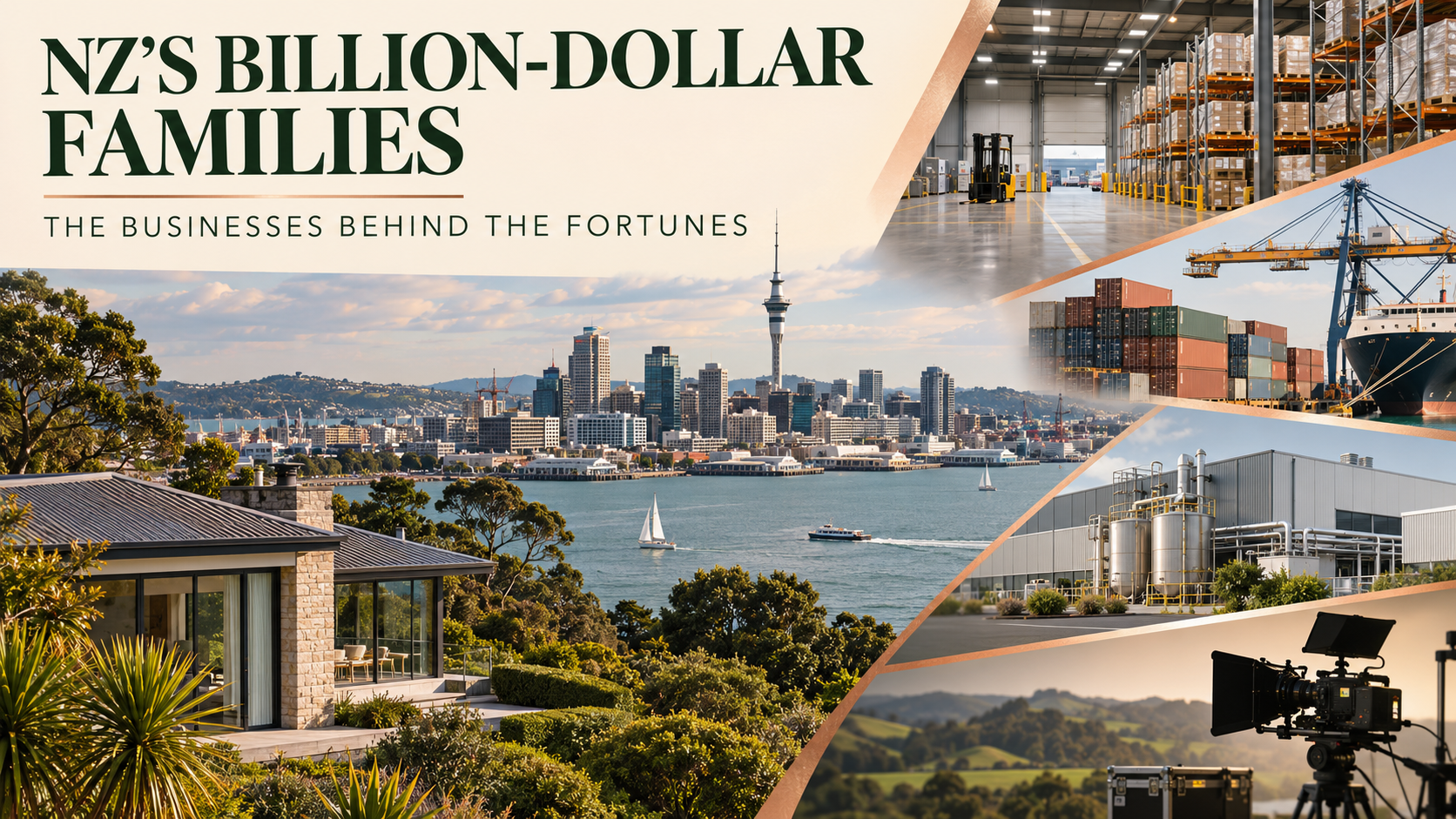
New Zealand’s biggest fortunes are not all sitting in rental houses or waterfront mansions. They are tied to global toy brands, industrial property, energy, food production, retail and the technology behind blockbuster films.
A documentary from YouTube channel Aussie Fortunes has put eight prominent business families under the spotlight: Gallagher, Norman, Talley, Jackson–Walsh, Todd, Goodman, Hart and Mowbray.
Its attention-grabbing title suggests one wealthy family “owns New Zealand”.
The more revealing story is how these families built businesses that reach far beyond New Zealand, and how their investment decisions intersect with the property market.
This is not a definitive ranking of the country’s eight richest families. The documentary’s selection includes longstanding business dynasties alongside entrepreneurial fortunes, and excludes other major names.
Nor does estimated wealth mean cash in the bank, ownership of an entire company or control of the country.
But the businesses behind these names offer a striking picture of where substantial New Zealand wealth comes from.
WHO ARE NEW ZEALAND’S RICHEST PEOPLE IN 2026?
NBR’s 2026 Rich List places ZURU founders Nick and Mat Mowbray at the top, with estimated combined wealth of $20 billion.
The wider list profiles 150 individuals and families whose combined estimated wealth reached $129 billion. Its leading names include Graeme Hart, Sir Peter Beck, the Goodman and Todd families, and Sir Peter Jackson and Dame Fran Walsh.
These are estimates made for the Rich List, rather than audited personal balance sheets.
Property Noise previously explored the broader picture in our coverage of New Zealand’s 2026 Rich List and the rise in estimated wealth to $129 billion.
The important distinction is between the value attributed to someone’s interests and the scale of the businesses associated with them.
A company’s assets, revenue or managed property portfolio cannot simply be counted as a family’s personal fortune.
THE MOWBRAYS: FROM TOYS TO A MUCH BIGGER BUILDING AMBITION
The Mowbray story is closely associated with ZURU’s international toy and consumer-products businesses.
For Property Noise readers, however, one of the most interesting developments is ZURU Tech.
The business describes an ambition to change how buildings are designed and produced, combining digital design with a manufacturing-led construction system. Its published material addresses everything from structural engineering to layouts and finishes.
That moves the story beyond wealthy entrepreneurs buying expensive homes.
It raises a much larger question: could a globally scaled manufacturing approach change how housing is delivered?
The commercial ambition is significant, but it should not be confused with proof that New Zealand construction costs are about to fall. Local approvals, infrastructure, transport, site conditions and practical delivery would still matter.
The family’s residential property has also attracted attention. Property Noise previously reported on Anna Mowbray and Ali Williams’ Westmere helipad application and neighbours’ concerns.
That earlier coverage illustrates how private investment can become a public planning debate. It should not be read as an update on the application’s current status.
THE GOODMANS: THE PROPERTY EMPIRE BEHIND THE DIGITAL ECONOMY
The Goodman connection offers the most direct commercial-property story.
Goodman Group describes its business as owning, developing and managing logistics properties and data centres in major global cities. It operates across Asia Pacific, Europe and the Americas, alongside investment partners.
Gregory Goodman is the group’s chief executive and a co-founder. His official biography also identifies his involvement with Goodman’s New Zealand property-management business.
This is property serving business activity: places where products are stored, distributed and increasingly supported by digital infrastructure.
For investors, it demonstrates why “property” is a much broader category than residential houses.
A warehouse, a data centre and a rental home have different tenants, funding requirements, infrastructure needs and risks.
It is equally important to distinguish Goodman family interests from Goodman Group’s full portfolio. Listed shareholders and investment partners also have interests in the wider business.
The family does not personally own every building associated with the Goodman name.
THE TODDS: A FAMILY BUSINESS CONNECTING ENERGY AND LAND
Todd is another name whose significance extends beyond any single property holding.
Its current website identifies energy as a core focus, alongside investments in natural healthcare, property, technology and minerals. The group’s history records the development of separate energy, property and investment activities.
The property connection is both direct and economic.
Homes, factories, offices and new developments need reliable infrastructure. Energy availability and cost affect how businesses operate and where investment is viable.
That makes the Todd story relevant to discussions about development and productivity, rather than simply the size of a family fortune.
Its longevity also highlights a different wealth-building model: retaining and adapting a business across generations.
GRAEME HART: BUSINESS ACQUISITIONS, PACKAGING AND A HIGH-PROFILE PROPERTY FOOTPRINT
Graeme Hart is another central figure in the documentary’s selection.
His business reputation is associated with Rank Group and international packaging investments. His Auckland property holdings have also attracted substantial public attention.
Recent reporting citing NBR’s 2026 Rich List put his estimated fortune at $14.1 billion, behind Nick and Mat Mowbray’s combined estimate. The same reporting identified neighbouring properties associated with his Glendowie estate.
But a large residential estate explains only a fraction of the broader business story.
The distinction matters when discussing wealthy property owners. A conspicuous mansion can become the public symbol of a fortune generated primarily through operating businesses.
Luxury real estate is visible. The corporate structures and transactions behind substantial wealth are often much less so.
THE NORMANS: A RETAIL FORTUNE WITH A COMMERCIAL-PROPERTY CONNECTION
The Norman family’s business interests are associated with the James Pascoe Group and retail names including Farmers.
Historical reporting documents the group’s acquisition of Whitcoulls and Borders’ New Zealand stores in 2011, illustrating the role acquisitions have played in expanding the retail business.
For the property sector, major retailers matter because their decisions influence shopping-centre occupancy, leasing demand and the commercial prospects of surrounding locations.
However, operating a shop does not necessarily mean owning its premises.
Any assessment of a retail family’s property wealth needs to separate trading businesses from freehold ownership and leased locations.
That is a distinction often lost when a familiar brand is described as a business “empire”.
THE TALLEYS: FOOD PRODUCTION AND THE PHYSICAL ASSETS BEHIND IT
Talley’s describes itself as a New Zealand-owned, family-run food business that developed from a small Motueka fishing operation.
Its Motueka activities date to 1936, and the business identifies processing and packaging facilities among its operations there.
This is another reminder that business wealth can depend on specialised physical assets.
Food production requires facilities suited to processing, storage and distribution. Those properties serve a different purpose from land held primarily for appreciation.
Their value is connected to the operation they support, their location, infrastructure and the investment required to keep them productive.
The Talley story therefore belongs in a discussion about New Zealand wealth and property, even though its public identity is principally food rather than real estate.
THE GALLAGHERS: AN INVENTION THAT BECAME AN INTERNATIONAL BUSINESS
Gallagher traces its beginnings to Hamilton in 1938.
The company describes a family-owned business whose animal-management products are used internationally, while its security operation tells the same founding story.
The broader lesson is that innovation can create wealth by helping other businesses use their assets more effectively.
Agricultural technology has a relationship with land without relying on the purchase and resale of residential property.
It also challenges the idea that New Zealand’s only credible route to substantial wealth is collecting houses.
Businesses capable of selling a useful product internationally can reach markets far larger than the domestic property market.
JACKSON AND WALSH: CREATIVE WORK THAT BUILT VALUABLE TECHNOLOGY
Sir Peter Jackson and Dame Fran Walsh represent a different route to substantial wealth: creative work, filmmaking and the businesses developed around it.
One transaction requires particular care.
In December 2021, Unity completed a US$1.625 billion acquisition of Weta Digital’s tools, pipeline, technology and engineering talent.
The visual-effects business continued separately as Wētā FX. It was not a simple sale of every activity associated with the Wētā name.
For property readers, the wider connection is the infrastructure that supports creative industries.
Studios, workshops and specialist workplaces are part of a city’s commercial ecosystem. Successful businesses can create demand for those spaces and support employment around them.
Again, property is part of the story, but intellectual property and specialist capability can be major sources of value.
WHAT THESE FORTUNES TELL US ABOUT NEW ZEALAND PROPERTY
The documentary’s eight stories share some themes, but they are not interchangeable.
Some involve multigenerational ownership. Others centre on founders scaling businesses internationally.
Property appears in several roles:
• An operating asset supporting production.
• A commercial investment generating income.
• Infrastructure serving logistics and technology.
• A development opportunity.
• A personal residence.
Those categories should not be collapsed into one claim about wealthy families “owning New Zealand”.
The more useful question is how capital is being deployed.
Is it building productive capacity? Delivering homes? Supporting employment? Improving infrastructure? Or primarily bidding up the price of assets that already exist?
Those questions are more revealing than the price of someone’s mansion.
The family selection and documentary premise come from Aussie Fortunes’ supplied video description. This article adds independently sourced business background and Property Noise analysis; it is not a transcript or a verification of every claim made in the video.
THE BIGGEST WEALTH STORY IS LARGER THAN HOUSING
New Zealand’s wealthy families attract attention because of their fortunes, their brands and sometimes their homes.
But their businesses reveal a broader story.
The country’s largest fortunes can be tied to export markets, manufacturing, energy, technology, creative work and commercial property serving global demand.
For a nation that spends so much time discussing house prices, that is worth examining.
A valuable home can store wealth. A successful business can create products, employment, intellectual property and investment opportunities on a much larger scale.
The compelling story is not that one family owns the country. It is how businesses founded here became valuable far beyond it.