
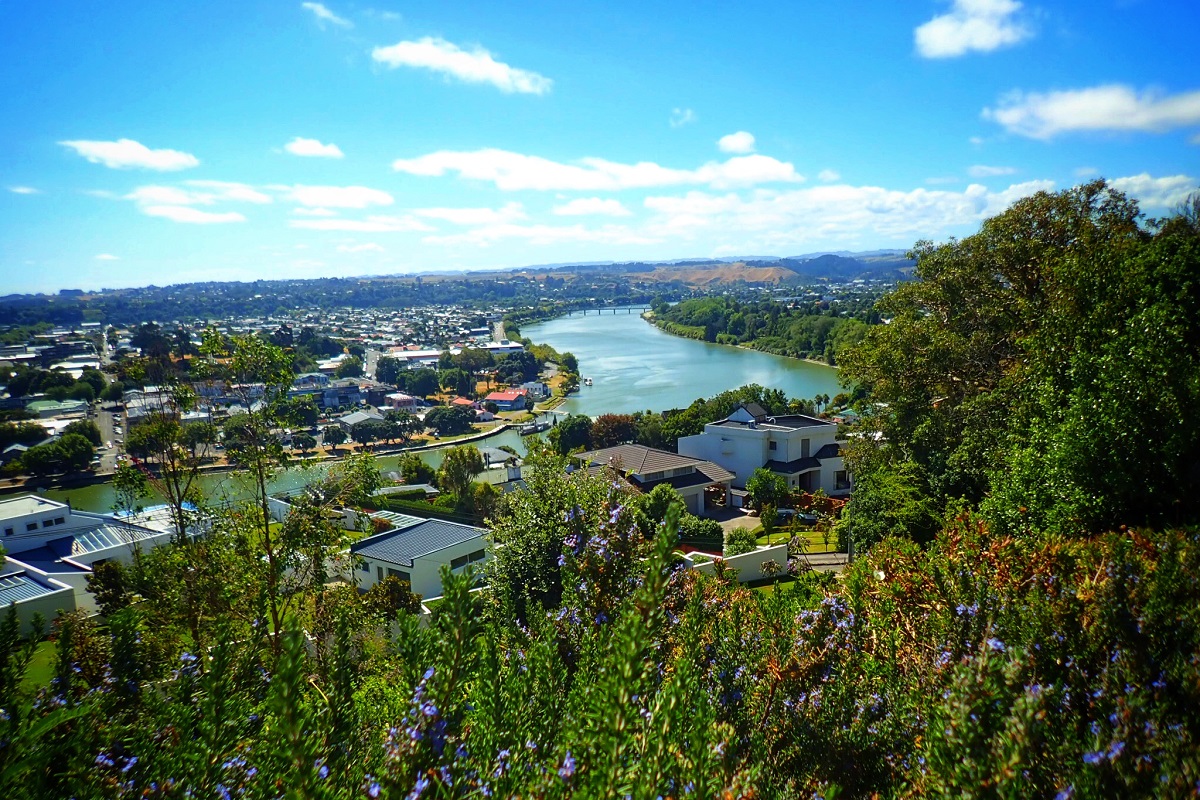
PHOTO: Whanganui – New Zealand. CoreLogic
New Zealand’s housing affordability crisis has pushed first-home buyers to look well beyond Auckland and the major centres — and new analysis has identified 10 regional towns where home ownership remains surprisingly achievable.
Forget paying close to $1 million for a small Auckland property.
Across parts of regional New Zealand, first-home buyers are still purchasing standalone houses with backyards for between roughly $400,000 and $630,000 — and in every town identified in the analysis, buying was calculated to be cheaper than renting.
Research reported by OneRoof using data from Valocity examined affordability, household incomes, rental costs and employment conditions to identify regional locations where first-home buyers have been particularly active.
The result paints a fascinating picture of a changing New Zealand property market.
For some aspiring homeowners, the answer to housing affordability may increasingly be simple:
Leave the big city.
Regional NZ Is Offering First-Home Buyers Something Auckland Struggles To Deliver
Housing affordability isn’t simply about the sticker price of a property.
Income, employment opportunities, mortgage servicing, rental costs and lifestyle all play a part.
But the difference in property prices between Auckland and some regional centres remains enormous.
The analysis found median prices across the 10 selected towns ranged from the low $400,000s into the low $600,000s.
Greater Auckland’s comparable median was around $880,000.
Greymouth provided perhaps the clearest example.
Its median property price was just $410,000, while the median price-to-household-income ratio was 4.3.
Across greater Auckland, that ratio was 6.7 times household income.
That’s a substantial difference for someone trying to get onto the property ladder.
The 10 NZ First-Home Buyer Hotspots
Here are the towns identified by the analysis, ranked from the most affordable.
| Town | Median Price | Median Weekly Rent | Price-to-Income Ratio |
|---|---|---|---|
| Greymouth | $410,000 | $470 | 4.3 |
| Timaru | $500,000 | $540 | 4.8 |
| Oamaru | $474,477 | $510 | 5.0 |
| Whanganui | $459,500 | $550 | 5.2 |
| Ashburton | $547,000 | $530 | 5.2 |
| Levin | $500,000 | $550 | 5.6 |
| Blenheim | $595,000 | $610 | 5.7 |
| Feilding | $555,000 | $600 | 6.3 |
| Gisborne | $620,000 | $670 | 6.5 |
| Mosgiel | $630,000 | $650 | 6.7 |
Importantly, the study wasn’t simply a search for New Zealand’s cheapest houses. Locations needed more than 40 sales since the beginning of the year and unemployment below 5%, adding an employment component to the affordability equation.
1. Greymouth – Median Price $410,000
At the top of the affordability rankings is Greymouth.
Median house price: $410,000
Median weekly rent: $470
Average regional household income: $94,754
Price-to-income ratio: 4.3
Unemployment: 4.6%
The West Coast economy is benefiting from mining, infrastructure and healthcare employment.
Tradespeople, engineers, drivers, medical professionals and other workers are among those being attracted to the region.
There are even properties available below $300,000, although buyers at that level should expect renovation work.
For buyers willing to relocate, Greymouth combines some of the country’s lowest property prices with the West Coast’s outdoor lifestyle.
2. Timaru – Median Price $500,000
Timaru combines comparatively affordable property with employment and a coastal lifestyle.
Median house price: $500,000
Median weekly rent: $540
Household income: $104,847
Price-to-income ratio: 4.8
Unemployment: 4.4%
Local employment is supported by the port and agricultural sector, while short commuting times add another attraction.
The difference between Timaru and Auckland can be dramatic. The source gives an example comparing a $1.5 million Auckland first home with a similar style of property potentially costing around $450,000 in Timaru.
3. Oamaru – Median Price $474,477
Historic Oamaru comes in even cheaper.
Median price: $474,477
Median rent: $510
Price-to-income: 5.0
Unemployment: 3.6%
The North Otago economy benefits from agriculture and large employers connected to wool, textiles and dairy.
Its restored Victorian precinct and established community infrastructure also give Oamaru something that can’t necessarily be measured in a simple affordability ranking — character.
4. Whanganui – Median Price $459,500
At $459,500, Whanganui’s median price is barely half Auckland’s $880,000 figure.
Median rent: $550
Price-to-income: 5.2
Unemployment: 4.9%
Entry-level buyers can potentially find solid homes between approximately $350,000 and $550,000.
Whanganui also offers an established arts scene, beaches, the river and considerably shorter commuting times than New Zealand’s largest cities.
5. Ashburton – Median Price $547,000
Mid-Canterbury’s Ashburton demonstrates why affordability alone doesn’t explain regional property demand.
Median price: $547,000
Median rent: $530
Price-to-income: 5.2
Unemployment: 4.4%
Its rural economy provides an important employment base, while Christchurch remains accessible.
According to local market commentary in the source, good three-bedroom properties can still be found from the high $300,000s into the early $400,000s.
And Mt Hutt is practically on the doorstep.
6. Levin – Median Price $500,000
One location Property Noise readers should watch particularly closely is Levin.
Median house price: $500,000
Median rent: $550
Price-to-income: 5.6
Unemployment: 4.9%
Levin’s position between Palmerston North and the Kāpiti Coast has always been important, but major transport investment could fundamentally change its connectivity.
The Ōtaki to north of Levin expressway, expected to open in 2029, is already influencing perceptions of the town, while planned improvements to passenger rail connections between Palmerston North and Wellington could strengthen its commuter appeal further.
A quality three-bedroom home is described as costing around $500,000 to $550,000, while a 5% deposit on a $500,000 property would be just $25,000.
Add Waitārere Beach, outdoor recreation and substantial residential development, and Levin becomes an interesting long-term property story.
7. Blenheim – Median Price $595,000
Blenheim offers a different proposition.
Median price: $595,000
Median rent: $610
Price-to-income: 5.7
Unemployment: 4.4%
The Marlborough economy remains strongly connected to viticulture, while aquaculture and robotics are among the industries highlighted as attracting skilled workers.
There’s also an interesting demographic effect occurring.
As older homeowners move into retirement villages, well-maintained properties that may not have changed hands for decades are returning to the market — potentially creating opportunities for younger purchasers.
8. Feilding – Median Price $555,000
Feilding has a median property price of approximately $555,000.
Median weekly rent is $600 and its price-to-income ratio sits at 6.3.
The rural economy provides an important foundation, while employment and infrastructure investment across the wider Manawatū region help support demand.
Some first-home buyers are entering with deposits of between $25,000 and $50,000, according to the source.
9. Gisborne – Median Price $620,000
Gisborne demonstrates that “affordable” remains relative.
Median price: $620,000
Median rent: $670
Price-to-income: 6.5
Unemployment: 4.8%
Some buyers are finding the market difficult, particularly where household incomes are constrained.
The source describes first-home buyers who have spent years accumulating deposits, with some entering the market in their 30s and 40s rather than their 20s.
That itself says plenty about how New Zealand’s definition of a “first-home buyer” has changed.
10. Mosgiel – Median Price $630,000
Rounding out the top 10 is Mosgiel, near Dunedin.
Median price: $630,000
Median rent: $650
Price-to-income: 6.7
Unemployment: 3.6%
First-home buyers spending approximately $600,000-$650,000 can potentially secure a renovated standalone home with a reasonable section.
Mosgiel also provides relatively easy access to Dunedin, with the source putting the commute at around 20 minutes.
Why Buying Can Be Cheaper Than Renting
Perhaps the standout finding from the analysis is this:
In all 10 towns, buying was calculated to be cheaper than renting.
The mortgage calculations used a 30-year term.
That deserves attention because New Zealand’s housing conversation often assumes renting is automatically the cheaper short-term option.
That’s clearly not universally true.
Of course, mortgage repayments aren’t the entire cost of home ownership. Rates, insurance, maintenance and unexpected repairs also need to be considered.
But for households capable of assembling a deposit and securing finance, regional New Zealand can radically change the numbers.
The 5% Deposit Changes the Equation
The Government-backed low-deposit pathway can also make the upfront hurdle significantly smaller for eligible buyers.
On a $500,000 home, 5% is:
$25,000.
That’s still a substantial amount of money.
But compare it with trying to save a 10% or 20% deposit on an $880,000 Auckland property.
It’s an entirely different financial challenge.
The source notes examples of buyers purchasing with 5% deposits of around $25,000.
Is Auckland’s Loss Becoming Regional New Zealand’s Gain?
There’s a bigger property trend developing here.
Remote and hybrid working, infrastructure investment and huge disparities in housing costs have made regional living considerably more realistic for some households.
And first-home buyers aren’t necessarily sacrificing the lifestyle they once imagined.
In many cases they’re getting more:
🏡 Standalone house
🌳 Larger section
🚗 Garage
🏖️ Beaches nearby
🏔️ Ski fields and mountains
🚲 Outdoor recreation
⏱️ Five or 10-minute commute
💰 Smaller mortgage
The trade-off can be fewer employment choices, lower average salaries and less access to the entertainment and services of a major city.
But when Auckland buyers are confronted with an $880,000 median versus $410,000 in Greymouth or $459,500 in Whanganui, the economics become difficult to ignore.
Property Noise Take: The NZ Housing Map Is Changing
For decades, New Zealand property discussion has been overwhelmingly dominated by Auckland.
But the first-home buyer equation is changing.
The extraordinary property boom dramatically widened the gap between what younger New Zealanders could afford and what homes in the largest cities cost.
The correction since 2021 has helped, but it hasn’t magically made Auckland cheap.
Regional New Zealand presents a very different proposition.
And importantly, the strongest regional opportunities aren’t simply places where houses are cheap.
The more compelling locations combine:
affordable housing + employment + infrastructure + lifestyle + population demand.
That’s why places such as Levin, Ashburton, Timaru, Whanganui and Feilding deserve particular attention.
A $450,000 house in a declining town without employment isn’t necessarily a bargain.
A $500,000 house in a growing regional economy benefiting from new infrastructure may be a completely different proposition.
The Bottom Line
For first-home buyers frustrated by the cost of New Zealand’s major cities, the property ladder hasn’t necessarily disappeared.
It may simply have moved.
Greymouth’s $410,000 median is less than half Auckland’s $880,000.
Whanganui sits below $460,000.
Oamaru is below $475,000.
Timaru and Levin are around $500,000.
And these aren’t simply collections of cheap houses. The analysis deliberately considered employment and economic conditions alongside property affordability.
For a generation that has repeatedly been told home ownership is slipping beyond reach, that’s significant.
The Kiwi first home — standalone, backyard and garage included — isn’t dead.
You might just need to change the postcode.
SOURCE: ONEROOF