
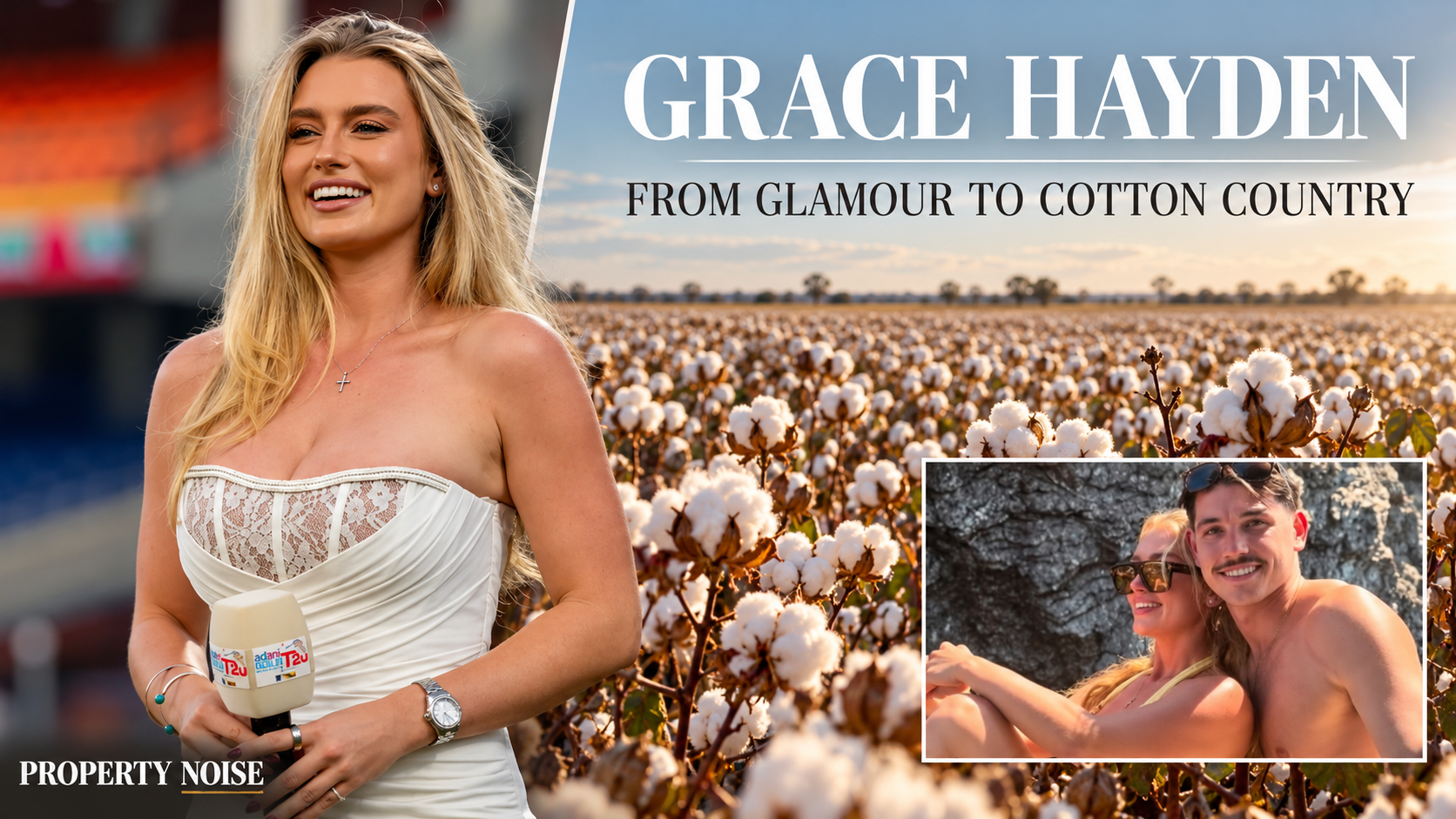
Grace Hayden may be familiar to audiences through sports broadcasting and race-day appearances, but her life away from the cameras has a connection to a very different Australian asset class: large-scale agricultural property.
Through her partner, Wilson Statham, the presenter is connected to the family behind Sundown Pastoral Company, an agricultural enterprise whose interests extend from cotton-growing land to textile technology.
It is a property story built around productive farmland, irrigation and supply chains—rather than another celebrity mansion.
Grace Hayden’s country connection
Hayden, the daughter of former Australian cricketer Matthew Hayden, has developed her own public profile as a sports presenter.
Recent reporting by news.com.au describes her spending time with Statham on a farm near Moree in northern New South Wales.
Their relationship provides the connection to the agricultural business. It does not establish that Hayden owns the farm or holds an interest in the Statham family’s property portfolio.
That distinction matters when looking beyond the celebrity headlines to understand the business and land involved.
Who is Wilson Statham?
Wilson is one of four sons of David and Danielle Statham, whom Sundown Pastoral Company identifies as its principals and managing directors.
The company’s own account describes both parents as actively involved in operating and developing the business.
Wilson’s connection therefore runs through an established agricultural family, with a business encompassing farming and activities further along the cotton supply chain.
For property readers, the interest lies in how those operations connect land ownership with production, processing and the market for finished textiles.
Keytah: The agricultural property behind the name
A central property associated with the business is Keytah, west of Moree.
Good Earth Cotton’s official founders’ profile identifies Keytah as part of Sundown Pastoral Company’s agricultural holdings. Sundown also identifies the neighbouring Wathagar Gin as adjoining its Keytah cotton property.
A cotton gin separates cotton fibres from seeds and other material after harvesting. Its proximity to the growing operation illustrates how agricultural property can support several connected stages of production.
This is working rural real estate. Its commercial purpose depends on what the land and associated infrastructure can produce.
For readers following other substantial property holdings, Property Noise previously covered the major property purchases of Australia’s technology entrepreneurs.
From farmland to fashion
The Stathams’ business interests also include Good Earth Cotton and FibreTrace.
The companies describe Good Earth Cotton as focused on regenerative cotton production, while FibreTrace provides technology intended to trace fibres through the textile supply chain.
These are the businesses’ descriptions of their activities and environmental positioning.
The commercial connection is clear: a farming enterprise can seek value beyond selling an agricultural commodity by developing relationships with manufacturers and brands.
In this case, the story moves from cotton-growing country into the world of textiles—a link between rural property and an industry more commonly associated with city showrooms and fashion campaigns.
Why productive land is a different property story
Agricultural property requires a different assessment from a prestige home.
A residential buyer might prioritise views, architecture and proximity to amenities. A farming operation must also consider productive capacity, water availability, infrastructure and operating costs.
The acreage alone does not tell the full story.
Commodity prices, seasonal conditions, financing costs and management decisions can all affect a farm’s performance. Owning substantial land does not remove those risks.
Nor does the value of a family business automatically establish the personal wealth of each family member—or their partners.
For that reason, this article does not assign a personal fortune or property valuation to Hayden.
A rural connection of her own
Hayden’s familiarity with country life also predates the public attention surrounding her relationship.
In a published CarExpert interview, she recalled learning to drive a manual vehicle with her father on the family property.
That gives the country connection a personal dimension beyond the business associated with Statham’s family.
It also offers a different perspective on a presenter whose public appearances usually place her beside sporting venues, cameras and race-day crowds.
More stories about the homes and property connections of public figures can be found in Property Noise’s celebrity property coverage.
Property Noise view: The land is the real story
Grace Hayden brings public interest to the story, but the property substance sits with the Statham family’s agricultural operations.
Keytah and its associated infrastructure illustrate a form of Australian property ownership where land supports an operating enterprise with connections far beyond the farm gate.
For Hayden, it is a reported part of her life away from broadcasting. For property readers, it is an introduction to the productive assets behind a prominent farming family.
Behind the race-day photographs is a connection to cotton country—and a business where property, production and technology meet.
Sources: Sundown Pastoral Company’s official business and team information; Good Earth Cotton’s founders’ profile; reporting by news.com.au; and Grace Hayden’s published CarExpert interview. Family business holdings should not be interpreted as assets personally owned by Grace Hayden.