
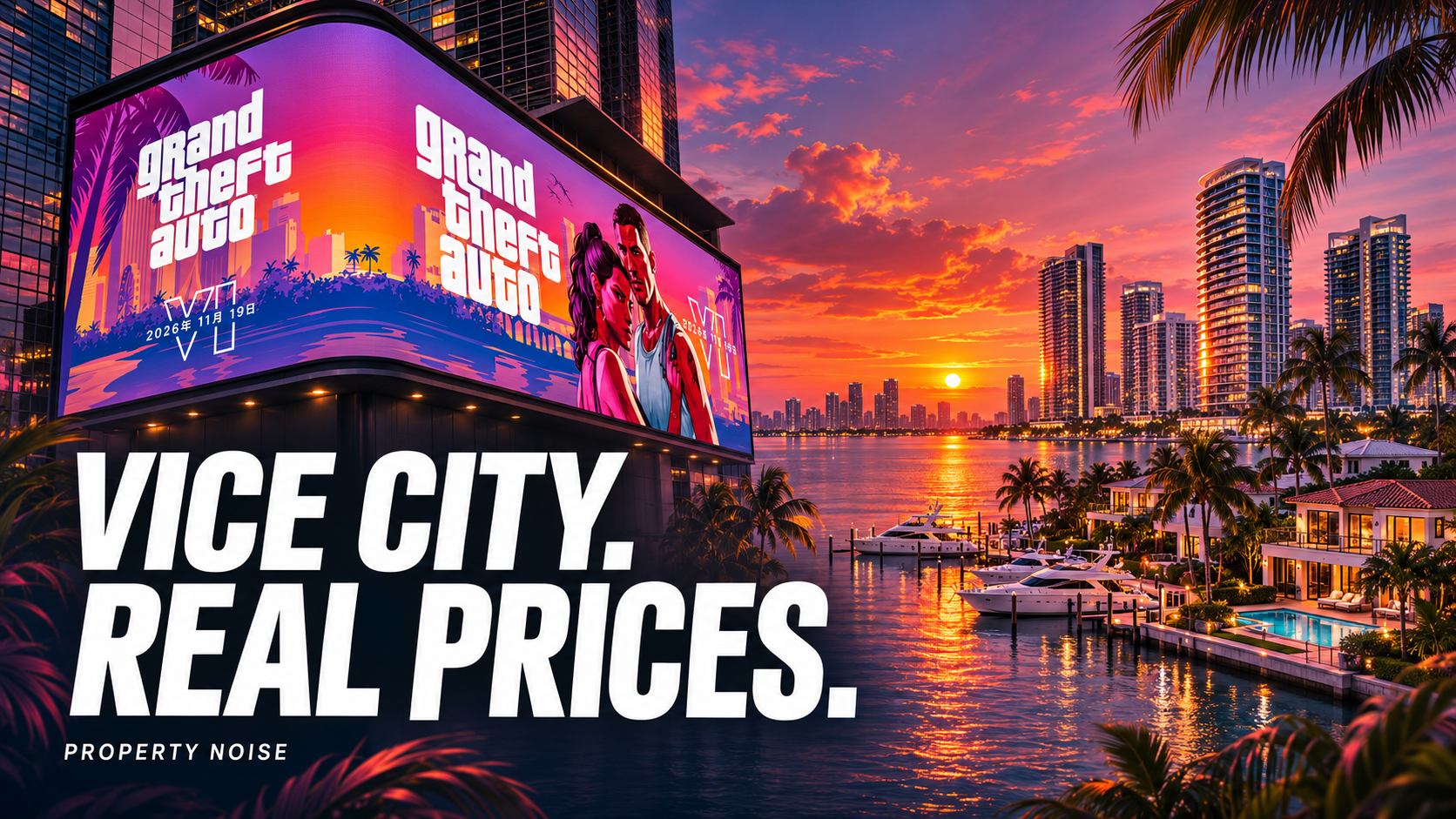
Grand Theft Auto VI has arrived after a 13-year wait, putting a fictional version of Florida in front of a worldwide audience. Behind the neon, beachfront apartments and tropical roads lies a real property market where buying into the lifestyle can cost considerably more than buying the game.
Rockstar Games released GTA VI on 19 November, returning players to Vice City and introducing the wider state of Leonida.
The release is one of the biggest entertainment events of the year. The Financial Times reported more than 15 million preorders, citing Sensor Tower data. Rockstar’s parent company, Take-Two Interactive, says the Grand Theft Auto franchise has sold nearly 480 million units worldwide.
For Property Noise readers, the setting offers another way into the story. What would it cost to live in the places that inspired the game?
GTA VI’s worldwide phenomenon started years before release
The scale of interest was evident when Rockstar released the first GTA VI trailer in December 2023.
Guinness World Records recorded more than 90.4 million YouTube views in its first 24 hours, making it the most-viewed videogame reveal trailer over that period.
Its predecessor had already shown what the franchise could do commercially. GTA V reached US$1 billion in sales within three days of its September 2013 release.
The long gap between the two games gave fans years to examine trailers, identify landmarks and debate the map. A hotel pool, road layout or strip of waterfront buildings could become the subject of detailed comparison with the real world.
That attention makes the setting a large part of the game’s appeal. Players are entering an imagined place that looks familiar enough to make them curious about the real one.
Why GTA VI’s Vice City looks familiar
GTA VI follows Jason and Lucia through Leonida, a fictional state drawing heavily on Florida.
Vice City takes its inspiration from Miami. Other regions include the island chain of the Leonida Keys, the wetlands of Grassrivers and the industrial landscape of Ambrosia.
Rockstar’s version brings those different environments into a single playable world. For property buyers, their real-world counterparts offer very different prices and lifestyles.
Miami’s waterfront image also has a place in Property Noise’s coverage of the top end of the market.
Related reading — Inside Miami’s ultra-exclusive “Billionaire Bunker” country club
What homes cost in the real GTA VI locations
Realtor.com’s November 2026 comparison reported the following median listing prices. All figures below are in US dollars.
- Vice City / Miami — US$496,000.
- Grassrivers / Homestead, near the Everglades — US$440,000.
- Ambrosia / Hendry County, including Clewiston — US$330,000.
- Leonida Keys / Florida Keys — US$1.195 million.
- Port Gellhorn / Panama City — US$396,000.
- Mount Kalaga / Eufaula, Alabama, near Providence Canyon — US$298,000.
The matches beyond Miami include interpretations of the game’s inspirations. Realtor.com identifies several as fan theories rather than confirmed one-to-one locations.
These are asking-price medians across different markets and property mixes. They provide a snapshot of advertised homes, with the final price of any purchase depending on the individual property and negotiation.
The Florida Keys come with a seven-figure price tag
The Florida Keys stand out in that comparison, with a median listing price of US$1.195 million.
That puts the island market at roughly 2.4 times the reported Miami median.
The difference illustrates how little a broad description such as “Florida property” tells a buyer. A city apartment, an inland home and an island property can sit in very different markets, even when the same game makes them part of one journey.
For an overseas buyer, understanding the local market would be essential before treating a familiar-looking setting as a realistic purchase target.
Miami is already turning GTA VI attention into revenue
The game’s connection to the real city has become a commercial opportunity.
Miami-Dade County announced a US$3.9 million marketing and advertising package ahead of launch. It included arrangements involving Miami International Airport, PortMiami and the county’s transport system.
A “Welcome to Vice City” display at the county-owned Kaseya Center formed part of an earlier US$975,000 agreement included within that package. The county said those funds had been allocated towards a public park at Dan Paul Plaza behind the arena.
That is a measurable benefit from the launch campaign. Whether the game generates additional tourism spending or changes property demand will take longer to establish.
Could GTA VI make its real-world locations more desirable?
The possibility is easy to understand. Someone who spends hours exploring an imagined Miami may become interested in visiting the city, recognising its architecture or seeing the waterfront for themselves.
That creates opportunities for tourism operators and local businesses to explain the connection between the game and the place.
The property question requires more evidence. Establishing a connection between launch attention and property demand would mean tracking enquiries and transactions over time, then asking buyers what influenced their decisions.
For now, GTA VI has given Florida an extraordinary entertainment platform. It has also given property watchers a reminder of how strongly a place’s image can travel.
Millions of players can explore Vice City from home. Buying a home in its real-world inspiration requires a very different budget.