
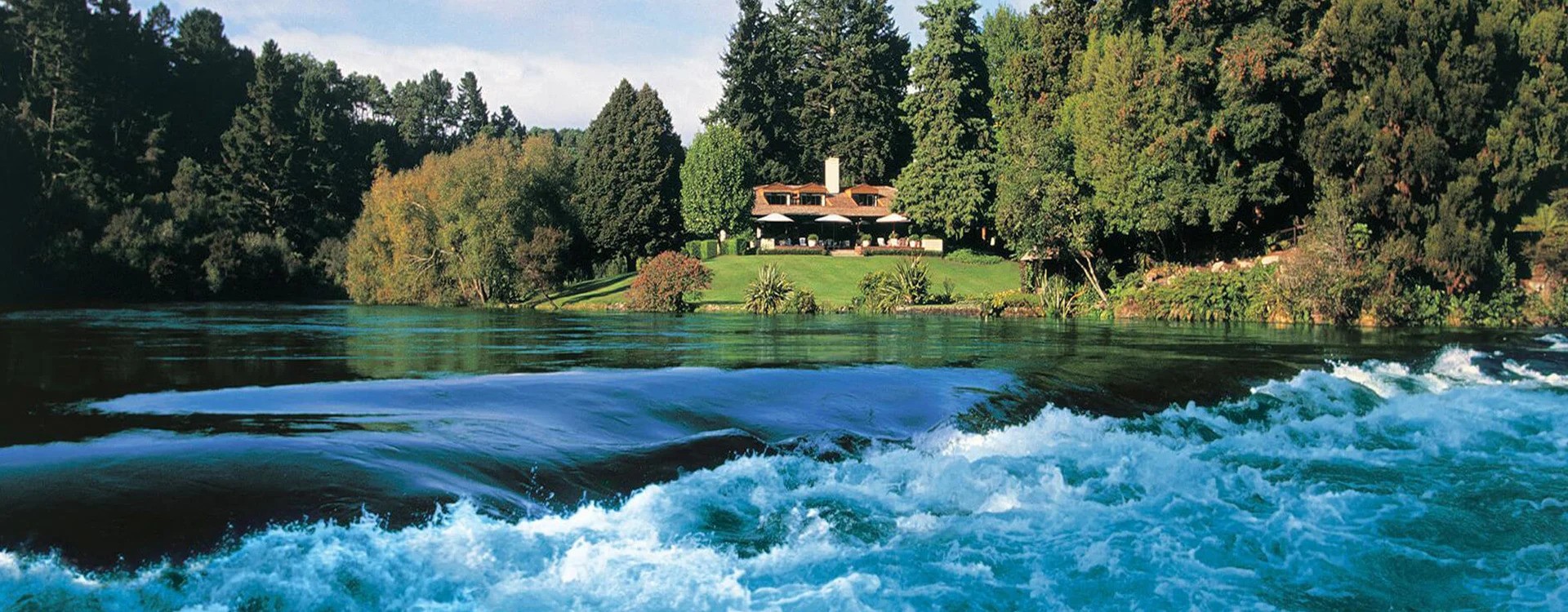
PHOTO: Huka Lodge. Lightfoot Travel.
One of New Zealand’s most famous luxury properties has undergone a spectacular $25 million transformation — but the real achievement at Huka Lodge may be how little appears to have changed.
Set beside the powerful Waikato River near Huka Falls in Taupō, Huka Lodge has been synonymous with secluded luxury, international celebrities and extraordinary New Zealand hospitality for generations.
Now, following an extensive architectural transformation, the legendary retreat has entered a new chapter.


The approximately $25 million project has expanded guest amenities, transformed key communal areas and introduced a significantly enhanced wellness offering.
Yet rather than attempting to reinvent Huka Lodge, the architects faced a considerably more difficult challenge:
How do you modernise and substantially expand one of New Zealand’s most recognisable luxury lodges without destroying the character that made it special in the first place?
That challenge sits at the centre of a new video released by architecture channel The Commercial Project, which takes viewers inside the remarkable transformation.
Huka Lodge: An Extraordinary Piece of New Zealand Property
Huka Lodge occupies an exceptional position alongside the Waikato River, only a short distance from the thundering Huka Falls.
The property has long been recognised internationally for a style of luxury that is deliberately understated.
Rather than relying on towering architecture or conspicuous grandeur, Huka Lodge’s identity has traditionally come from its low-slung buildings, intimate spaces, established gardens and extraordinary relationship with the river and surrounding landscape.
That created an unusual problem for the team responsible for its transformation.
The brief required a substantial increase in guest amenity space, but returning guests still needed to recognise the lodge they knew.
In architectural terms, this wasn’t simply a renovation.
It was an exercise in restraint.
NEW | Access New Zealand’s Ultimate Real Estate Agent Database — 18,000+ Agents & Agencies Included
The $25 Million Question: How Do You Change Huka Lodge Without Changing Huka Lodge?
Christian Anderson Architects approached the project by carefully examining the architectural language already established throughout the property.
Instead of creating an obviously contemporary extension sitting alongside an historic building, the architects sought continuity.
Structural beams were carried through common areas.
Bandsawn painted elements, wall linings, ceiling panelling and timber flooring were used to create visual connections between existing and newly constructed spaces.
The objective was simple to describe but extraordinarily difficult to execute:
The new Huka Lodge needed to feel as though it had always been there.
According to the project video, returning guests have commented that they struggle to identify where the original architecture finishes and the new work begins.
For a heritage-sensitive luxury renovation of this scale, that’s arguably the ultimate compliment.
Timber Becomes a Major Part of the Story
One of the strongest features of the redevelopment is its extensive use of timber.
Forté supplied timber flooring alongside wall and ceiling treatments across the project, helping establish a consistent material language throughout the lodge.
The materials needed to achieve two quite different things.
They had to reinforce Huka Lodge’s established Arts and Crafts character while also providing the performance, durability and precision expected of a contemporary ultra-luxury hospitality property.
That material continuity helps prevent the expanded lodge from feeling like a collection of renovations undertaken at different times.
Instead, old and new are deliberately blurred.
The River Room Moves Even Closer to the Waikato
Perhaps one of the most striking architectural changes has occurred in the River Room.
The Waikato River has always been fundamental to Huka Lodge’s identity.
Rather than simply being scenery viewed from the property, the river provides the sound, movement and atmosphere that define the experience.
During the redevelopment, a terrace beyond the original fireplace was removed.
In its place is a glazed bay projecting towards the river.
The result brings guests physically and visually closer to the Waikato.
Expanded glazing opens the room towards the water, creating a dramatically stronger connection between interior and landscape without fundamentally changing the character of the room itself.
It’s a relatively restrained architectural intervention with an enormous experiential impact.
Huka Lodge’s Wellness Offering Gets a Major Upgrade
Luxury travel has also changed considerably.
For many high-end travellers, an exceptional room and restaurant are no longer enough. Wellness facilities have become an increasingly important part of the international luxury-hospitality market.
The renewed Huka Lodge responds with a substantially expanded wellness offering incorporating a gym, spa and treatment rooms.
Again, the challenge was integration.
These facilities needed to meet contemporary luxury expectations without appearing like a separate modern resort suddenly dropped into the Huka Lodge landscape.
Timber and other carefully selected materials extend across internal and external environments, helping the wellness spaces settle naturally into the greenery surrounding them.
Landscape Architecture Was Just as Important
Architecture alone couldn’t solve the problem of bringing together buildings created across different periods.
Landscape design by Suzanne Turley Landscapes plays an important role in stitching the expanded property together.
Paths, gardens, buildings and outdoor spaces needed to read as one cohesive environment rather than expose the chronology of the property’s development.
This relationship between architecture and landscape is particularly important at Huka Lodge because the natural setting isn’t simply decoration.
The setting is part of the product.
The Waikato River, mature vegetation and secluded grounds are fundamental to what guests are paying to experience.
Virginia Fisher Interiors: Luxury Without Losing the Lodge
Interior designer Virginia Fisher’s approach similarly avoids drawing a hard line between historic Huka Lodge and its contemporary additions.
Furniture, colour, texture and materials are layered throughout the interiors rather than used to announce which rooms are “new”.
That’s a subtle but important distinction.
Luxury-property renovations can easily fall into the trap of making the newest spaces visually dominant.
At Huka Lodge, the opposite appears to have been the objective.
The redevelopment needed to feel settled from day one.
Why Huka Lodge Matters Beyond Luxury Tourism
There’s another fascinating dimension to the project.
Huka Lodge represents the uppermost end of a wider global property trend: luxury buyers and travellers increasingly value experience, authenticity and connection to place rather than luxury defined simply by size.
A spectacular location cannot easily be replicated.
Neither can decades of history.
For landmark properties such as Huka Lodge, that makes sensitive redevelopment potentially more valuable than wholesale reinvention.
The architecture isn’t trying to compete with the Waikato River.
It’s trying to provide a better place from which to experience it.
That’s a very different philosophy from simply building bigger.
A New Benchmark for New Zealand Luxury Property?
New Zealand already punches considerably above its weight in the international luxury-lodge sector.
Remote landscapes, privacy and relatively low-density development have created a luxury-tourism proposition that’s difficult for many destinations to replicate.
Huka Lodge sits near the top of that market.
And investing around $25 million into a property of this nature demonstrates just how sophisticated the premium accommodation sector has become.
International luxury travellers increasingly expect exceptional architecture, wellness, food, privacy, technology and service — while simultaneously wanting the experience to feel authentic and effortless.
Delivering both is enormously difficult.
The Most Impressive Part? You May Not Notice the Renovation
Perhaps the most compelling aspect of Huka Lodge’s transformation isn’t something dramatic.
It’s the absence of drama.
A $25 million redevelopment could easily have produced a completely different property.
Instead, the architects, designers and landscape team appear to have deliberately resisted that temptation.
The ultimate objective wasn’t:
“Look at what we’ve built.”
It was:
“Does this still feel like Huka Lodge?”
If returning guests genuinely struggle to distinguish the new additions from the original lodge, then the project has achieved something many major renovations fail to accomplish.
It has modernised an icon without overwhelming it.
And beside one of New Zealand’s most spectacular stretches of river, Huka Lodge may now be better equipped for its next generation precisely because it hasn’t forgotten what made it extraordinary in the first place.