
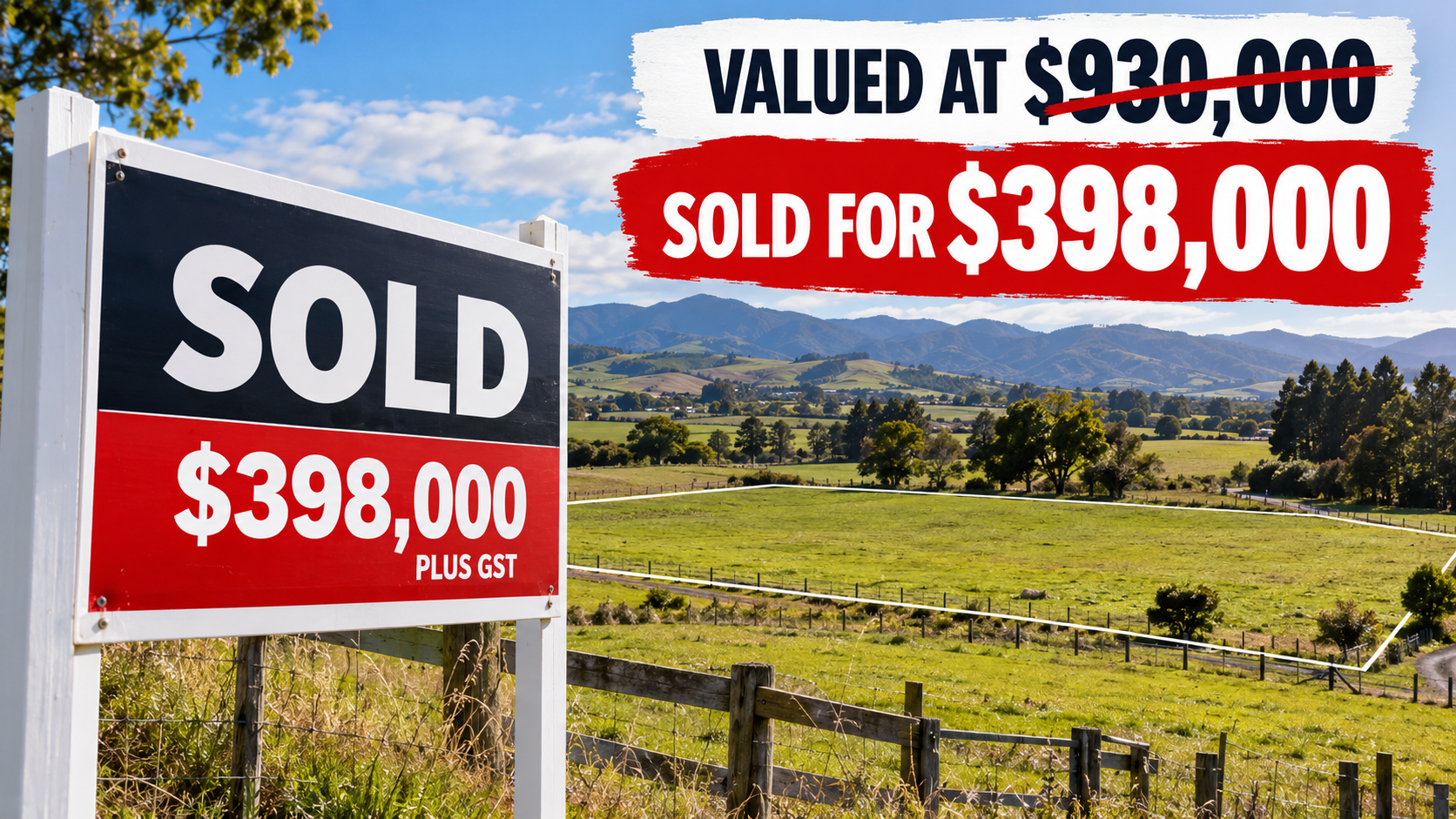
A Wairarapa property owner has failed in a bid to challenge the conduct of real estate agents after a five-hectare block sold for less than half its registered valuation. The case raises important questions about mortgagee sales, property valuations and the rights of owners facing financial difficulties.
A $532,000 GAP BETWEEN VALUATION AND SALE PRICE
A Wairarapa property owner has lost a challenge over the sale of land that fetched just $398,000 plus GST, despite having received a registered valuation of $930,000 only months earlier.
The Real Estate Agents Disciplinary Tribunal upheld a decision by the Registrar of the Real Estate Agents Authority not to pursue a complaint against two agents involved in the mortgagee sale.
The case highlights a difficult reality for property owners: a registered valuation does not guarantee a property will achieve that price, particularly when development approvals have expired and a mortgagee is exercising its right to sell.
The land comprised approximately five hectares of residential-zoned property in Wairarapa, originally intended for development.
HOW A MILLION-DOLLAR PROPERTY ENDED UP SELLING FOR $398,000
The owner had borrowed approximately $300,000 from a solicitor, who held a mortgage over the property.
When the loan could not be repaid and was not renewed, the mortgagee instructed two real estate agents to arrange a sale.
The property had previously attracted substantial valuations.
In April 2024, a registered valuation obtained by a lender assessed the land at $1.225 million, based on an assumption that the first stage of a proposed development had received consent.
However, by July 2025, an agent involved in the sale assessed the property’s likely market value at between $400,000 and $450,000.
The owner subsequently obtained another registered valuation in August 2025, placing the property’s value at $930,000.
That valuer was aware that an earlier resource consent had lapsed and that a fresh application had been prepared.
Despite the higher valuation, the land eventually sold for $398,000 plus GST.
OWNER’S AUGUST 2025 VALUATION
$930,000
FINAL SALE PRICE
$398,000
Plus GST
DIFFERENCE BETWEEN VALUATION AND SALE PRICE
$532,000
Approximately 57% below the owner’s valuation, comparing the figures before GST adjustments.
OWNER CLAIMED THE PROPERTY WAS UNDERSOLD
In October 2025, the owner complained to the Real Estate Agents Authority, arguing that inadequate marketing had contributed to the land being sold substantially below its value.
The owner claimed the sale left the trust that owned the property carrying significant debt.
However, the agents disputed suggestions that their conduct had resulted in an undervalue.
They maintained they had not been shown the higher valuations before the sale and understood those assessments to be associated with potential development.
Crucially, the previous subdivision consent had expired.
The agents were marketing the property as a single bare block of land with possible future development potential, rather than as an approved subdivision.
They also pointed to several tenders received in the mid-to-high $300,000 range, which they considered consistent with market conditions.
TRIBUNAL: AGENTS WERE ACTING FOR THE MORTGAGEE
One of the most significant findings concerned who the agents were legally representing.
The Tribunal confirmed that the agents’ client was the mortgagee, not the landowner.
Accordingly, the agents were required to act in the mortgagee’s interests and follow lawful instructions.
The Tribunal stated:
“The licensees were not required to consult the owner on the marketing or acceptance of an offer, which were the prerogative of the mortgagee.”
That distinction is particularly important in mortgagee sales, where the original owner may no longer control the selling process.
The Tribunal found insufficient evidence that unprofessional conduct by the agents had caused the property to sell below its proper value.
It also considered that the higher valuations did not establish wrongdoing by the agents, given they were not known to them before the sale and involved development assumptions.
A VALUATION IS NOT THE SAME AS A BUYER’S OFFER
The dispute illustrates how dramatically property values can differ depending on the assumptions used.
Land with an approved subdivision, completed infrastructure plans and development certainty can be valued very differently from bare land requiring new consents.
Potential buyers may also discount their offers to account for planning uncertainty, development costs, financing requirements and risk.
In this case, the expiry of the earlier subdivision consent was a central factor.
Although the owner had obtained a valuation of $930,000, the Tribunal was not persuaded that the difference between that figure and the eventual sale price demonstrated misconduct by the real estate agents.
WHAT DOES THIS MEAN FOR PROPERTY OWNERS?
The decision offers several lessons for owners, lenders and real estate professionals.
-
Development approvals matter: A lapsed resource consent can materially change how prospective buyers assess land.
-
Valuations depend on assumptions: A registered valuation may not reflect the price achievable under different sale conditions.
-
Mortgagee sales change control: The mortgagee generally directs the sale process, subject to applicable legal duties.
-
Evidence is essential: A complaint against an agent needs credible evidence of possible misconduct, not simply a disappointing sale price.
-
Legal advice matters: Owners concerned about a mortgagee’s marketing decisions or sale price may need to examine their rights against the mortgagee itself.
Importantly, the Tribunal’s decision did not determine that every aspect of the mortgagee sale was beyond challenge. It dealt with whether the Registrar had erred in declining to pursue the complaint against the agents.
THE FINAL DECISION
The Registrar had declined to take the complaint further in May 2026, finding insufficient grounds to warrant further action.
The owner sought a review, but the Tribunal upheld that decision and dismissed the application.
It found no error in the Registrar’s approach.
The parties retain the right to appeal to the High Court.
PROPERTYNOISE VIEW: A HALF-MILLION-DOLLAR QUESTION
There is a striking difference between a property being valued at $930,000 and ultimately selling for $398,000.
For any landowner, that gap would be difficult to accept.
However, the case demonstrates why the circumstances behind a valuation are just as important as the number itself.
The bigger question for property owners is not simply what their land might be worth with development potential, but what buyers are prepared to pay for it in its current legal, planning and market circumstances.
A valuation may suggest what a property is worth. A completed sale reveals what a buyer was prepared to pay. Neither figure, by itself, settles whether a mortgagee has met its legal obligations.
Source: Stuff, 29 October 2026, reporting on a Real Estate Agents Disciplinary Tribunal decision. This article is an independently written summary and commentary based on the supplied reporting.