
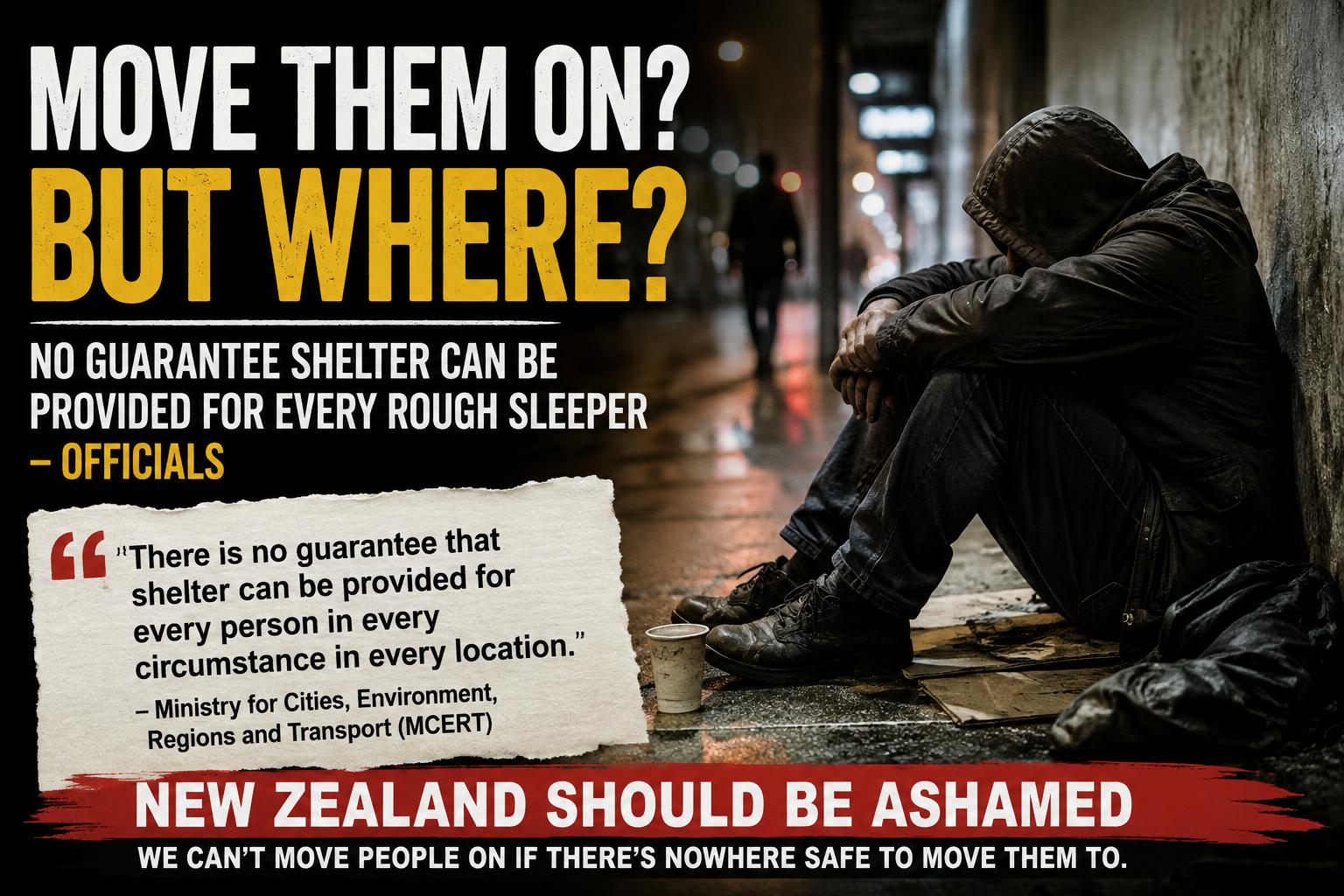
PHOTO: “Move on” sounds simple until there’s nowhere to move to.
New Zealand is preparing to give police greater powers to move rough sleepers on from public places. At the same time, officials have acknowledged they cannot guarantee those people will actually have somewhere safe to sleep. That is not simply a policy gap. It raises a fundamental question about what sort of country New Zealand wants to be.
There are moments when government policy becomes so contradictory that the contradiction itself tells the story.
This is one of them.
The National-led Government is progressing legislation that would give police powers to issue move-on orders in circumstances involving disorderly behaviour, begging or rough sleeping.
Yet according to reporting by RNZ, government officials have now acknowledged something extraordinary:
“There is no guarantee that shelter can be provided for every person in every circumstance in every location.”
Read that again.
New Zealand is contemplating giving the state greater power to tell vulnerable people they cannot remain where they are while being unable to guarantee them somewhere else to go.
That should trouble New Zealanders across the political spectrum.
This isn’t about being soft on antisocial behaviour.
It isn’t about pretending homelessness is simple.
And it certainly isn’t an argument that businesses, residents and city-centre communities should simply tolerate threatening or seriously disruptive behaviour.
It’s about something much more basic.
If the state tells somebody they cannot sleep here, surely the state should be able to tell them where they CAN sleep.
Right now, apparently, it can’t.
And the Government should be deeply uncomfortable about that.
“Move on” sounds simple until there’s nowhere to move to
Political language can sanitise reality remarkably effectively.
Move-on order.
It sounds administrative.
Almost harmless.
Move along.
Find somewhere else.
But imagine actually being the person receiving that instruction.
You don’t have a bedroom.
You don’t have a couch waiting at a friend’s house.
You don’t have $150 for a motel.
You may not have a car.
You may have mental health, addiction or physical health issues.
Perhaps you’ve recently left prison.
Perhaps you’ve escaped violence.
Perhaps you’ve simply reached the end of a catastrophic sequence of events that most New Zealanders fortunate enough to have secure housing have never experienced.
A police officer tells you that you need to leave.
Fine.
Where do you go?
That’s the question this entire policy should have been required to answer before legislation progressed.
The Government’s own officials can’t provide the answer
RNZ spent weeks asking government agencies a remarkably straightforward question:
Where can a person sleeping rough go if they need a bed tonight?
Not eventually.
Not once a housing assessment has been completed.
Not when a Housing First placement becomes available.
Tonight.
The eventual response from the Ministry for Cities, Environment, Regions and Transport was that accommodation depended on circumstances, location, capacity, real-time availability and the support required.
And therefore:
There is no guarantee.
Auckland City Missioner Helen Robinson told RNZ she was grateful this had finally been formally acknowledged — but said she was “deeply distressed” that this was the reality.
She should be.
We all should be.
Just 65 immediate-access transitional housing beds — all in Auckland
Perhaps the most startling number in RNZ’s reporting is 65.
Officials confirmed there were only 65 immediate-access transitional housing beds nationwide.
And all 65 were in Auckland.
Only 20 were in central Auckland.
Think about what that means.
Wellington?
Christchurch?
Hamilton?
Tauranga?
Dunedin?
Palmerston North?
Rotorua?
Whangārei?
Napier?
Nelson?
The countless smaller communities where homelessness isn’t always as visible but is still very real?
Zero immediate-access beds under that particular programme.
This is occurring while frontline providers describe demand as “relentless”.
That isn’t a functioning safety net.
It’s a desperately limited resource trying to catch people falling through an enormous hole.
Meanwhile, transitional housing capacity has fallen
It gets worse.
According to the information supplied to RNZ, the total number of contracted transitional housing places has fallen by around 300 since November 2023.
Officials attributed that partly to the planned removal of higher-cost motel accommodation and normal portfolio changes.
Reducing reliance on motels is not inherently bad policy.
Emergency motel accommodation was expensive, sometimes inappropriate and capable of producing terrible outcomes.
The previous system deserved criticism.
But you cannot judge a housing policy simply by how many households you successfully remove from an undesirable category on a spreadsheet.
The question is:
Where did those people go?
If somebody leaves emergency accommodation for permanent housing, fantastic.
That’s success.
If they leave a motel and end up sleeping in a car, garage, tent, doorway or under a bridge, you haven’t solved homelessness.
You’ve changed where homelessness appears in the statistics.
Reducing emergency housing numbers isn’t the same as reducing homelessness
This distinction is absolutely critical.
The Government has repeatedly highlighted the dramatic reduction in households using emergency housing.
That sounds impressive.
And where families have genuinely moved into sustainable accommodation, it deserves recognition.
But community housing organisations and social-service providers have repeatedly raised concerns that tighter emergency-housing criteria are contributing to rough sleeping.
The Government disputes simplistic interpretations of that relationship and maintains emergency housing remains available to those meeting the criteria and in genuine need.
Fair enough.
Then measure the outcome that actually matters.
How many people have nowhere safe to sleep tonight?
Because an emergency-housing figure isn’t a homelessness figure.
A person sleeping under a shop awning isn’t in emergency housing.
A person living in a car isn’t necessarily in emergency housing.
A teenager couch-surfing isn’t necessarily in emergency housing.
A family squeezed into an overcrowded garage isn’t necessarily in emergency housing.
You can make an emergency-housing statistic fall without making housing insecurity disappear.
That’s why policy needs to be judged on human outcomes, not merely administrative categories.
A food grant isn’t a bed
RNZ’s reporting exposes another uncomfortable issue.
MSD said that of people approaching it for emergency housing, 89 percent receive either emergency housing, transitional housing, help with a private rental, or hardship assistance.
At first glance, 89 percent sounds reassuring.
Until you notice those outcomes are not remotely equivalent.
Emergency accommodation provides somewhere to sleep.
Transitional housing provides somewhere to sleep.
Assistance entering a private rental may eventually provide somewhere to sleep.
Hardship assistance?
That may be extremely useful.
But as RNZ rather pointedly observed:
You cannot sleep in a food grant.
When someone is literally sleeping on the pavement, the relevant measure shouldn’t be whether they received assistance.
It should be:
Did they have a safe place to sleep that night?
That is the number New Zealand deserves to know.
Then there’s the reality confronting frontline health workers
Perhaps the most disturbing part of this story comes not from politicians but from those dealing directly with rough sleepers.
Wellington nurse practitioner Serena Moran described treating people who had been assaulted and then being unable to find anywhere for them to stay.
Her description of having to provide pain relief and effectively send somebody back onto the street is devastating.
That’s New Zealand.
In 2026.
A medical professional treats an injured homeless person and cannot necessarily find a safe bed for them that night.
And we’re debating additional powers to tell those same people to move on.
Something is seriously wrong with that picture.
People are dying outside
This debate isn’t theoretical.
RNZ has reported deaths involving people sleeping rough, including people found unresponsive outdoors in Wellington and Christchurch, and reported another rough sleeper died in Auckland in July.
Sleeping rough carries obvious risks.
Exposure.
Violence.
Illness.
Theft.
Exploitation.
Mental-health deterioration.
And death.
When those are the stakes, the country’s response cannot simply revolve around whether someone is visible in a shopping precinct.
Removing homelessness from public view is not the same as solving homelessness.
Businesses and residents have rights too
There needs to be some balance in this conversation.
People running shops and hospitality businesses shouldn’t have to tolerate threatening behaviour outside their doors.
Families should be able to use public spaces safely.
Workers should feel safe walking through city centres.
Police need practical tools for dealing with genuinely intimidating, aggressive and disorderly behaviour.
Homelessness cannot become an automatic exemption from laws that protect everybody else.
But there is already a fundamental distinction between behaviour and existence.
If someone assaults another person, threatens them, damages property or engages in serious disorder, deal with the behaviour.
But poverty itself should never become something we effectively police out of sight.
A person sleeping in public because they literally have nowhere else to go presents a very different moral question.
Fourteen years old
The proposed legislation is even more confronting because, according to RNZ’s reporting, move-on orders could apply to people as young as 14.
Fourteen.
A Year 10 student.
If a 14-year-old is sleeping rough, our first question should surely not be:
How quickly can we move them along?
It should be:
How did a child end up sleeping here, and how do we get them somewhere safe tonight?
Any system capable of directing a homeless child to leave a location while being unable to guarantee that child immediate safe shelter deserves the strongest possible scrutiny.
Housing First isn’t an answer for tonight
Housing First is an important programme.
But even that illustrates the mismatch.
According to officials quoted by RNZ, Housing First supports people experiencing chronic homelessness, with eligibility including having slept rough for at least 12 months during the previous three years.
That means someone newly homeless does not simply become a Housing First client because they need somewhere tonight.
Transitional housing can help.
But capacity is finite.
Immediate-access transitional housing can help.
But there are only 65 beds under the programme described by officials, all in Auckland.
Emergency housing can help.
But eligibility has tightened and government agencies themselves say it isn’t necessarily the most appropriate solution for every rough sleeper.
So again:
Where does the person go tonight?
We keep returning to that question because everything else is secondary.
National should be ashamed that the policy has reached this point
The National Party campaigned on restoring accountability, improving public services and getting better results from government spending.
Those are legitimate objectives.
The emergency housing system inherited by this Government was deeply problematic.
New Zealand absolutely needed a better solution than spending huge sums putting vulnerable families into motels for extended periods.
But reforming a broken system requires replacing it with something better.
It cannot mean tightening one doorway before ensuring another one is open.
And it certainly shouldn’t mean congratulating ourselves because emergency-housing numbers have fallen while frontline organisations report increasing pressure from people sleeping rough.
The Government should be ashamed not because homelessness exists under its watch — homelessness existed under previous governments too — but because it is advancing coercive powers before ensuring the basic alternative exists.
That distinction matters.
This is not solely National’s historical problem.
But this legislation is this Government’s choice.
It owns that choice.
Christopher Luxon’s earlier admission should have been a wake-up call
RNZ previously reported Prime Minister Christopher Luxon acknowledged he did not know Auckland lacked a general night shelter for rough sleepers.
That should have triggered an urgent response.
Not political embarrassment followed by business as usual.
Auckland is New Zealand’s largest city.
If the Prime Minister discovers that the country’s largest city lacks something as fundamental as sufficient immediate night-shelter capacity, the next question should be:
What do we need to build, fund or commission to fix this?
Because before expanding police powers, surely New Zealand can establish one very simple principle:
Nobody should be ordered away from a sleeping place unless a safe alternative is genuinely available.
Not theoretically available.
Not available after an assessment next Tuesday.
Not potentially available through another pathway.
Available tonight.
This should not be a left-versus-right issue
It would be easy to turn this into another predictable political argument.
National bad.
Labour good.
Or vice versa.
That achieves nothing.
New Zealand’s housing crisis developed across successive governments.
Housing became extraordinarily expensive.
Social housing supply failed to keep pace with need.
Emergency accommodation ballooned.
Mental-health and addiction services struggled.
Successive governments made mistakes.
But the current Government is responsible for the policies it implements now.
And there is a straightforward conservative argument against the current contradiction too:
Government should not exercise coercive power without accepting responsibility for the foreseeable consequences of exercising it.
If the state uses its authority to remove someone from a location, it cannot simply wash its hands of what happens next.
Build the alternative first
If the Government genuinely believes move-on powers are necessary, then establish the infrastructure that makes them defensible.
Create sufficient 24/7 emergency shelter capacity in major centres.
Ensure police know exactly where someone can be taken.
Provide specialist beds for people with complex mental-health and addiction needs.
Provide safe accommodation for women escaping violence.
Provide appropriate facilities for young people.
Connect people immediately with health, income and housing services.
Fund outreach teams adequately.
Measure how many people asking for a bed actually receive one that night.
Publish those numbers.
Then have the debate about enforcement.
Because a move-on order accompanied by:
“Come with us. We’ve got somewhere safe for you tonight.”
is fundamentally different from:
“You can’t stay here. Go somewhere else.”
One can be part of a pathway out of homelessness.
The other simply relocates misery.
New Zealand can do better than this
We’re not talking about solving the entire housing crisis overnight.
We’re talking about something much more fundamental.
A bed.
A roof.
A safe place for a human being to spend the night.
New Zealand is wealthy enough to achieve that.
We somehow find billions for infrastructure, roads, hospitals, prisons and countless other legitimate government responsibilities.
Surely we can establish enough emergency shelter that when police encounter someone sleeping in a doorway at 2am, the country has a better answer than:
Move on.
Because eventually we have to decide what success looks like.
Is success having fewer homeless people visible in our CBDs?
Or is success having fewer homeless people?
Those are not the same thing.
And until every person being told to move on has somewhere safe they can actually move to, the National-led Government should reconsider this policy.
Not because rough sleeping should be normalised.
Precisely the opposite.
Nobody should have to sleep on the street in the first place.
Moving homelessness around the corner doesn’t solve it.
It just makes it easier for the rest of us not to look.
NOTE: This commentary is based on the RNZ reporting and information you supplied above; where it criticises the Government, that is editorial commentary rather than an assertion that officials themselves reached those conclusions.
SOURCE: RNZ