
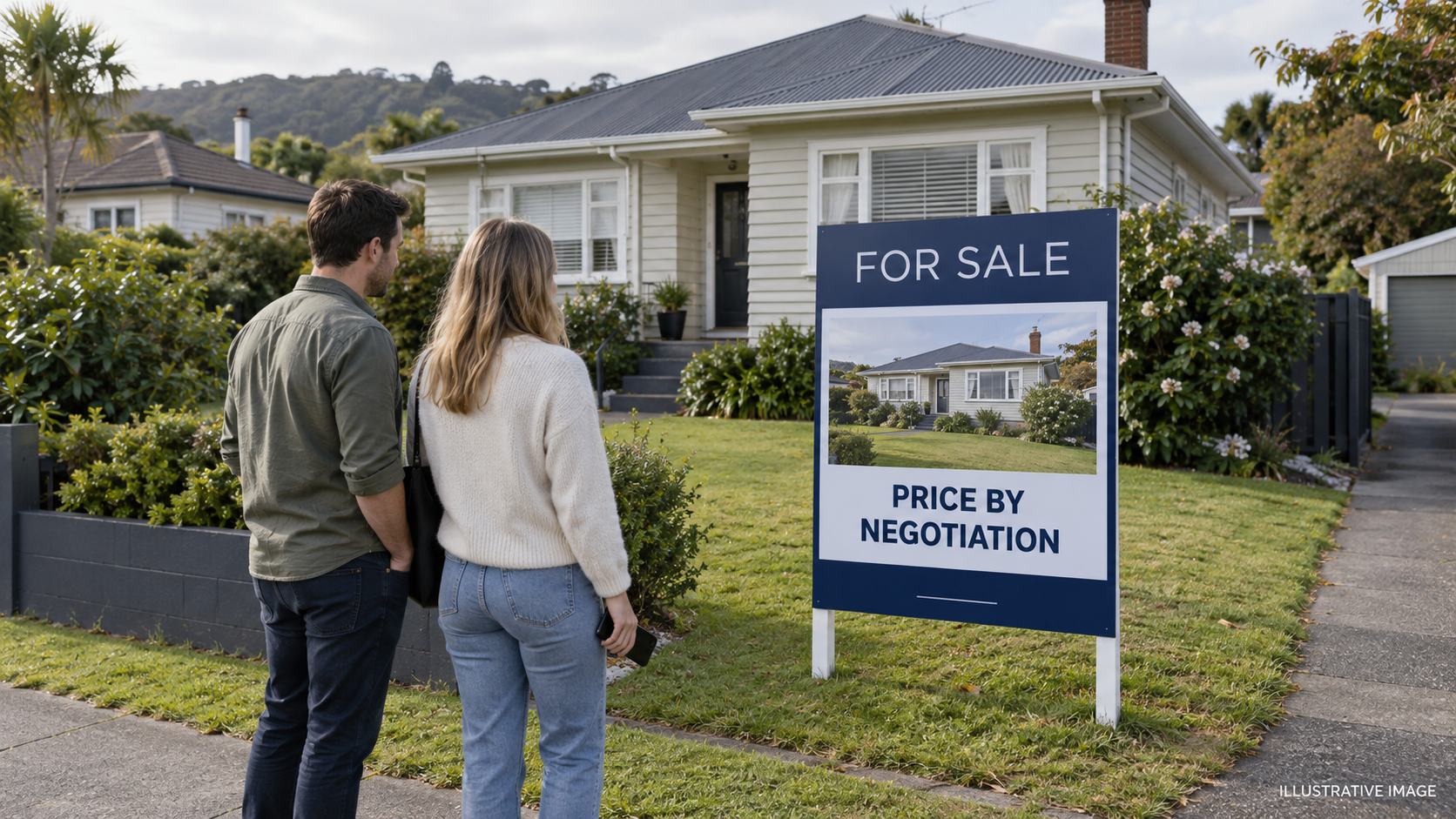
PROPERTY NOISE OPINION: Buyers are expected to make one of the biggest financial decisions of their lives. Is asking for a meaningful price indication really asking too much?
You find a home that looks promising. The location works. The photographs catch your attention. The layout could suit your family.
Then you reach the price.
“By negotiation.”
Or perhaps it is a deadline sale, a tender or an auction. There is a date, an agent’s number and an invitation to get in touch—but no clear indication of whether the property is remotely within your budget.
The seller wants the strongest possible result. The buyer wants to know whether pursuing the property is realistic.
Both positions are reasonable. The question is whether New Zealand’s approach to property advertising gives enough weight to the person expected to find the money.
Should every NZ property listing show an asking price—or, at the very least, a credible price guide?
WHAT DOES “PRICE BY NEGOTIATION” ACTUALLY TELL A BUYER?
“Price by negotiation” describes how a sale might be reached. It does little to explain where the conversation should begin.
For an experienced purchaser with recent comparable sales at hand, that uncertainty may be manageable. For a first-home buyer, someone relocating or a purchaser unfamiliar with the neighbourhood, it can be a substantial obstacle.
A buyer may investigate the listing, contact the agent and attend an open home before discovering that the seller’s expectations sit well beyond their borrowing capacity.
That does not mean every unpriced listing wastes money. Buyers can ask questions early, and agents can provide useful guidance. But the process becomes unnecessarily cumbersome when a basic affordability question requires a conversation that an advertisement could have answered.
A price indication would let buyers decide whether to begin—not promise them that they will succeed.
WHY SELLERS AND AGENTS USE UNPRICED CAMPAIGNS
There is a legitimate argument for leaving the asking price open.
An unusual property may have few direct comparisons. A distinctive home could appeal to purchasers who value its features very differently. A seller may also worry that setting an asking price too low would limit the result.
A deadline campaign creates a timetable for interested buyers. An auction provides a competitive process. A tender allows purchasers to submit offers with their own price and conditions.
These methods can serve a purpose.
However, the sale method and the availability of price guidance are separate questions. A deadline tells a buyer when to act. It does not explain what level of offer the seller might realistically consider.
A campaign can invite competition while still helping buyers understand the likely price territory.
THE FEAR OF LEAVING MONEY ON THE TABLE
For vendors, the strongest objection to publishing a price is often straightforward: what if somebody would have paid more?
That concern deserves to be taken seriously. An agent works for the seller, and a seller should not have to advertise a confidential minimum simply to satisfy curiosity.
But a credible guide need not be a promise to accept an offer or a declaration of the seller’s bottom line.
It could communicate an evidence-based expectation while allowing negotiations, competing offers and changing circumstances to influence the eventual result.
The difficult part is designing a system in which that guidance is useful. A guide deliberately set too low would replace uncertainty with a different problem.
Transparency only helps if the number means something.
THE COST IS MORE THAN AN OPEN-HOME VISIT
The early stages of buying a home involve effort: comparing properties, organising finance, arranging viewings and deciding which opportunities deserve attention.
As buyers become more serious, they may also seek legal advice, obtain reports or commission inspections. The costs and timing vary, and some information may already be available.
Buyers should establish as much as possible about price expectations before committing to significant expenses.
Even so, it is reasonable to question a process that asks purchasers to become increasingly invested while the most important commercial expectation remains unclear.
For working parents, out-of-town buyers and people with limited flexibility, time is a real cost too.
ARE MORE ENQUIRIES ALWAYS BETTER ENQUIRIES?
An unpriced listing may prompt someone to contact the agent to ask about the price.
That creates an interaction. It does not necessarily create a genuine prospect.
Imagine two hypothetical campaigns. One generates numerous enquiries from people who cannot afford the seller’s expectations. Another generates fewer enquiries, but most come from buyers with the budget and motivation to proceed.
The first campaign might look busier on a report. The second could produce more useful conversations.
This is not evidence that unpriced campaigns perform worse. It is a reason to assess marketing by the quality of the response, rather than enquiry totals alone.
Vendors should be able to ask: how many of the people contacting us are realistic purchasers?
THE AGENT’S APPRAISAL SHOULD START A BETTER CONVERSATION
New Zealand sellers are not supposed to begin with no professional guidance.
Settled.govt.nz, the consumer website operated by the Real Estate Authority, explains that an agent should provide a written estimate of the expected selling price, based on comparable sales. This is commonly called an appraisal or current market appraisal.
That appraisal is not a guaranteed outcome. Nevertheless, it means the listing discussion should already include an evidence-based assessment of value.
The editorial question is whether more of that useful context should reach buyers through the advertisement.
There may be sound reasons why an appraisal and an advertised guide differ. But “we need the market to tell us” should invite further explanation when the seller has already received a professional assessment.
PRICE GUIDANCE MUST BE HONEST
Publishing a number would not, by itself, solve the problem.
A very low guide could draw in buyers whose budgets never had a realistic chance of meeting the seller’s expectations. An excessively broad range could be almost as unhelpful as no price.
The Real Estate Authority’s advertising guidance warns that advertising may be misleading where the lower end of a price range is not an amount the vendor would consider and the agent knows the vendor would only accept something higher.
That makes accuracy central to this debate.
An asking price, a guide, an appraisal, a rating valuation and an auction reserve serve different purposes. Buyers need to understand those differences, and advertising should avoid blurring them.
This article argues for stronger transparency. It does not suggest that every current unpriced listing is unlawful or that a sale above a guide proves misconduct.
FIVE QUESTIONS BUYERS CAN ASK BEFORE SPENDING MORE
Before pursuing an unpriced property, buyers could ask:
- What price guidance can you provide, and what recent comparable sales support it?
- Has the seller indicated a price range they would genuinely consider?
- Have expectations changed since the campaign began?
- What property information and reports are already available?
- What should I establish before paying for my own due diligence?
An agent may have confidentiality constraints and cannot guarantee what a seller will accept. But the answers can still help a buyer judge whether to continue.
WHAT SELLERS SHOULD ASK THEIR AGENT
Vendors should also question the strategy before agreeing to it.
Why does this property suit an unpriced campaign? What evidence supports that recommendation? How will buyers receive meaningful guidance? When will the approach be reviewed?
A seller could request a comparison between a priced campaign and an unpriced one, including the risks of each.
The point is to choose a strategy deliberately, with an explanation tailored to the property.
A standard phrase on an advertisement should not substitute for a considered marketing plan.
SHOULD NEW ZEALAND REQUIRE A PRICE ON EVERY LISTING?
Property Noise’s position is that residential buyers deserve a meaningful starting point.
There is a strong case for requiring a clear asking price or a defensible price guide on residential listings, with carefully defined exceptions and obligations to review information when circumstances change.
That would require proper policy work. Rules would need to accommodate auctions, genuinely unusual homes, changing instructions and the difference between an estimate and an agreed sale price.
It would also need safeguards against misleadingly low guides. A poorly designed requirement could create false confidence rather than useful transparency.
But those challenges are reasons to improve the proposal—not dismiss the buyer’s frustration.
Sellers deserve a competitive campaign. Buyers deserve enough information to decide whether they can participate.
A property advertisement can describe the kitchen, count the bathrooms and explain the lifestyle in extraordinary detail.
Surely it can also give the buyer a credible idea of the price.
This is a Property Noise opinion article advocating greater price transparency. Official consumer and industry guidance is linked below.