
PROPERTY NOISE | OPINION & ANALYSIS
New Zealand taxpayers fund Parliament. MPs make the rules that shape our housing market. Ahead of the NZ General Election 2026, voters deserve to know what property their representatives hold—and whether those representatives have a credible plan to improve everyone else’s financial future.
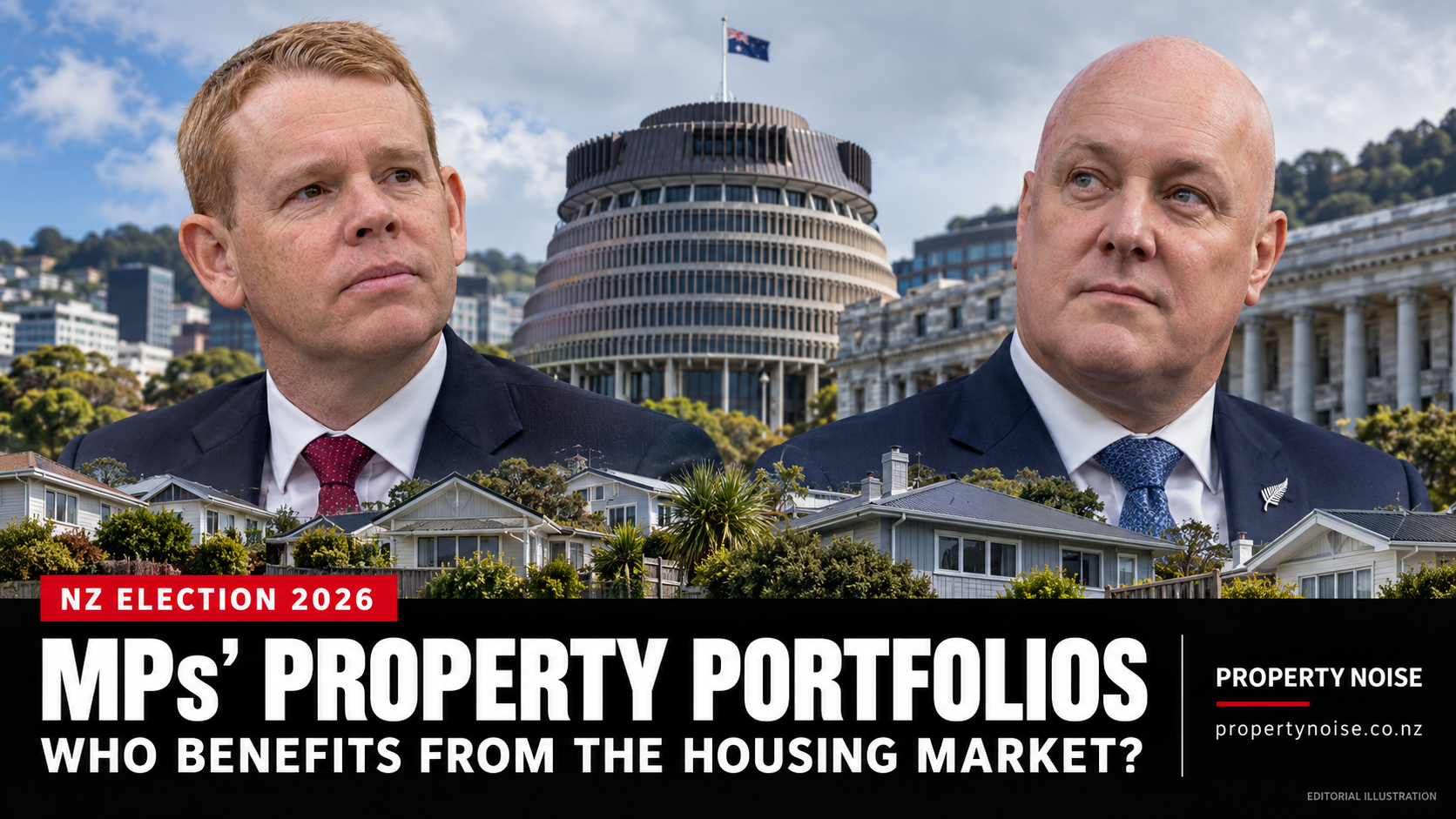
PHOTO:
New Zealand’s housing debate has an uncomfortable question at its centre: how well does a Parliament containing property investors understand the people struggling to buy their first home?
Owning investment property does not disqualify someone from public office. But when politicians help determine the rules governing landlords, tenants and property taxation, their own financial interests deserve scrutiny.
The challenge for MPs is straightforward: show voters how your housing policies help households build security, rather than simply asking them to celebrate a stronger property market.
With the 2026 New Zealand General Election scheduled for Saturday, 7 November, that question belongs firmly in the campaign. Vote NZ
WHAT PROPERTY DO NEW ZEALAND MPs DECLARE?
Parliament’s latest annual register records interests as at 31 January 2026. Selected declarations appear below; this is not a complete list of MPs.
| MP | Declared property interests |
|---|---|
| Christopher Luxon — National | Two Auckland residential properties and one Auckland investment property. |
| Chris Hipkins — Labour | Upper Hutt family home; Raumati South residential property owned by a superannuation trust. |
| David Seymour — ACT | Trust-beneficiary interests in Auckland and Whangārei homes, a Northland holiday home and a Whangārei section. |
| Winston Peters — NZ First | Houses in St Marys Bay and Whananaki South; land in Whananaki South. |
| Parmjeet Parmar — ACT | Eight Auckland rental dwellings, a Mount Wellington commercial property and an Eastern Beach family home owned by a trust. |
| Katie Nimon — National | Jointly owned Napier family home; five rental properties owned by a holding company. |
These are declared interests, including indirect ownership structures—not a ranking of personal net wealth. www3.parliament.nz
Property Noise previously examined the issue in how much property New Zealand MPs declared in 2025. That earlier coverage provides historical context; the table above uses the 2026 disclosures.
SOME POLITICAL PROPERTY PORTFOLIOS HAVE EXPANDED
In May, The Spinoff reported that coalition MPs had purchased or built at least 25 additional rentals, investment properties or second homes during the parliamentary term.
Its reporting included Parmar’s redevelopment projects, which increased the number of rental dwellings on two existing sites. An ACT spokesperson said government policy changes were not a factor in her investment decision.
Nimon told the publication that her husband worked in rental real estate and had purchased three properties as part of that business.
The same reporting noted that Luxon’s holdings had decreased from seven homes to three. Those differences matter: neither a growing portfolio nor a shrinking one, by itself, establishes why an investment decision was made. The Spinoff
Still, the public-interest question remains legitimate: how do politicians demonstrate that their housing decisions serve the wider population when they also hold property investments?
WE PAY MPs—WHAT SHOULD WE EXPECT IN RETURN?
The phrase “we are making MPs wealthy” captures a frustration. Taxpayers fund their salaries, while elected representatives exercise considerable influence over the conditions in which households earn, save, rent and buy.
However, property disclosures alone cannot establish that taxpayers created an MP’s wealth. Investments may predate Parliament, involve inherited assets, carry substantial borrowing or reflect a partner’s business.
The stronger criticism is about results.
Voters should expect a government to create conditions in which ordinary people can improve their lives: earn more, secure suitable housing, build savings and withstand financial shocks.
If political success is measured mainly by rising house prices, we should ask whose success is being measured.
An existing owner may welcome a valuation increase. A first-home buyer may see the deposit target moving further away. A homeowner with a large mortgage may gain little day-to-day relief from a higher paper valuation.
A wealthier property-owning population and a more affordable housing market are not automatically the same outcome.
A HOUSING RECOVERY IS NOT A HOUSEHOLD RECOVERY
Election campaigns need to distinguish between property prices and financial wellbeing.
Property Noise’s recent coverage of NZ house values falling for a sixth consecutive month examines the weakness in the market. Our reporting on ASB’s interest-rate outlook and forecast recovery timeline explores the pressures facing borrowers.
Neither rising nor falling prices tells the whole household story.
A lower purchase price can help a buyer, but that advantage may disappear if their income is uncertain or borrowing becomes more expensive. Conversely, a higher property valuation does not necessarily make mortgage repayments easier.
For voters, the useful question is whether housing becomes more manageable relative to their earnings—not whether a politician can point to a rising market index.
MORE HOMES FOR SALE DOES NOT MEAN EVERYONE CAN BUY
Greater choice can strengthen a buyer’s negotiating position. Property Noise explored that shift in NZ housing stock hits a 12-year high—buyers now hold the cards.
But negotiating power only helps someone who can obtain finance and sustain the repayments.
That distinction should shape the election debate. A first-home buyer needs more than a selection of listings. They need a realistic deposit pathway, a dependable income and confidence that the ongoing costs will be manageable.
Similarly, a renter needs more than a promise that investment will eventually deliver cheaper housing. They need a clear explanation of how a policy will improve availability, quality, affordability or security—and when those improvements should become visible.
PROPERTY INVESTMENT DESERVES SCRUTINY, WITH CONTEXT
A rental portfolio can involve very different activities.
Buying an existing dwelling changes its ownership. Redeveloping a site into several homes can add housing supply. Maintaining a rental properly provides an ongoing service.
Those differences matter when assessing policy.
Politicians should explain whether a proposed measure encourages additional homes, supports better rental accommodation or primarily changes the financial return on existing assets.
Voters should also ask how the benefits will be measured. If a policy is promoted as helping tenants or first-home buyers, its success should be assessed against outcomes for those groups.
A claim that a policy is “good for housing” is too broad to settle the debate.
FIVE QUESTIONS TO ASK BEFORE THE NZ GENERAL ELECTION 2026
Candidates should be ready to answer:
- What property interests do you hold? Explain direct, joint, company and trust interests clearly.
- How will your housing policies help people who do not already own property?
- What measurable improvement should renters and first-home buyers expect—and by when?
- How will you address affordability if house prices grow faster than household incomes?
- How do you manage potential conflicts between your investments and your parliamentary responsibilities?
These questions apply across Parliament. Public accountability should follow the financial interest and the policy decision, regardless of party.
VOTERS DESERVE MORE THAN ANOTHER PROPERTY PROMISE
New Zealanders do not need their MPs to make everyone a property investor. They need representatives who can explain how working, saving and paying tax will lead to greater financial security.
Property ownership is relevant because it helps voters understand a politician’s interests. It becomes meaningful scrutiny when those interests are considered alongside policy choices and measurable public outcomes.
Before the election, every candidate should be able to answer one direct question:
We fund your job. What is your credible plan to make our housing—and our financial future—more secure?