
PHOTO: For decades, American real estate operated under a system that most buyers probably never seriously questioned.
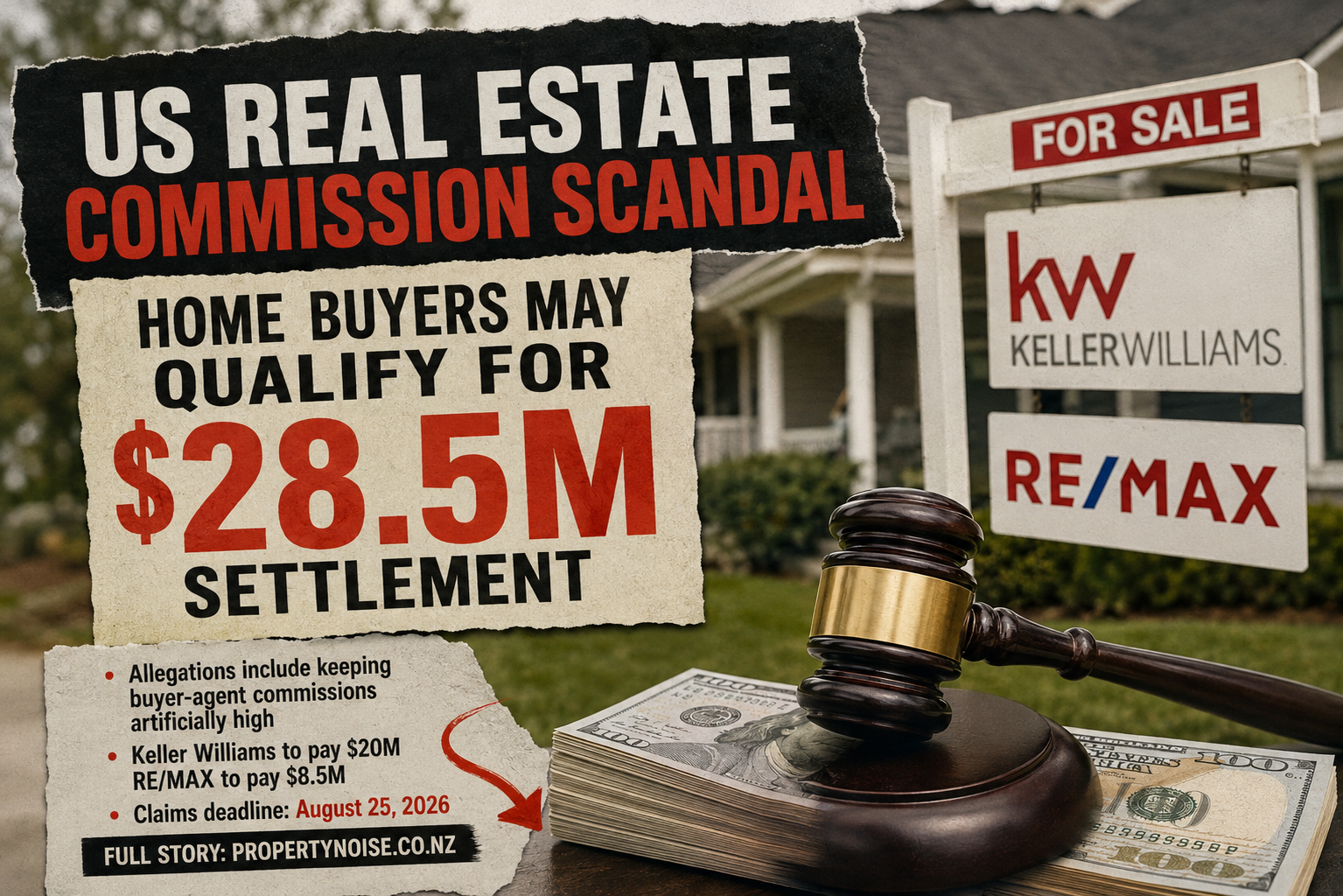
Keller Williams and RE/MAX have agreed to pay a combined US$28.5 million to settle claims alleging longstanding real estate commission practices restricted competition and helped keep buyer-agent commissions artificially high. Neither company admits wrongdoing — but the case is another major blow to the traditional American commission model.
For decades, American real estate operated under a system that most buyers probably never seriously questioned.
You found a house.
You had a buyer’s agent.
The seller had a listing agent.
And somewhere inside the transaction, commissions were paid.
It was simply how real estate worked.
But a succession of enormous antitrust lawsuits has forced Americans to ask a much more uncomfortable question:
What if the system itself helped keep those commissions higher than a genuinely competitive market would have?
That question is now costing some of America’s biggest real estate organisations hundreds of millions of dollars.
And this week, attention has turned to homebuyers.
A US federal court has given final approval to settlements involving two enormous names in American real estate: Keller Williams and RE/MAX.
Together, they will contribute:
US$28.5 MILLION
to resolve claims in what’s commonly known as the Batton homebuyer litigation.
Keller Williams is contributing US$20 million.
RE/MAX is contributing US$8.5 million.
Both companies deny wrongdoing, and settling the litigation does not constitute an admission that the allegations are true.
But eligible American homebuyers now have only days remaining to lodge claims.
The deadline is:
August 25, 2026.
So what exactly were the real estate companies accused of?
This is where the story gets interesting.
The plaintiffs alleged that major real estate companies and industry participants were involved in a system that reduced competition between buyer agents.
The allegation centres on how buyer-agent compensation traditionally operated within America’s Multiple Listing Service — or MLS — system.
For years, listing brokers could make offers of compensation to brokers representing buyers through an MLS.
The plaintiffs alleged these arrangements helped maintain buyer-broker commissions at artificially high levels.
They also alleged the system could encourage “steering” — where properties offering lower compensation to buyer agents might become less attractive to agents deciding which properties to show clients.
The companies dispute those allegations.
But the underlying question is explosive:
Was America’s supposedly competitive real estate market actually competitive when it came to commissions?
The US Department of Justice has itself been scrutinising competition in real estate brokerage for years. In December 2025, the DOJ said Americans had historically paid brokerage commissions of around 5% to 6%, which it described as two to three times rates in some other developed economies.
This isn’t actually the famous $1.8 billion case
This distinction is important because America’s real estate commission litigation has become extraordinarily complicated.
You may remember the massive Sitzer/Burnett case.
In 2023, a Missouri jury found against the National Association of Realtors and other defendants in litigation brought on behalf of home sellers.
The jury awarded nearly:
US$1.8 BILLION
in damages.
That case subsequently contributed to settlements worth more than US$1 billion involving NAR, major brokerages and other industry participants.
And just this week, the US Court of Appeals for the Eighth Circuit upheld that huge settlement framework despite objections from some class members.
But Batton is different.
This time, the people seeking compensation are buyers.
Sellers said they paid too much. Now buyers say they did too.
That’s what makes the wider commission scandal so fascinating.
The seller litigation essentially attacked the traditional commission system from one side of the transaction.
The Batton plaintiffs attacked it from the other.
Their argument was that buyers were also economically harmed by allegedly inflated buyer-agent commissions.
Why?
Because ultimately the money involved in purchasing a property has to come from somewhere.
If commission structures inflate the overall cost of a transaction, plaintiffs argue buyers can bear that cost through the price they pay for the property.
The Department of Justice has also taken the position in separate litigation that competition between real estate brokerages is critical to protecting buyers and that anticompetitive brokerage arrangements can potentially increase housing costs.
Who could actually receive some of the $28.5m?
The potential class is enormous.
According to the official settlement administrator, people may qualify if they purchased residential real estate in the United States during the applicable eligibility period and the property was listed on an MLS.
The qualifying start date varies between jurisdictions.
Some eligibility periods stretch back many years — the official settlement site asks consumers whether they purchased MLS-listed residential real estate in the US since 2006.
The relevant period ends on April 14, 2026.
And there’s another important detail.
If someone purchased multiple qualifying homes, they need to submit a separate claim for each property.
How much will each buyer receive?
Nobody knows yet.
And anyone expecting an enormous cheque should probably temper expectations.
The US$28.5m headline is the gross settlement fund, not an amount divided equally among homebuyers.
Before consumers receive money, deductions can include administration and notice costs, taxes, legal fees, litigation expenses and approved awards to class representatives.
The remaining net settlement fund will then be distributed according to a court-approved plan.
The ultimate amount available to an individual claimant will depend partly upon how many valid claims are made.
The official settlement administrator says final individual payments cannot be determined until the number of eligible valid claims is known.
The deadline is almost here
Eligible buyers wanting a payment have to act quickly.
Claims must be submitted electronically by:
11:59pm Central Time, Tuesday August 25, 2026
or mailed claims must be postmarked by August 25.
The official claims information is available through:
Home Buyer Class Action Litigation settlement website
Doing nothing means an eligible class member won’t receive settlement benefits while still being bound by the settlement releases if applicable.
Keller Williams: US$20 million
Keller Williams reached its settlement agreement with the plaintiffs on January 20, 2026.
It agreed to contribute:
US$20 million.
The settlement covers Keller Williams and relevant agents and franchisees against the covered claims.
Interestingly, reporting when the agreement was announced indicated the Batton settlement did not impose additional business-practice changes on Keller Williams.
The company had already been involved in the broader seller-side commission litigation and maintains its denial of wrongdoing.
RE/MAX: another US$8.5 million
RE/MAX reached its Batton settlement agreement on March 22, 2026.
Its contribution is:
US$8.5 million.
A subsequent filing with the US Securities and Exchange Commission confirmed the amount.
RE/MAX was explicit that settling was not an admission or concession of liability.
The company said it continued to deny the material allegations and elected to settle after considering the risks and costs associated with continuing litigation.
That’s an important distinction.
A settlement does not mean a court has concluded that RE/MAX committed the alleged conduct.
And now a judge has signed off
Earlier this month, US District Judge LaShonda Hunt granted final approval to the Keller Williams and RE/MAX agreements following a fairness hearing.
The court found the settlements fair and adequate.
Remarkably, according to reporting on the approval, there were no class-member objections or opt-outs recorded against these settlements.
With final approval granted, the claims against Keller Williams and RE/MAX covered by these agreements are dismissed.
The wider litigation involving other defendants, however, is another matter.
The companies are also cooperating
There’s another interesting component.
The official settlement information says Keller Williams and RE/MAX have agreed to cooperate with plaintiffs in the continuing litigation against remaining defendants.
That’s potentially significant.
Settlements in complex antitrust litigation aren’t always just about writing a cheque.
Cooperation from major industry participants can also assist plaintiffs as they pursue claims against others.
How did American real estate get here?
You have to go back further than Batton to understand how profound the change has been.
As early as 2020, the US Department of Justice brought an antitrust case against the National Association of Realtors.
The DOJ alleged that certain NAR rules illegally restrained competition.
Among the issues raised were transparency around buyer-broker compensation, claims that buyer-agent services were “free”, restrictions relating to filtering MLS listings based on compensation and other industry rules.
The government initially reached a proposed settlement with NAR.
Then something unusual happened.
In 2021, the Justice Department withdrew from its own settlement, saying it wanted to preserve its ability to investigate NAR more broadly.
That should have been a warning that the traditional American commission model was heading into serious trouble.
Then came the commission earthquake
Years of litigation culminated in the seller cases that fundamentally changed how US real estate operates.
Following NAR’s huge settlement, major rule changes came into effect on August 17, 2024.
One of the biggest:
Offers of buyer-agent compensation were prohibited from being displayed on MLS systems covered by the settlement changes.
That doesn’t mean sellers are prohibited from contributing towards buyer-agent compensation.
They can still negotiate arrangements away from the MLS.
But the traditional mechanism changed.
Another major reform requires agents working with buyers to enter into a written buyer agreement before touring a property, setting out matters including compensation.
Think about how fundamental that is
For decades, many American consumers effectively treated buyer representation as something bundled invisibly into the property transaction.
A buyer might think:
“My agent doesn’t cost me anything — the seller pays.”
But economists and antitrust plaintiffs questioned that assumption.
If the seller knows they must fund commissions from the transaction proceeds, isn’t that cost ultimately factored into the property’s economics?
And if buyer agents know what commission is being offered before deciding which listings to pursue, could that distort competition?
Those questions went from academic debates to:
jury verdicts, billion-dollar settlements and nationwide rule changes.
This scandal has already cost the industry more than $1 billion
The US$28.5m Batton settlements need to be viewed in that context.
This is not:
“RE/MAX and Keller Williams suddenly face a $28.5m commission problem.”
It is another component of a much larger reckoning.
The broader seller settlements approved in 2024 involved more than US$1 billion.
NAR itself agreed to pay US$418 million.
HomeServices of America agreed to US$250 million.
RE/MAX had previously agreed to a US$55 million settlement in the seller litigation before subsequently agreeing to another US$8.5m in Batton.
And the Eighth Circuit has now upheld the major seller settlement against an appeal.
The original jury verdict was nearly $1.8 BILLION
This is worth repeating because it demonstrates the scale of what happened.
In October 2023, the Missouri jury considering the Sitzer/Burnett case returned a verdict of approximately:
US$1.78 billion.
Because US antitrust damages can potentially be trebled, the theoretical exposure was considerably greater before settlements intervened.
That verdict sent shockwaves through American real estate.
The industry knew the traditional model could no longer simply be defended with:
“That’s how we’ve always done it.”
The US Justice Department still isn’t finished
Anyone assuming the settlements ended Washington’s interest in real estate commissions should think again.
As recently as December 2025, the Department of Justice intervened with a statement of interest in another homebuyer lawsuit.
Its language was striking.
The DOJ said competition among brokerages was crucial because buying a home is the largest purchase most Americans make.
It specifically highlighted America’s historically high commission rates and argued that trade-association rules capable of artificially inflating commissions deserved antitrust scrutiny.
So this story is far from over.
And here’s where New Zealand should pay attention
The American system is different from ours.
We shouldn’t lazily transplant US litigation onto New Zealand real estate and pretend the regulatory and commission structures are identical.
They’re not.
But there is one enormous lesson for every established real estate market:
Consumers are beginning to question what an agent is actually worth.
That conversation isn’t going away.
Technology has transformed almost everything else involved in selling a house.
Buyers find properties online.
Algorithms recommend listings.
Professional photography can be distributed globally within minutes.
Documents are signed electronically.
Automated valuation models estimate prices.
AI can produce property descriptions.
Social media reaches thousands of prospective buyers instantly.
Property portals aggregate enormous audiences.
Yet traditional percentage-based commission structures remain remarkably resilient.
Eventually consumers ask:
Why?
If a $2m house isn’t twice as hard to sell as a $1m house, why should the commission be twice as large?
That’s the uncomfortable mathematical question.
There are excellent agents worth every dollar they’re paid.
A brilliant negotiator can potentially generate substantially more for a vendor than their fee.
Great agents manage complex campaigns, solve problems, identify buyers and hold deals together.
But the industry cannot rely indefinitely on tradition as its explanation for pricing.
Consumers increasingly expect:
transparency.
negotiability.
choice.
And most importantly:
demonstrable value.
America has now learned how expensive the consequences can become when consumers and courts conclude competition may have been constrained.
$28.5 million is actually the smaller story
The headline says:
Homebuyers could share US$28.5 million.
But that’s not really the biggest story.
The bigger story is that one of the world’s most established real estate commission systems has been forced to change.
Major brands have paid enormous settlements.
NAR has paid hundreds of millions.
MLS compensation rules have changed.
Buyer agreements have changed.
The Justice Department remains interested.
Sellers have sued.
Buyers have sued.
And consumers are now being explicitly encouraged to understand and negotiate how their agents get paid.
That’s a cultural shift.
Could it happen elsewhere?
Absolutely.
Not necessarily through identical litigation.
Not necessarily tomorrow.
And certainly not because the American allegations automatically apply to other countries.
But consumers everywhere are becoming better informed.
They can compare agents.
Compare commissions.
Compare marketing.
Compare sales histories.
Compare reviews.
And increasingly ask an incredibly simple question:
“What exactly am I paying for?”
The real estate industry should welcome that question rather than fear it.
Because genuinely exceptional agents have a good answer.
Those relying mainly on an established commission structure may find the next decade considerably less comfortable.
America’s real estate establishment has received its warning
For decades, the commission system was deeply embedded in the machinery of American residential property.
Then consumers challenged it.
Lawyers challenged it.
Juries challenged it.
The Department of Justice challenged it.
And ultimately, the industry changed.
Now another US$28.5 million is being put on the table for eligible homebuyers.
Keller Williams and RE/MAX emphatically deny wrongdoing.
The court has not made a finding through these settlements that either company committed the alleged antitrust violations.
That needs to be stated clearly.
But the wider transformation is undeniable.
Real estate commissions are no longer something consumers are expected simply to accept because “that’s the way the industry works.”
And that may ultimately prove far more expensive — and far more important — than the US$28.5 million being distributed today.
SOURCE: USA TODAY