
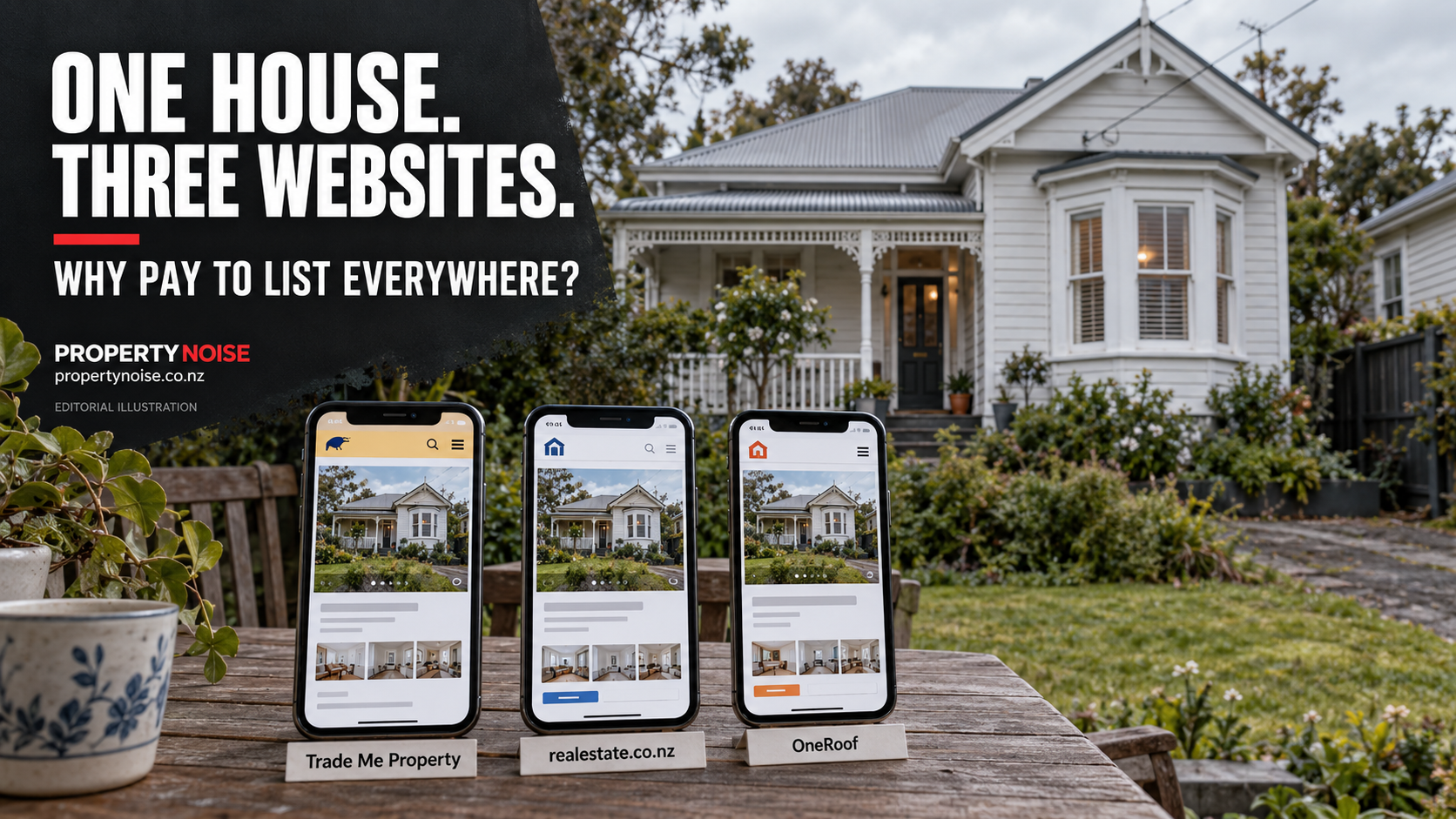
New Zealand homeowners can find themselves paying to promote the same house on realestate.co.nz, Trade Me Property and OneRoof. If the industry already has its own property portal, why does selling a home involve so many platforms — and could Google eventually change the equation?
PHOTO: When the same home appears on all three, are sellers reaching more buyers – or paying to reach the same people again?
One house. One set of photographs. One buyer needed.
Yet a property marketing proposal can contain several website packages, each promising visibility, reach and an advantage over competing listings.
For sellers, the obvious question is: are these platforms bringing different buyers, or are we paying repeatedly to reach the same people?
That is a fair question. Answering it requires separating the cost of being listed from the cost of being promoted — and separating platform prices from the marketing bill an agency presents.
Why not simply use realestate.co.nz?
There is a strong argument for making realestate.co.nz the centre of New Zealand property search.
It is an industry-owned platform, with ownership involving REINZ and Property Page Limited, which comprises Bayleys, Barfoot & Thompson, Harcourts, Ray White and LJ Hooker.
In its August 2026 anniversary report, the company said it had more than two million monthly users and had introduced AI-powered property search. Those are the platform’s own reported figures. realestate.co.nz
An established national portal, supported by the industry supplying its listings, clearly has a role.
But industry ownership does not mean every buyer starts there. Nor does it guarantee that one website will deliver the best result for every property.
A seller’s immediate concern is finding a buyer. Their agent must explain how the proposed advertising serves that goal, rather than simply promoting the platform the industry owns.
Why do multiple listing sites exist?
Property portals compete to attract two groups: people looking for homes and people paying to advertise them.
Their products overlap, but their routes to an audience differ.
Trade Me sits within a broader online marketplace. OneRoof combines property listings, estimates and editorial content within the NZME media network. Realestate.co.nz concentrates on property search.
NZME identifies OneRoof among its digital brands alongside the New Zealand Herald and other publications. That gives it a different distribution proposition from a standalone listing site. NZME Digital Brands
The commercial logic is straightforward: if a platform can deliver useful enquiries, it has something agents and sellers may pay for.
The harder question is whether each additional paid package delivers enough additional value.
Three platforms do not automatically mean three separate audiences. Equally, overlapping audiences do not mean that every additional listing is wasted.
What does Trade Me Property cost?
Trade Me has separate pricing for private sellers and agency accounts. Comparing them without that distinction can produce misleading conclusions.
Private-seller examples
Its public residential fee schedule lists these initial advertising prices:
| Property rating value | Bronze | Silver | Gold |
|---|---|---|---|
| $650,000–$799,000 | $999 | $1,499 | $1,799 |
| $800,000–$999,000 | $1,099 | $1,599 | $1,899 |
| $1 million–$1.199 million | $1,299 | $1,799 | $2,099 |
| $1.5 million or more | $1,499 | $2,299 | $2,699 |
These are published private-listing examples, not an agent’s campaign quote. Trade Me says Bronze relisting is free, while Silver and Gold relisting attracts reduced fees. It also notes that price testing can result in different offers. Trade Me
Agency-account examples
Trade Me’s 2026 agency price book, with residential rates dated December 1, 2025, shows a different structure:
| Agency product | Zone 1 | Zone 2 | Zone 3 | Zone 4 |
|---|---|---|---|---|
| Base listing | $299 | $249 | $249 | $199 |
| Silver partnership package, including base listing | $999 | $899 | $799 | $599 |
These residential prices include GST. Platinum partnership pricing varies by zone and expected sale-price band. The price book also lists an optional $199 Audience Boost addition. Trade Me Property
The lesson is simple: ask which account, zone and package applies to your property.
Property Noise examined earlier pricing concerns in Trade Me property listing fees are through the roof. That article dates from 2023, so its historical prices should not be used as today’s rate card.
What does realestate.co.nz cost?
Realestate.co.nz offers premium advertising packages, but there is no single figure that can fairly represent every agency, location and campaign.
A publicly accessible Regional Zone rate card, explicitly dated April 1, 2025, provides these residential and lifestyle examples:
| Regional premium package | Published price, including GST |
|---|---|
| Silver — four weeks | $649 |
| Gold — six weeks | $749 |
| Platinum — until sold | $1,149 |
The card lists a $249 Digital Exposure add-on for Silver and describes Digital Exposure as included in Gold. That promotion extends across Google Display, Facebook and Instagram. click.realestate.co.nz
These are dated regional advertising examples, not confirmed October 2026 prices or a complete agency subscription bill. Sellers should obtain the current rate applicable to their listing.
They also demonstrate why “it’s on realestate.co.nz” is an incomplete description. A standard listing and a premium campaign are different purchases.
What does OneRoof cost?
OneRoof offers listing promotion and campaign products, with sales contacts covering different regions.
However, a current, verifiable public residential price table was not available for this comparison. Its published contact page directs listing and upgrade enquiries to its team. oneroof.co.nz
That makes the agent’s itemised proposal particularly important.
Ask for the exact product name, duration, GST treatment and what appears on OneRoof versus any wider media placement.
A OneRoof listing, a paid placement and a campaign incorporating other advertising should not be treated as the same thing.
The real comparison is what your money buys
The three platforms’ figures cannot simply be added together to produce a universal “cost of selling online”.
Some prices concern private listings. Others concern agency partnerships or premium upgrades. Some agency selling models bundle marketing into their service.
For a seller, the useful comparison is:
What does this package cost me, what does it include, and why is it appropriate for this property?
That question sits alongside the commission debate explored in The $30,000-plus question: are real estate commissions still justified?.
It also matters when comparing traditional selling arrangements with challengers such as Arizto, examined here by Property Noise.
Why the industry cannot simply agree to abandon a competitor
Individual agencies can assess their advertising choices. An industry-wide agreement between competitors raises a different issue.
New Zealand already has relevant history.
In 2020, the Supreme Court upheld findings that Hamilton agencies and directors had engaged in price-fixing through an agreed response to Trade Me’s earlier pricing changes, centred on passing listing costs to vendors. Commerce Commission
The sensible debate is therefore about independent purchasing decisions, better evidence and clearer prices, rather than competitors collectively deciding how to restrict advertising or pass on costs.
Could Google change property search anyway?
Google is doing more than displaying links to property websites.
Its official documentation describes Home Listings Ads, which show properties for sale directly in Google Search, including photographs, prices, neighbourhood information and listing-agent details.
The format uses listings supplied through ComeHome, powered by HouseCanary, alongside promoted buyer’s agents. Local Services Help
In June 2026, HouseCanary announced a US-wide expansion of its Google home-discovery programme, following a pilot in eight markets. Listings come from participating American multiple listing services. housecanary.com
That is a genuine development. It is not evidence that a comparable service has launched in New Zealand. No confirmed NZ rollout was identified for this article.
If a similar model arrived here, Google could become a more important place where buyers first encounter homes.
But that would not necessarily eliminate advertising charges. It could move more of the competition for attention into another advertising system.
Sellers deserve evidence, not a shopping list of upgrades
There are reasonable arguments for using several platforms. There are also reasonable arguments for keeping a campaign focused.
What sellers should expect is an explanation.
Before authorising the marketing budget, ask:
- Which buyers is each platform expected to reach?
- Which listings are included, and which paid upgrades are optional?
- What did comparable campaigns generate in enquiries and inspections?
- What happens when the initial promotion expires?
- How will results be reported?
A large viewing count can be encouraging. A qualified enquiry or inspection is more useful evidence of progress.
New Zealand does not necessarily need fewer property websites. It needs a clearer account of why sellers should pay for each one.