
A property sale every week? Every fortnight? For New Zealand’s real estate industry, the national figures point to a much smaller pool of transactions per salesperson—but calculating the true average requires care.
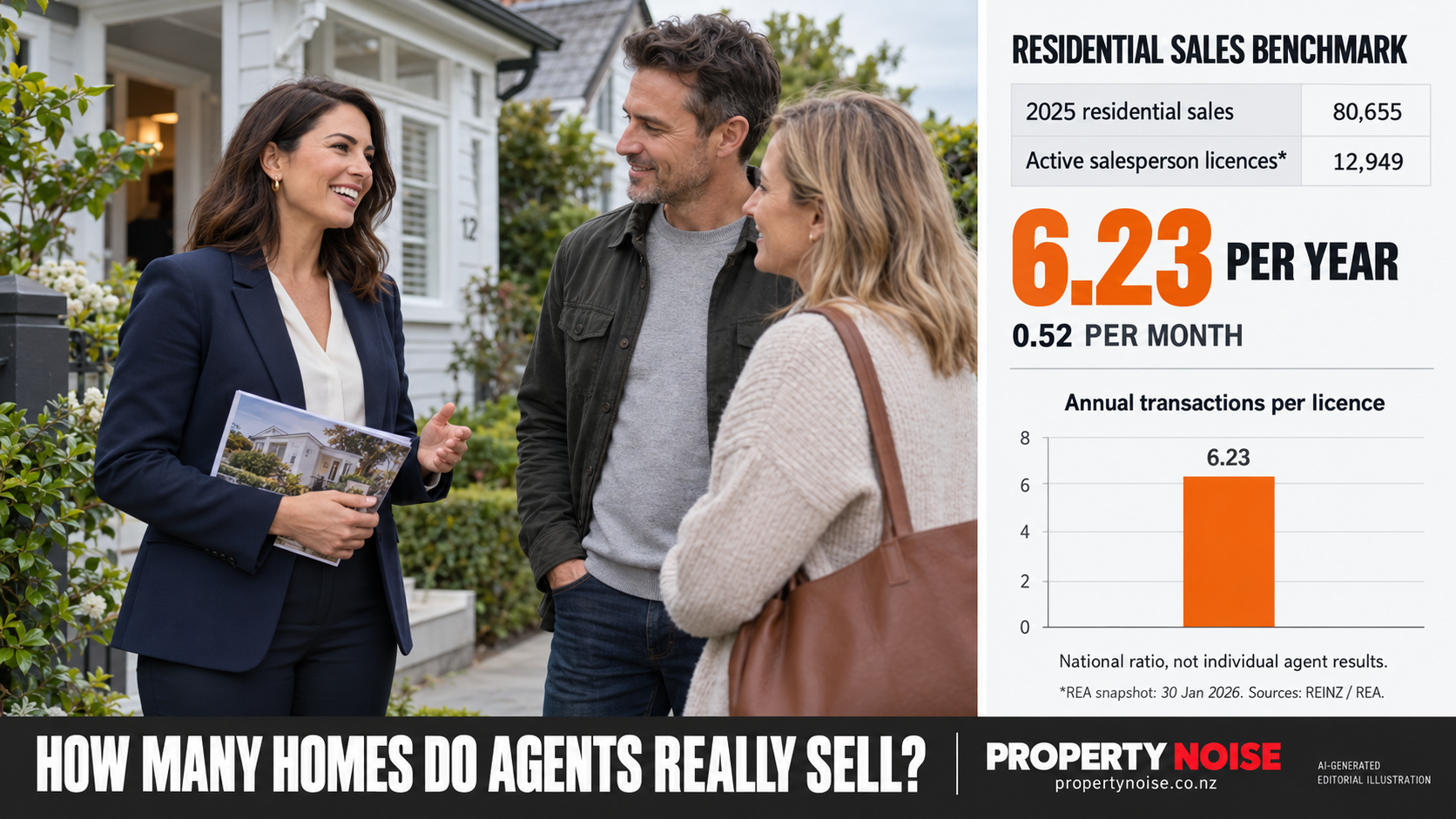
PHOTO: National figures suggest roughly six residential transactions annually per active salesperson licence—a benchmark that masks differences between agents, teams and sectors. Image: AI-generated illustration / Property Noise.
The public often sees real estate through its biggest success stories: award-winning agents, impressive sales boards and million-dollar deals.
What is harder to see is how much business is available to the thousands of other people licensed to sell property.
So, how many sales does the average NZ real estate agent make per year—or per month?
Comparing REINZ’s annual residential sales total with the Real Estate Authority’s published active salesperson count produces a rough benchmark of 6.2 residential transactions per salesperson licence per year, equivalent to 0.52 per month.
That is roughly one transaction every two months.
However, this is a national market-to-licence ratio. It is not a verified average of individual residential agents’ sales, and it cannot be applied directly to rural specialists.
Here is what the figures show—and what they leave unanswered.
THE STARTING POINT: HOW MANY HOMES ACTUALLY SELL?
According to REINZ’s review of the 2025 property market, New Zealand recorded 80,655 residential sales during 2025, up 10.3% from 2024.
That works out to approximately 6,721 residential transactions a month across the country.
These are completed sales recorded in the REINZ series. They are different from new listings, properties advertised online or the number of “sold” posts appearing on social media. reinz.co.nz
For this analysis, 2025 provides a complete calendar year. A quieter month in 2026 can help illustrate changing conditions, but it should not be presented as a full-year result.
HOW MANY ACTIVE REAL ESTATE SALESPEOPLE ARE THERE?
The REA licensing statistics page displays the following active licence counts, dated 30 January 2026:
| Licence category | Active licences |
|---|---|
| Salesperson | 12,949 |
| Branch manager | 618 |
| Individual agent | 1,899 |
| Company | 839 |
| Total | 16,305 |
These categories matter. The total includes company licences, so 16,305 cannot be described as 16,305 individual salespeople.
REA distinguishes between salespeople, branch managers and agents. Its public register allows consumers to check a professional’s licence status. An active licence establishes licensing status; it does not tell a seller how many properties that person has sold. The Real Estate Authority
THE CALCULATION: ABOUT SIX TRANSACTIONS A YEAR
Using the published figures:
80,655 residential sales ÷ 12,949 active salesperson licences = 6.23 transactions per licence per year.
Dividing that result by 12 gives a monthly equivalent of 0.52.
| National benchmark | Result |
|---|---|
| REINZ residential sales, calendar 2025 | 80,655 |
| Active salesperson licences, 30 January 2026 | 12,949 |
| Residential transactions per salesperson licence annually | 6.23 |
| Monthly equivalent | 0.52 |
Calculations by Property Noise using REINZ and REA figures. The licence count is a snapshot shortly after the sales year, rather than the average workforce throughout 2025. reinz.co.nz
This comparison helps explain why the industry can feel crowded even when tens of thousands of homes change hands.
But it does not establish that the typical residential agent personally sells six houses annually.
WHY THIS IS NOT THE TRUE AVERAGE FOR RESIDENTIAL AGENTS
There are several reasons the simple calculation needs qualification.
The workforce covers several sectors. The salesperson total is not restricted to residential specialists. It can include people working in rural property, commercial transactions, leasing and business broking.
Some agents and branch managers also sell property. Their transactions can appear in residential sales totals, although those people are excluded from the salesperson-only denominator.
A sale may involve several professionals. Listing agents, buyer-introducing agents, co-agents and team members can contribute to one transaction. Counting their individual involvement is different from counting unique properties sold.
A licence snapshot is not a full-year workforce measure. People join, leave, suspend their licences or work for only part of the year.
An average does not reveal the middle of the market. Establishing the median agent’s annual sales would require individual transaction records and consistent rules for allocating shared sales.
These issues can push the calculation in different directions. There is no defensible adjustment that turns the national ratio into an exact residential-agent average.
Property Noise previously explored the pressure behind these figures in Too many agents, not enough sales? The numbers behind NZ real estate’s brutal 2026.
WHAT IF WE INCLUDE ALL INDIVIDUAL LICENCE CATEGORIES?
Adding active salespeople, branch managers and individual agents produces a broader pool of 15,466 individual licences, excluding companies.
Dividing the same residential sales total by that pool produces approximately 5.21 transactions per individual licence annually, or 0.43 per month.
This is another benchmark—not a better estimate of a residential specialist’s performance. It includes supervisors, business owners and people working outside residential sales. reinz.co.nz
The useful finding is that the denominator changes the answer substantially. Any claim about “average agent sales” should explain exactly who has been counted.
WHAT DOES THE SLOWER 2026 MARKET SHOW?
REINZ recorded 5,430 residential sales in August 2026, down 13% from August 2025. Properties took a median of 51 days to sell, three days longer than a year earlier. reinz.imiscloud.com
For comparison, dividing August’s sales by the January salesperson snapshot produces 0.42 transactions per licence for that month.
That calculation uses an older workforce snapshot. It is an illustration of transaction availability, not an exact August agent average or a forecast for the rest of 2026.
Nevertheless, the commercial implication is clear: when fewer properties sell, there are fewer transactions available to generate commissions.
Longer campaigns can also require more follow-up, inspections and negotiation before a successful sale.
For the wider industry context, read Do we have too many real estate agencies in New Zealand?.
WHAT ABOUT RURAL AND LIFESTYLE AGENTS?
Rural agents need a separate analysis.
Selling a suburban house, a lifestyle block and a working dairy farm involves different buyers, transaction values and due diligence.
REINZ’s report for the 12 months to June 2026 showed dairy sales activity increasing 48%, finishing farm activity rising 23% and dairy support activity increasing 19%. Lifestyle growth was more modest, while grazing activity eased.
Median dairy-farm selling time fell from 116 days to 91 days. reinz.co.nz
Those figures demonstrate why a residential downturn should not automatically be described as a downturn for every rural specialist.
However, the public sources reviewed do not establish a reliable national average of annual sales per active rural agent.
That calculation would require:
- A clearly defined annual rural or lifestyle transaction total.
- A matching count of professionals actively selling in that sector.
- Rules for agents who work across residential, lifestyle and rural property.
- Consistent treatment of team sales and shared transactions.
Dividing farm sales by every licensed salesperson in New Zealand would produce a misleading result.
Likewise, residential, lifestyle and rural totals should not simply be added together without confirming their definitions and checking for overlap.
SIX SALES DOES NOT MEAN SIX FULL COMMISSIONS IN ONE PERSON’S POCKET
Even where an individual completes six sales, their earnings cannot be calculated by multiplying six by the commission charged to each vendor.
The vendor’s fee is agency revenue. The salesperson’s share depends on their agreement, any shared sale arrangements and applicable costs.
For illustration, suppose an agency receives $20,000 excluding GST from a transaction and the salesperson receives an assumed 50% share.
That would leave $10,000 before the salesperson’s own expenses and income tax. Six identical transactions would produce $60,000 on those assumptions.
This is an example—not a published average commission, commission split or agent income.
The distinction matters when discussing whether selling property is highly lucrative. Transaction volume, fee levels and the amount retained by an individual are separate questions.
Property Noise examines the vendor’s side of that debate in NZ real estate’s $20,000 question: are agents still worth the commission?.
WHAT SELLERS SHOULD ASK THEIR AGENT
The national ratio is useful context. An agent’s relevant local results are more useful when choosing who should sell your property.
Ask:
- How many unique properties have you personally sold in the past 12 months?
- How many were comparable to mine in location, price and property type?
- Are those your results, your team’s results or the whole office’s results?
- Were you the listing agent, a co-agent or the person who introduced the buyer?
- How many listings did you take on that did not sell?
- Who will handle my campaign, and how many listings are they managing now?
Sales volume alone does not establish service quality or negotiating ability. These questions help make the figures comparable and clarify who will do the work.
Advertising deserves the same scrutiny. Read One house, three websites: why are Kiwi sellers paying to advertise the same property everywhere?.
SO, HOW MANY SALES DOES THE AVERAGE NZ AGENT MAKE?
The available official figures support a rough residential market benchmark of 6.2 transactions annually per active salesperson licence, using 2025 sales and REA’s January 2026 snapshot.
They do not establish the true average or median sales performance of residential specialists, and they do not provide a verified rural-agent average.
For sellers, that makes one question especially valuable:
“Show me your own comparable sales from the past 12 months—and explain your role in each one.”
Methodology: Research checked 5 October 2026. Calculations use published national aggregates, not individual agent transaction records. REA’s displayed licensing statistics are dated 30 January 2026. Annual and monthly periods are labelled separately.