
PROPERTY NOISE | BUSINESS & COMMERCIAL PROPERTY
New Zealand’s next grocery challenger is planning to take its business from customers’ doorsteps to their neighbourhoods.
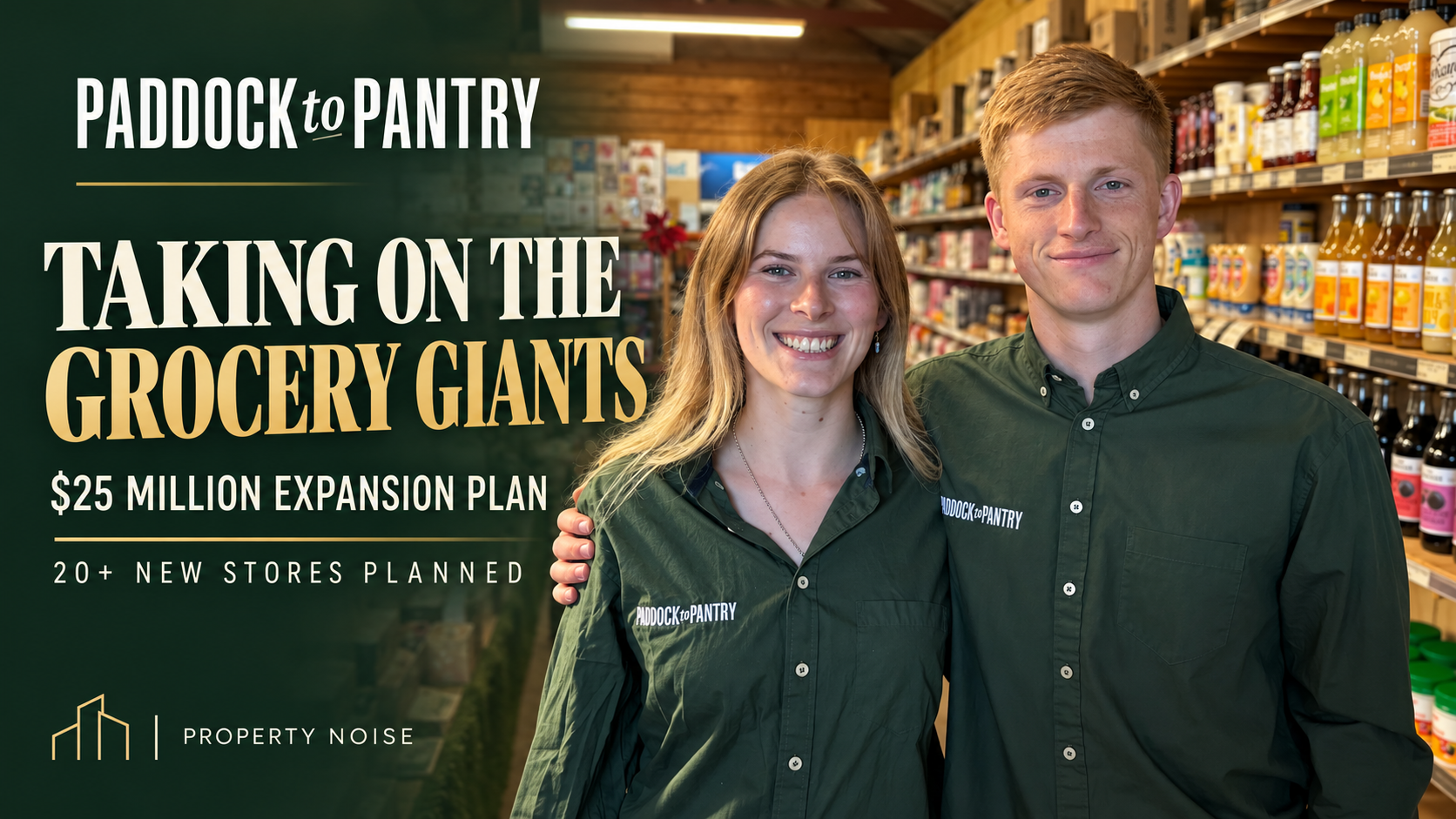
Family-owned Paddock to Pantry plans a $25 million expansion, opening more than 20 stores over the next five years and targeting communities with limited supermarket choice.
The proposal, outlined in the supplied news report, includes new shops, a distribution centre and a larger delivery fleet. The company says the expansion could eventually create up to 1000 jobs across retail, warehousing, transport and distribution.
For shoppers, the promise is another place to buy groceries. For the property sector, it represents potential demand for retail premises and logistics space.
But turning an online grocery business into a substantial store network is a demanding undertaking. The real test will be whether Paddock to Pantry can secure suitable sites, offer competitive prices and keep customers coming back.
PADDOCK TO PANTRY EXPANSION: WHAT IS PLANNED?
The company intends to open roughly one new store every three months.
Its first new outlet is scheduled for Kinloch, near Taupō, in December, with East Coast and South Auckland locations expected to follow early next year.
According to the supplied report, a licensing application lodged with Taupō District Council identifies 140 Kenrigg Road, Kinloch, as the proposed grocery-store location. An application indicates the company’s intentions; it does not establish that every approval has been granted.
The announced programme includes:
| Part of the expansion | Company’s stated plan |
|---|---|
| Total investment | Approximately $25 million |
| Store rollout | More than 20 openings over five years |
| New-store spending | Approximately $10 million |
| Store sizes | Around 500–1800 square metres |
| Distribution | A proposed 5000-square-metre centre |
| Transport | An expanded delivery fleet |
| Employment | Potentially up to 1000 jobs across the expanded operation |
These are expansion targets, rather than completed investments or jobs already created.
WHO IS BEHIND PADDOCK TO PANTRY?
Paddock to Pantry sits within a broader family grocery and delivery operation.
An NZ Post business profile identifies Wayne Kennerley as the founder of Kennerley Gourmet Grocery, which began in 2018 with a small rural grocery store. The operation subsequently developed into a group including Paddock to Pantry, The Meat Box, Celebration Box and The Wild Rose.
In the supplied expansion report, John Kennerley describes himself as a Paddock to Pantry co-founder and business manager of both Paddock to Pantry and The Meat Box.
That background matters. This is an existing operator seeking to expand its reach, with experience selling groceries online and delivering products to customers.
Its next step is to make physical stores a much larger part of the business.
FROM ONLINE GROCER TO A NETWORK OF LOCAL STORES
Paddock to Pantry says approximately 90% of its current sales come through e-commerce. Within five years, it expects that proportion to fall to about a third as its store network grows.
That would be a substantial shift in its sales mix.
Online retail allows a business to serve customers beyond the immediate neighbourhood of a shop. Physical stores offer something different: visibility, convenient top-up shopping and the opportunity for customers to browse fresh products in person.
Combining the two could give Paddock to Pantry more ways to reach households.
It also introduces additional costs. Store premises, fit-outs, refrigeration, staffing and stock must earn their keep. Opening a shop is only the beginning; building reliable local demand is what determines whether it works.
WHY SMALLER COMMUNITIES ARE CENTRAL TO THE STRATEGY
John Kennerley says the company is targeting communities with limited supermarket choice and ultimately wants Paddock to Pantry to become New Zealand’s third-largest grocery retailer.
The first part of that ambition addresses a problem identified by the Commerce Commission.
In its August 2025 grocery report, the commission said smaller towns and rural communities often had little local choice. Some stores effectively operated as local monopolies. The major supermarket groups held 82% of the national market, according to that report.
A national market-share figure does not capture every household’s experience. What matters to an individual shopper is which stores they can realistically reach—and what those stores charge.
A new local operator could provide a useful alternative. Whether it delivers meaningful savings will depend on its prices, product range and availability.
THE PROPERTY CHALLENGE BEHIND THE GROCERY CHALLENGE
Every new outlet needs a workable location.
For a grocery store, that means more than finding an empty building. Customer access, parking, delivery access, storage, refrigeration and the surrounding population all influence whether a site makes commercial sense.
The proposed range of 500–1800 square metres suggests Paddock to Pantry intends to use different store formats rather than one standard footprint.
From a property perspective, that could broaden the types of premises it considers. However, the supplied announcement does not identify the full site pipeline or say which locations would be leased, purchased or newly developed.
Property Noise has previously covered how securing supermarket sites becomes a story in its own right, including Woolworths’ historical approval to acquire residential land for supermarket facilities.
Earlier coverage of the Awapuni supermarket development in Palmerston North also illustrates how planning and development negotiations can shape when a store becomes possible.
Those are historical examples, rather than evidence of obstacles at Paddock to Pantry’s proposed sites.
WHAT COULD NEW STORES MEAN FOR LOCAL PROPERTY?
A grocery store can make a neighbourhood more convenient by reducing the distance residents travel for everyday essentials.
It may also attract regular visits that benefit neighbouring businesses.
That connection between housing and services appears in Property Noise’s coverage of a proposed development that could add 3000 homes near Kerikeri, where plans included a supermarket alongside other community facilities.
However, there is no evidence in the supplied expansion announcement that a Paddock to Pantry opening would produce a particular increase in nearby house prices.
The immediate property story is the potential for new commercial activity and improved access to services. Any effect on residential values would depend on the location and wider market.
MORE STORES ARE WELCOME—BUT THE CHECKOUT WILL DECIDE
Paddock to Pantry’s expansion is an ambitious attempt to turn an established online operation into a larger physical grocery business.
It could give underserved communities another shopping option while creating opportunities for suppliers, employees and commercial property owners.
The crucial question is what shoppers receive once the doors open.
More grocery competition needs to show up in the weekly shopping bill, the quality of the products and the convenience of getting them.
Paddock to Pantry has set out its ambition. Delivering more than 20 stores—and making each one a sustainable alternative—is the next challenge.
Source: Supplied news report, with additional background from NZ Post Business IQ and the Commerce Commission. Investment, store-opening and employment figures are company plans and projections.