

New Zealand residential property is worth an estimated $1.66 trillion — yet that enormous pool of wealth is sitting inside a housing market still struggling for momentum.
Cotality’s latest figures put the country’s residential real estate across 1.74 million dwellings, accounting for almost half of household assets.
But the size of the market tells a different story from its recent performance. Property values are edging lower, sales are running behind last year and buyers continue to have considerable choice.
For homeowners waiting for a convincing recovery in NZ house prices, the message is clear: a valuable asset base does not automatically create a rising market.
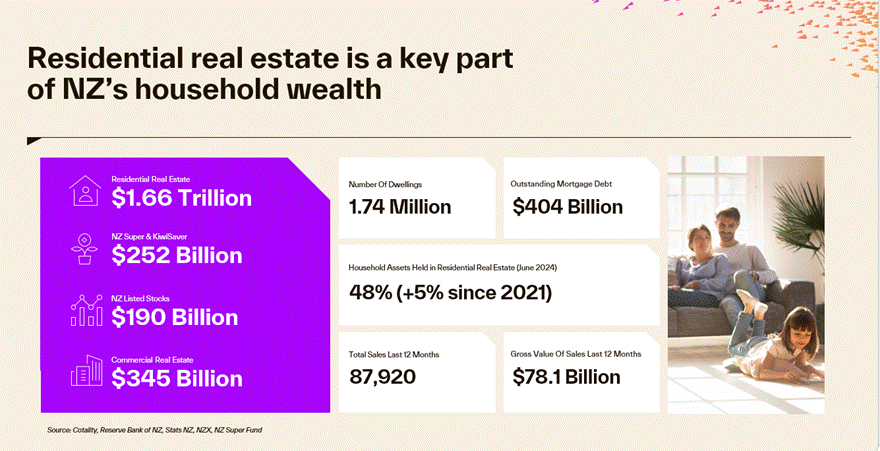
How much is New Zealand residential property worth?
The figures supplied by Cotality show just how heavily housing features in New Zealand’s financial landscape.
| Measure | Reported value |
|---|---|
| Total residential property value | $1.66 trillion |
| Residential dwellings | 1.74 million |
| Commercial real estate value | $345 billion |
| NZ Super and KiwiSaver holdings | $252 billion |
| Listed stocks | $190 billion |
| Outstanding mortgage debt | $404 billion |
| Residential property sold over the past 12 months | $78.1 billion |
| Property sales over the past 12 months | 87,920 |
Residential property dwarfs each of the other asset categories shown. However, these comparisons describe different asset pools; they should not be treated as interchangeable measures of household investment or net wealth.
The $1.66 trillion headline is also a gross property valuation, rather than cash available to homeowners. Mortgage debt remains a substantial part of the picture.
Why small house-price movements matter so much
When housing represents such a large share of assets, relatively modest percentage changes can have significant implications.
For illustration, 1% of $1.66 trillion is $16.6 billion. That is a simple calculation showing the scale involved, not a forecast or an estimate of losses already incurred.
Changes in estimated property wealth also do not require a transaction. A household can remain in the same home while its balance sheet changes around it.
Property Noise previously explored this distinction in its report on NZ household wealth falling $8.4 billion as land values declined. That report covered a separate statistical release, but reinforces why property movements matter beyond the immediate buying and selling market.
NZ property values remain more than 18% below their peak
According to the supplied Cotality update, national property values fell 1.3% over the year to September, with a 1.3% decline over the three months to September.
These are separate comparisons over overlapping periods and should not be added together.
National values remain more than 18% below their previous peak.
Cotality Chief Property Economist Kelvin Davidson describes a cautious environment in which the market’s scale should not be mistaken for strength.
“But scale shouldn’t be confused with momentum.”
That distinction matters. A housing market can hold enormous accumulated wealth while generating limited price growth and fewer transactions.
Auckland falls while Christchurch moves higher
The national result also conceals a substantial difference between two major centres.
| Market | Annual property-value change to September |
|---|---|
| New Zealand | −1.3% |
| Auckland | −3.2% |
| Christchurch | +3.4% |
Christchurch’s annual increase contrasts with Auckland’s decline, showing why a national headline cannot describe every homeowner’s experience.
The difference between those two annual growth rates is 6.6 percentage points. It does not mean Christchurch homes are more expensive than Auckland homes; it measures how values changed over the period.
For buyers and sellers, recent evidence from comparable local properties remains more useful than assuming the national trend applies uniformly.
September sales fall as buyers retain negotiating room
Cotality reports 6,519 property transactions in September, approximately 14% fewer than a year earlier.
It was the ninth consecutive month of year-on-year sales declines.
Alongside elevated available stock, that points to a market where purchasers can compare options and negotiate.
However, Davidson also says most vendors are not being forced to sell. That helps explain why softer demand has not translated into a faster nationwide decline: sellers who can wait may resist offers below their expectations.
Property Noise’s earlier analysis of how New Zealand’s housing market has changed despite relatively flat asking prices examined the importance of buyer choice and competing listings. Asking prices and property-value indices measure different things, but both help explain the negotiating environment.
Mortgage rates present another hurdle
The supplied update puts September’s special fixed mortgage rates at:
- One year: 4.97%
- Two years: 5.27%
These compare with an average 4.80% rate being paid on existing fixed mortgages.
That comparison is relevant to the refinancing outlook, although an advertised special rate is not the rate every borrower will receive. An individual household’s outcome depends on its existing loan and the terms available when it refixes.
The figures nevertheless complicate the idea that mortgage costs will automatically provide the next lift in housing demand.
Can the OCR or election change the outlook?
Interest-rate decisions and election policies remain important points of attention.
In the supplied commentary, Davidson highlights Labour’s commitment to full interest deductibility and ACT’s proposal to remove property-loss ring-fencing as developments some prospective investors may welcome.
Those are policy positions discussed in the release, rather than a guarantee of future settings or an immediate change in investor returns.
Nor would a more favourable tax position, by itself, establish another property boom. Purchase prices, rents, borrowing costs, maintenance and other expenses would still shape an investment’s performance.
Property Noise’s take: a wealth giant waiting for momentum
The most revealing part of this release is the gap between what New Zealand housing is worth and how actively the market is moving.
A $1.66 trillion valuation shows housing’s importance. Falling values and weaker sales show that importance has not yet translated into renewed momentum.
For sellers, the challenge is attracting buyers in a market with alternatives. For buyers, greater choice creates room to negotiate, without guaranteeing a bargain or identifying the bottom of the cycle.
The evidence presented by Cotality points to consolidation rather than a broad upswing. A stronger recovery would need to become visible in transactions, buyer demand and sustained local price movements.
Until then, New Zealand’s housing wealth remains enormous — and its recovery remains unfinished.
Source: Supplied Cotality market commentary and figures covering September 2026. Additional calculations and analysis by Property Noise. Asset valuations, sales totals and mortgage-rate measures describe different aspects of the market and should be interpreted separately.