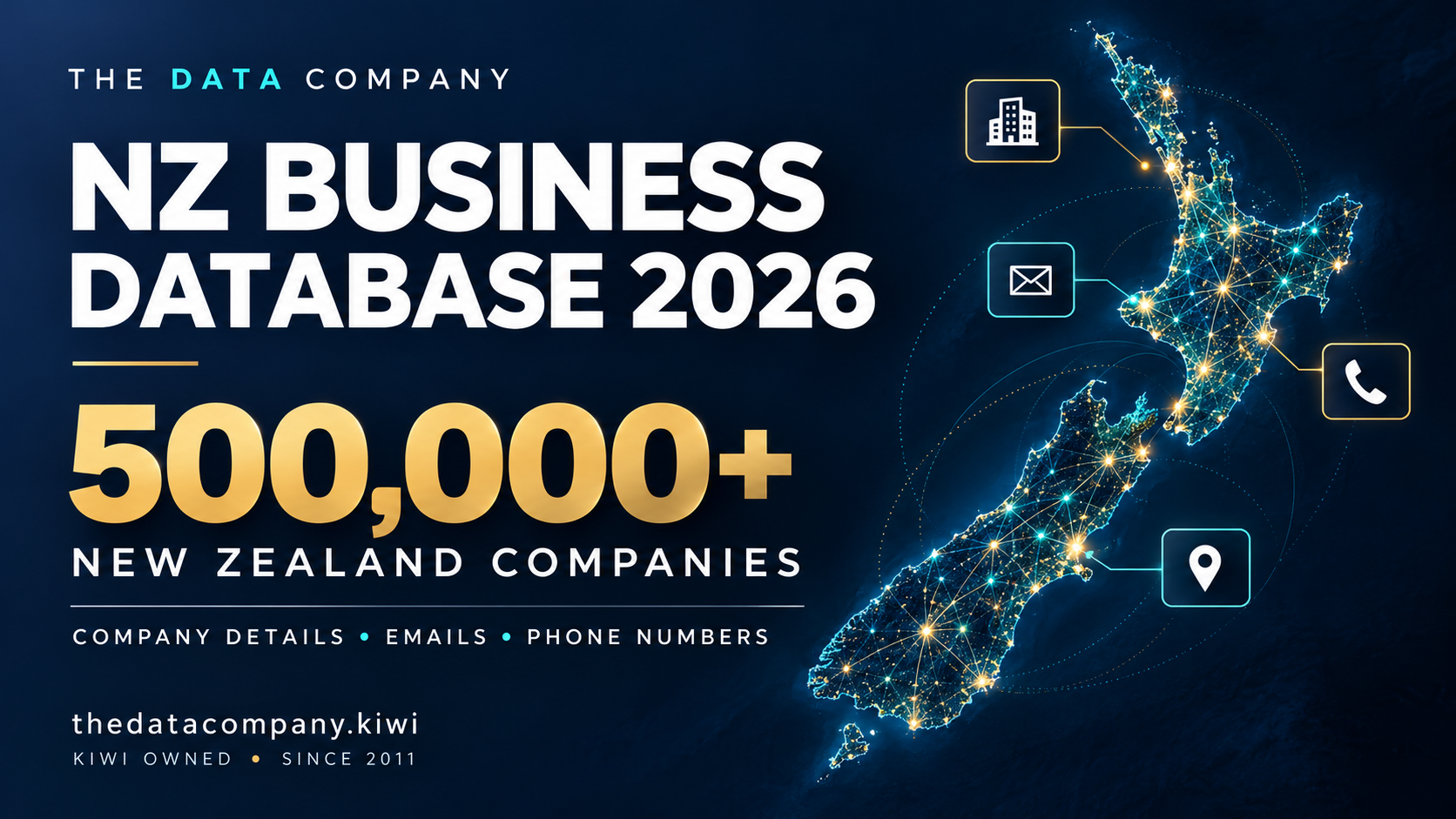
Finding your next customer starts with knowing who to approach. The Data Company’s NZ Business Database 2026 brings company information, industry categories and available contact details together to help businesses prospect with greater focus.
Whether you supply local trades, work with professional firms or sell to businesses nationwide, building a prospect list from scratch takes time.
Searching individual websites, copying details and organising information can consume hours before the first meaningful conversation begins.
The NZ Business Database 2026 from The Data Company offers a practical starting point: an organised resource covering more than 500,000 New Zealand companies, with fields that help users identify relevant businesses and plan their next steps.


WHAT DOES THE NZ BUSINESS DATABASE 2026 CONTAIN?
The Data Company’s published product information lists:
- 500,000+ New Zealand companies, with company names and industry categorisation.
- 500,000+ business contact names.
- 175,000+ business email addresses, described by the provider as verified.
- 100,000+ business mobile numbers.
The database’s listed fields include:
| Business information | Contact information | Location and identification |
|---|---|---|
| Business name | Contact name and surname | Street address |
| Business type | Email address | City and region |
| Classification code | Mobile number | Postcode |
| Type and status | Landline number | NZBN |
| Registration information | Website | Company ID |
Availability varies by record. A database containing email and mobile fields does not mean every business has both.
For the current edition, available counts and the fields relevant to your requirements, request a database count and quote.
WHY AN ORGANISED BUSINESS CONTACT LIST MATTERS
The value of a business database goes beyond its headline size.
A useful list helps you answer practical questions: Which businesses fit our service? Where are they located? Which prospects should we research first? What information do we already hold?
For example, a commercial cleaning provider could begin by identifying suitable business categories within its service area. A supplier of engineering products could build a research list around relevant industries. A training provider could organise prospective business customers by location.
These are examples of how structured data can support planning. They are not promises that every category or requested contact field will be available.
The advantage is having a clearer starting point for your own research, qualification and relationship building.
SPEND MORE TIME ON RELEVANT PROSPECTS
A large list becomes more useful when you narrow your priorities.
Rather than approaching every business in the same way, start with the customers you serve best. Consider their industry, location, likely requirements and the problem your service solves.
Then organise a manageable group of prospects for further checking.
That approach can help a sales team prepare more relevant conversations and avoid spending time researching businesses outside its market.
It also makes follow-up easier to manage. Recording outcomes, correcting details and removing unsuitable contacts gradually creates a working resource shaped around your business.
A purchased database provides the foundation. Your team’s knowledge makes it more valuable over time.
NATIONAL COVERAGE OR A MORE FOCUSED REQUIREMENT
Some businesses need a broad view of the New Zealand market. Others want to concentrate on a particular region or industry.
The Data Company offers complete national databases and targeted-list options, subject to available coverage.
For a growing business, the right scope depends on its capacity. A nationwide supplier may have a reason to research multiple regions, while a local operator may benefit from a tightly defined service area.
Before ordering, explain who you want to reach and where. That allows the available records and suitable supply options to be confirmed.
EXCEL AND CSV DELIVERY FOR PRACTICAL USE
The Data Company supplies data electronically in Excel or CSV format.
That makes it possible to sort, filter and organise records using familiar spreadsheet tools. CSV files can also support imports into compatible business systems, subject to their field requirements.
Before importing a large list, check your destination system’s requirements, map the fields carefully and review duplicates against existing records.
It is worth keeping the original delivery separate from your working version. That way, your team can track its own changes, notes and corrections clearly.
KIWI OWNED AND SERVING CLIENTS SINCE 2011
Established in 2011, The Data Company supplies business, residential, rural and specialist contact datasets across New Zealand and Australia.
Its range gives customers a way to discuss different prospecting requirements with one provider.
You can learn more about the service on Why Use The Data Company?.
For this product, the focus is straightforward: helping users access organised NZ company information without having to assemble an entire business contact list themselves.
KEEP YOUR DATA USE RELEVANT AND RESPONSIBLE
Good prospecting involves more than obtaining contact details.
Check that the intended use is appropriate, keep information secure and maintain accurate records of corrections and opt-outs. Buying a database does not automatically provide permission to send unsolicited commercial emails.
Review The Data Company’s privacy and compliance statement and terms and conditions before ordering or starting a campaign.
Business information also changes. Staff move, companies restructure and contact details become outdated. Confirm important details before relying on them.
GET YOUR NZ BUSINESS DATABASE 2026 QUOTE
A stronger prospecting process starts with a clear picture of your market.
The NZ Business Database 2026 brings scale and structure together, giving businesses a substantial resource for research, planning and identifying potential customers.
To get started, tell The Data Company:
- Which industries interest you.
- Which locations you cover.
- Which contact fields matter most.
- Whether you need nationwide coverage or a focused list.
Request your NZ Business Database count and quote here.
The Data Company — proudly Kiwi owned and serving clients since 2011.