
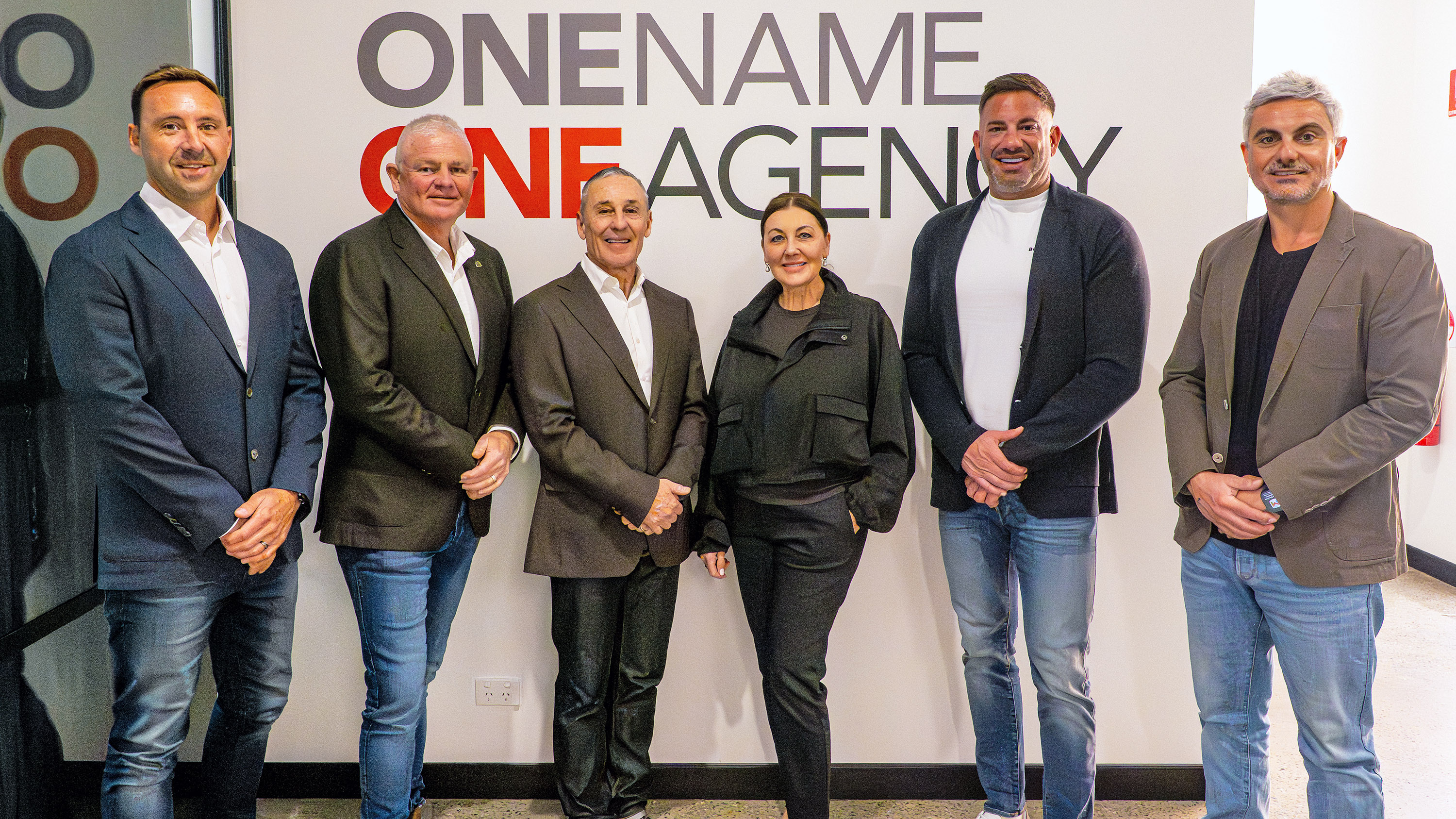
PHOTO: Pictured L-R_Aaron Blackburn, Mark Stewart … Davies, Matthew Crockett, Adam Martin.
ONE AGENCY ENTERS A NEW ERA: Ownership Passes From Founders to Four Insiders
After almost two decades building One Agency into an international network of more than 120 independent real estate businesses, founders Paul and Annie Davies are handing ownership to four people who already know the model from the inside.
One Agency is entering a significant new chapter, with ownership of the international real estate network passing from founders Paul and Annie Davies to four longstanding members of the group.
Mark Stewart, Matthew Crockett, Aaron Blackburn and Adam Martin will become the new custodians of One Agency, with Stewart appointed CEO.
It’s more than simply a change at the top.
The four incoming owners have spent almost a decade operating within One Agency themselves, building a successful multi-office real estate business since joining the network in 2017.
Now they’re taking control of the wider international brand.
THE BATTLE FOR #1: Who Will Be New Zealand’s Top Real Estate Agency?
From One Agency members to One Agency owners
For a network built around giving independent real estate operators greater control over their businesses, there is a certain symmetry to the deal.
The people buying One Agency are products of the One Agency model themselves.
Founder Paul Davies said that was central to the decision about who should take the network forward.
“Mark, Matthew, Aaron and Adam know One Agency because they have lived it.”
Davies said the four had built their own success within the network and understood the freedom and independence the model was designed to provide.
That matters because One Agency has deliberately positioned itself differently from the traditional real estate franchise.
Rather than an agency paying the conventional percentage-based franchise fees that can increase as an office’s turnover grows, One Agency operates a flat-fee model, allowing independently owned businesses to operate under the international brand while retaining greater control over their own operations and economics.
And the incoming owners say that isn’t about to change.
120+ businesses across four countries
The transition comes after almost two decades of growth under Davies.
One Agency has expanded to more than 120 independent real estate businesses operating across four countries.
That’s a substantial legacy for Davies, whose own involvement in real estate stretches back more than 50 years.
He established One Agency as an alternative to the conventional franchise model — based on the idea that successful real estate operators should be able to leverage a larger brand without surrendering much of the independence that helped make them successful in the first place.
Davies said:
“Good real estate operators should have the opportunity to build successful and profitable businesses on their own terms.”
That philosophy will remain at the heart of the group under its new owners.
What ISN’T changing?
For existing One Agency members, this may be the most important part of today’s announcement.
The flat-fee model stays.
Member independence stays.
The fundamental One Agency proposition stays.
Stewart says the new owners see themselves as custodians rather than reinventors of the brand.
“We have benefited from this model ourselves for almost a decade, so we understand exactly why independence, autonomy and the economics of the model matter so much to members,” he said.
“Our job now is to protect those foundations while investing in the tools, technology, resources and support that can help One Agency businesses become even stronger.”
What IS changing? Investment.
This is where the ownership transition could become particularly interesting.
One Agency says the next phase will involve increased investment in:
💻 Technology
🛠️ Agent and business tools
📊 Resources
🤝 Member support
📈 Future network growth
Further initiatives are expected to be announced as the new owners begin engaging with One Agency businesses throughout Australia and internationally.
For a real estate industry being rapidly reshaped by AI, automation, digital prospecting, portals and increasingly sophisticated marketing technology, that investment could become critical.
The battle between real estate brands isn’t just about who has the most offices anymore.
Increasingly, it’s about who gives agents the best technology, data, marketing systems and support — without destroying their margins in the process.
A succession plan that actually makes sense
There is something refreshing about the way this ownership transition has been structured.
Plenty of businesses talk about succession.
One Agency has effectively handed the keys to four operators who have spent years testing the product they’re now buying.
Stewart and his partners didn’t arrive from a competing corporate network.
They joined One Agency.
They operated under its model.
They built their own multi-office business.
And now they’re taking responsibility for the entire network.
Stewart described that progression as proof of what the One Agency proposition can enable.
“We joined One Agency as members and used the platform to build and grow our own business.”
“To now have the opportunity to help lead the network into its next chapter is something we take very seriously.”
Paul and Annie Davies aren’t disappearing
While ownership is changing, the founders won’t simply walk away from the organisation they spent almost 20 years building.
Paul and Annie Davies will remain connected with One Agency and support the new leadership team and wider network.
For Davies, the transition appears to represent the culmination of the philosophy behind One Agency.
The business was created to put more power into the hands of independent real estate operators.
Now some of those very operators own it.
“I am incredibly proud that One Agency’s next chapter will come from within,” Davies said.
“And I genuinely believe the best days of the network are still ahead.”
THE PROPERTY NOISE VIEW
This could prove to be a clever move.
Real estate networks face a difficult balancing act in 2026.
Agents want brand recognition, technology, marketing, systems and support.
But increasingly, experienced high-performing agents also want independence and control over the economics of their businesses.
That’s precisely the territory One Agency has attempted to occupy.
The bigger question now is what Stewart, Crockett, Blackburn and Martin do with it.
Keeping the flat-fee model intact should reassure existing members.
But promising greater investment in technology and tools raises expectations as well.
What technology?
How much investment?
What will agents actually receive?
And can One Agency use its independent model to accelerate beyond its current 120-plus businesses?
Those answers will ultimately determine whether this is simply a smooth change of ownership — or the beginning of a considerably bigger One Agency.
Either way, after almost two decades under its founders, the keys have officially changed hands.
And fittingly, they’ve been handed to people who were already inside the building.