
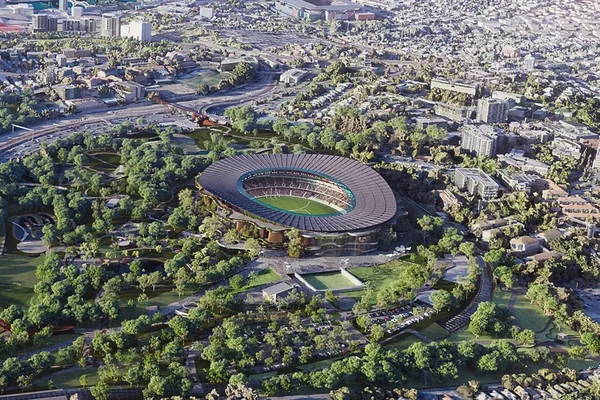




PHOTO: Brisbane Olympic Stadium.
🌍 From the Bird’s Nest to Brisbane: A New Olympic Icon Emerges
Beijing had the Bird’s Nest.
Los Angeles had the Coliseum.
Now, Brisbane has unveiled its vision for the centrepiece of the 2032 Summer Olympics.
Artist impressions released on Monday offer the first look at the 63,000-seat Olympic stadium, set to host the opening and closing ceremonies and welcome billions of viewers around the world.
The venue is earmarked for Victoria Park, just minutes from Brisbane’s CBD.
🏗️ Inside the $3.8 Billion Stadium Design
The stadium — with an estimated cost of AU$3.8 billion (NZ$4.4bn) — has been designed by leading Australian architecture firms COX Architecture and Hassell, in partnership with Japan’s Azusa Sekkei.
Key features include:
-
🏟️ 63,000-seat capacity
-
🌬️ Emphasis on natural ventilation and cooling breezes
-
☀️ Integrated shade and open sightlines
-
🌆 Long views across the Brisbane skyline
COX chairman Richard Coulson said the design reflects Queensland’s understated character rather than architectural bravado.
“The Queensland character is defined more by humility than bravado — a quality reflected in the architecture of the traditional Queenslander,” Coulson said.
https://www.youtube.com/watch?v=CFIuj5I9NsU&pp=ygUfQnJpc2JhbmUgT2x5bXBpYyBTdGFkaXVtIERlc2lnbg%3D%3D
🇦🇺 ‘A Stadium All Australians Can Be Proud Of’
Hassell co-designer Lucy O’Driscoll described the project as a career-defining opportunity.
“It’s an architect’s passion project — something Queenslanders and Australians will gather around, and something that puts us on the world stage,” she said.
The consortium was selected following an expressions-of-interest process launched in September, with Azusa Sekkei bringing experience from 120 stadium projects worldwide, many focused on cost efficiency.

🏛️ Government Backs the Project
Queensland Deputy Premier Jarrod Bleijie said site preparation is expected to begin mid-year.
“The Crisafulli government is working to restore confidence and momentum, ensuring the 2032 Games will be something every Queenslander can be proud of,” he said.
At a federal level, Infrastructure Minister Catherine King praised the project as a future city landmark.
“This stadium will be a worthy home for the world’s best athletes, performers and spectators during the Games.”
https://www.propertynoise.co.nz/introducing-nz-business-database-2024-the-ultimate-resource-for-connecting-with-new-zealand-companies/
⚖️ Legal Hurdles Still Remain
Despite government enthusiasm, the stadium faces a significant legal obstacle.
An application has been lodged under Section 10 of the Aboriginal and Torres Strait Islander Heritage Protection Act, which allows the Commonwealth to grant long-term protection to areas of cultural significance.
The application is currently under consideration by Environment Minister Murray Watt, and could yet delay or reshape the project.

An artist’s impression of Brisbane’s 2032 Olympics stadium.
🌳 Community Backlash Builds
The first public images of the stadium have sparked strong opposition from community and environmental groups.
A protest is planned for January 31, led by Save Victoria Park.
Spokesperson Rosemary O’Hagan criticised the development sharply:
“This latest tranche of greenwashed computer imagery is not real.
What’s real are the ancient trees, rolling hills and native wildlife the government intends to obliterate.”
Opponents argue the Games risk becoming one of the most environmentally damaging Olympics in history if the parkland is redeveloped.
🧠 What This Means for Brisbane
Beyond sport, the stadium represents:
-
🏗️ One of Queensland’s largest-ever infrastructure projects
-
🏠 Potential ripple effects across inner-city property values
-
🌍 A defining statement about Brisbane’s global identity
-
⚖️ An ongoing clash between development, heritage, and environment
With 17 new and upgraded venues planned statewide, this stadium will set the tone — politically, culturally, and economically — for the entire Games.
🔑 The Bottom Line
Brisbane’s Olympic stadium is bold, expensive, and ambitious — and already controversial.
Whether it becomes a beloved landmark or a symbol of division will depend on what happens next: in the courts, in the community, and on the ground at Victoria Park.
One thing is certain — the road to 2032 has well and truly begun.