
PHOTO: Winter has arrived—and so has another reminder that New Zealand’s housing market remains under pressure. SUPPLIED
The latest Trade Me Property Price Report shows asking prices, new listings and buyer demand all declined during June, highlighting a market that continues to struggle for momentum despite improving affordability and increased housing choice.
While seasonal slowdowns are nothing new, the latest figures also reinforce a broader trend that has been developing for some time: New Zealand’s property market is no longer experiencing the rapid growth homeowners became accustomed to over the past two decades.
National House Prices Slip Again
According to Trade Me Property, the national average asking price eased by approximately 1.3% during June, falling by around $11,000 to $823,300.
While a monthly decline may not appear dramatic, it reflects a market where vendors are continuing to adjust their price expectations as buyers remain cautious.
The latest figures suggest many sellers are still facing a more competitive environment than they did during the housing boom.
Buyer Demand Cools for Winter
It wasn’t just prices that softened.
Buyer activity also slowed noticeably.
Trade Me reported:
- New property listings fell 11% compared with May.
- Buyer searches declined 14% month-on-month.
Both figures are consistent with the traditional winter slowdown, when fewer homeowners list properties and many buyers delay decisions until spring.
However, seasonal factors don’t tell the entire story.
The Bigger Picture Is More Balanced
Despite the monthly decline, the annual data paints a more stable picture.
Compared with June last year:
- National asking prices are broadly unchanged.
- New listings are approximately 6% higher.
- Buyer searches are also up around 6% year-on-year.
That suggests underlying demand hasn’t disappeared.
Instead, buyers appear to be taking more time, negotiating harder and becoming increasingly selective.
Auckland Drops Below the $1 Million Mark
One of the most notable milestones came in Auckland.
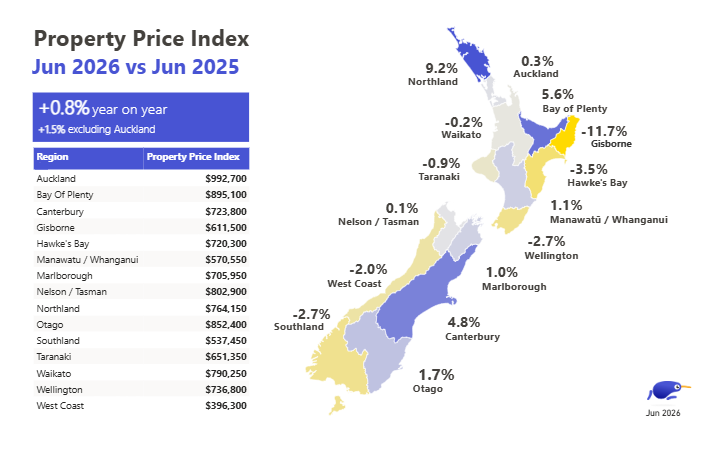
The country’s largest property market saw its average asking price fall to $992,700, slipping below the $1 million mark for the first time this year.
While psychologically significant, the move reflects a relatively modest monthly decline rather than a dramatic market correction.
On an annual basis, Auckland prices remain broadly stable.
Nevertheless, the city’s property market continues facing headwinds from:
- Higher mortgage costs.
- Reduced borrowing capacity.
- Improved housing supply.
- Softer investor demand.
Wellington Continues to Struggle
The capital experienced one of the largest monthly declines.
Average asking prices fell almost 4% during June, leaving Wellington’s market sitting well below levels recorded a year earlier.
Wellington has now become one of New Zealand’s weaker-performing major markets, with affordability challenges, public sector uncertainty and softer buyer confidence weighing on activity.
Canterbury Remains One of the Bright Spots
In contrast, Canterbury continues demonstrating resilience.
Average asking prices edged slightly higher during June and remain almost 5% above the same period last year.
Christchurch and surrounding districts continue benefiting from:
- Relative affordability.
- Population growth.
- Ongoing development.
- Strong owner-occupier demand.
For many buyers priced out of Auckland, Canterbury continues offering attractive value.
Northland Defies the National Trend
Perhaps the biggest surprise came from Northland.
Despite the national slowdown, the region recorded a significant increase in average asking prices during June.
While smaller regional markets can experience greater monthly volatility due to lower sales volumes, Northland continues attracting buyers seeking lifestyle properties and coastal living.
Its performance stands in sharp contrast to many of New Zealand’s larger urban centres.
More Choice Means More Negotiating Power
One of the most important developments for buyers isn’t necessarily lower prices.
It’s increased choice.
Compared with recent years, many regions now have healthier stock levels, allowing purchasers to:
- Compare more properties.
- Negotiate more confidently.
- Take additional time before making offers.
For sellers, however, the balance of power has shifted.
Presentation, realistic pricing and effective marketing have become more important than ever.
A Very Different Market
The latest data also reinforces a much broader structural change taking place across New Zealand’s housing market.
The conditions that fuelled years of extraordinary capital growth have weakened significantly.
Today’s market faces:
- Higher interest rates.
- Slower migration.
- Greater housing supply.
- More cautious lending.
- Reduced investor activity.
Rather than rapid price appreciation, buyers and sellers are adjusting to a market where modest movements have become the norm.
Is This Simply Seasonal?
Trade Me believes much of June’s slowdown reflects normal winter behaviour.
Historically, buyer activity often softens during the colder months before improving as spring approaches.
That pattern may well repeat this year.
However, seasonal trends are now occurring within a housing market undergoing much deeper structural change than many New Zealanders have experienced before.
What It Means for Buyers
Current conditions may present opportunities for buyers prepared to act.
With:
- Improved stock levels.
- Reduced competition.
- More realistic vendors.
- Greater negotiating power.
Some purchasers may find better value than has been available for several years.
Those with finance already approved could be well positioned ahead of the traditionally busier spring market.
The Bottom Line
Winter has certainly cooled New Zealand’s property market, but the latest figures suggest something bigger is also unfolding.
Instead of the rapid price growth that defined much of the past two decades, today’s market is characterised by stability, greater choice and more balanced negotiations.
For homeowners hoping prices quickly return to previous highs, the outlook remains uncertain.
For buyers, however, the current market may offer one of the best opportunities in years to negotiate and secure a property without the intense competition of the boom years.
As spring approaches, all eyes will be on whether buyer confidence returns—or whether New Zealand’s housing market continues its gradual transition into a slower, more sustainable era.
Frequently Asked Questions
Did New Zealand house prices fall in June?
Yes. According to Trade Me Property, the national average asking price fell approximately 1.3%, or around $11,000, during June.
Which city fell below $1 million?
Auckland’s average asking price dropped to approximately $992,700, marking the first time this year it has fallen below the $1 million mark.
Which region performed the strongest?
Northland recorded the strongest monthly increase, while Canterbury also remained resilient with positive annual price growth.