
PHOTO: One obstacle to solving Australia’s housing shortage is that new housing approvals remain inconsistent. FILE
For years, Australians have been told the solution to the country’s housing affordability crisis is simple:
Build more homes.
But what happens if governments actually succeed?
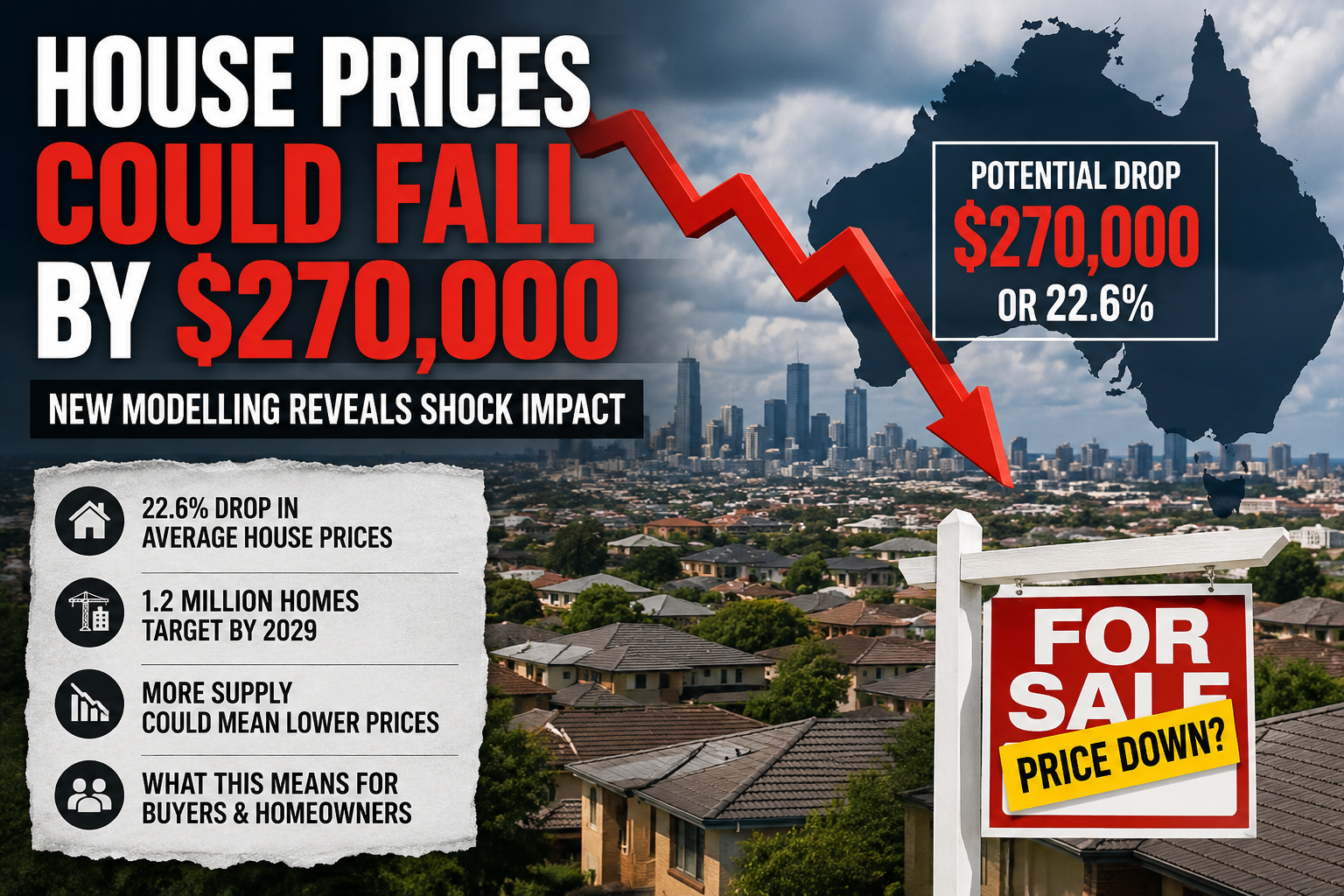
New modelling has delivered a striking answer, suggesting Australia’s average house prices **could fall by around $270,000—or approximately 22.6%—if the nation’s housing shortage is eliminated and the Federal Government achieves its ambitious goal of delivering 1.2 million new homes by 2029.
The findings raise one of the biggest questions facing Australia’s property market:
Can housing become affordable without significantly reducing the wealth of existing homeowners?
Unlock 1.2 Million+ Aussie Business Contacts — No Subscriptions, No Limits
A Potential $270,000 Price Correction
Research commissioned by OurTop10.com.au and conducted by Primara Research modelled what Australia’s housing market could look like if supply finally caught up with demand.
Their conclusion was eye-catching.
If enough homes are built to close Australia’s housing shortage—and assuming interest rates and unemployment remain broadly stable—the average Australian home could eventually be worth around 22.6% less than under a scenario where the current housing shortage continues.
For buyers locked out of the market, that’s potentially welcome news.
For existing homeowners, however, it represents a very different conversation.

Most regions have seen home values drag lower over recent months, with the largest downgrades in Perth and Brisbane according to Cotality research
Why More Housing Could Lower Prices
The relationship is rooted in basic economics.
When demand consistently exceeds supply, prices generally rise.
Australia has experienced exactly that over the past decade.
Population growth, migration, limited housing construction and planning constraints have all combined to create a significant shortage of available homes.
Increasing supply helps rebalance that equation.
With more homes available, buyers have greater choice, competition eases and upward pressure on prices begins to moderate.
The Government’s 1.2 Million Home Target
The Albanese Government’s National Housing Accord aims to deliver 1.2 million new homes by 2029.
To achieve that objective, Australia would need to construct approximately:
- 240,000 homes every year
- For five consecutive years
However, current projections indicate the target is already behind schedule.
Government estimates suggest Australia is around 125,000 dwellings short of where it needs to be and may not reach the overall target until 2030, one year later than originally planned.

The fall in the number of homes being built has been driven by a more than 10 per cent fall in apartment approvals
Any Impact Would Take Years
Importantly, the modelling does not suggest prices would suddenly collapse.
Housing markets respond slowly.
Even if construction accelerated immediately, it could take many months—or even years—for additional housing supply to influence prices.
The research suggests values could continue rising in the short term before eventually stabilising and softening as more homes become available.
In other words, increasing supply is likely to affect long-term affordability rather than creating an immediate market correction.
House Prices Could Rise Before Falling
According to the modelling, average Australian house prices could continue climbing over the next few years before supply begins catching up.
The forecast suggests prices may reach approximately $1.15 million before gradually easing back toward current levels if housing targets are eventually achieved.
This reflects the long lead times involved in:
- Land development
- Planning approvals
- Infrastructure
- Construction
- Settlement of completed homes
Housing supply simply cannot be increased overnight.
Affordability Remains a Major Challenge
Even without dramatic price falls, affordability continues to weigh heavily on Australia’s housing market.
Several factors are limiting buyer activity:
- Higher interest rates
- Rising living costs
- Reduced borrowing capacity
- Weaker consumer confidence
- Property tax changes
- Tighter lending standards
Many buyers who could previously afford to enter the market now find themselves borrowing significantly less than just a few years ago.
Construction Still Faces Challenges
One obstacle to solving Australia’s housing shortage is that new housing approvals remain inconsistent.
Recent building data has shown:
- Declines in apartment approvals.
- Continued challenges for higher-density developments.
- Rising construction costs.
- Labour shortages.
- Delays in planning approvals.
While approvals for detached houses have shown some improvement, increasing total housing supply remains a complex challenge.
Winners and Losers
If house prices were to moderate significantly over the coming decade, the effects would not be evenly shared.
Potential winners
- First-home buyers.
- Younger Australians.
- Families currently priced out of home ownership.
- Buyers needing smaller deposits.
Potential challenges
- Existing homeowners.
- Property investors.
- Retirees relying on housing equity.
- Those who purchased near recent market peaks.
Housing affordability and household wealth often pull in opposite directions.
The Political Balancing Act
Housing remains one of Australia’s most politically sensitive issues.
Governments are under increasing pressure to improve affordability while avoiding a sharp decline in property values that could undermine household wealth and consumer confidence.
Finding that balance may prove one of the country’s biggest economic challenges over the coming decade.
What Does This Mean for Investors?
For long-term investors, the modelling is a reminder that property markets are influenced by far more than supply alone.
Other major drivers include:
- Population growth.
- Employment.
- Wage growth.
- Interest rates.
- Migration.
- Consumer confidence.
- Government policy.
While additional housing supply may reduce upward pressure on prices, Australia’s strong long-term population growth is likely to continue supporting housing demand.
The Bottom Line
The modelling provides an important reminder that solving Australia’s housing affordability crisis is likely to involve trade-offs.
Building enough homes to close the supply gap could improve affordability for future buyers.
But it may also reduce the extraordinary capital growth homeowners have become accustomed to over recent decades.
Whether Australia ultimately delivers 1.2 million new homes remains uncertain.
What is certain is that the conversation has shifted.
The debate is no longer simply about how many homes Australia needs.
It’s increasingly about what achieving that goal could mean for house prices, household wealth and the future of the Australian property market.
Frequently Asked Questions
Could Australian house prices really fall by $270,000?
The figure comes from economic modelling that assumes Australia successfully closes its housing supply shortage while interest rates and unemployment remain broadly stable. It is a forecast scenario, not a prediction that prices will definitely fall by that amount.
Why would building more homes reduce prices?
Increasing housing supply generally improves buyer choice and reduces the imbalance between supply and demand, placing downward pressure on prices over time.
Will prices fall immediately?
No. Housing supply takes years to increase. Even if construction accelerates, any impact on prices would likely occur gradually rather than through a sudden market correction.
SOURCE: THE DAILY MAIL