
PHOTO: Gabrielle Stacey Dowd, a 28-year-old property management team leader with Harcourts. FILE
The real estate profession is built on trust.
Clients rely on agents and property managers to guide them through some of the biggest financial decisions of their lives. It is a career that demands professionalism, sound judgement and responsibility.
That’s why a recent drink-driving case involving a Queensland real estate agent has attracted significant attention.
The case is not just about a road crash.
It’s also a reminder that behind every professional title is a person who may be dealing with personal struggles, stress and mental health challenges.
The Crash
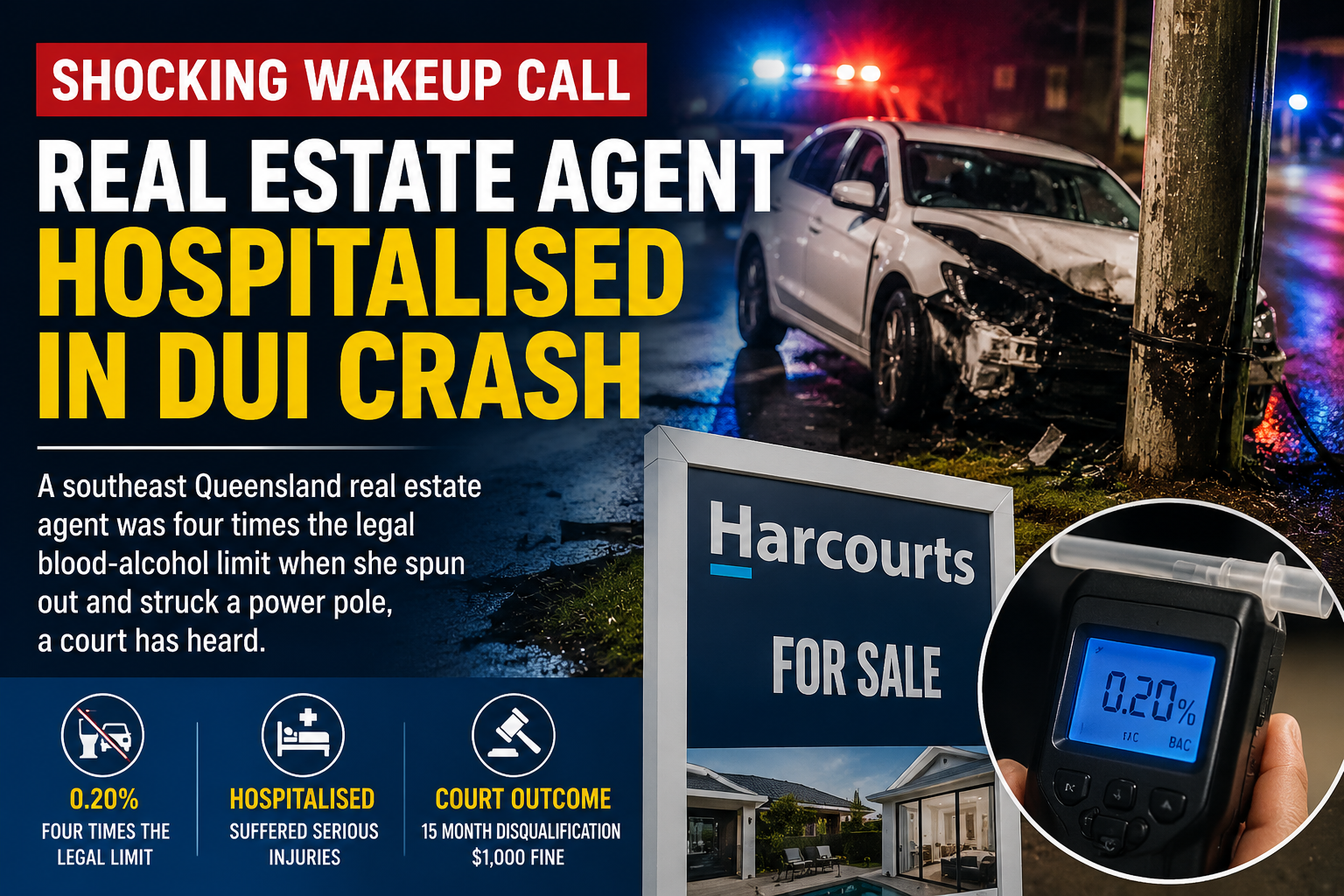
According to court proceedings, Gabrielle Stacey Dowd, a 28-year-old property management team leader with Harcourts, pleaded guilty to high-range drink driving and driving while unlicensed after a single-vehicle crash on Queensland’s Sunshine Coast. The crash occurred on Sugar Bag Road at Little Mountain, where her vehicle spun out and struck a power pole.
She suffered a punctured lung and was taken to hospital.
Blood testing later recorded a blood-alcohol concentration of 0.20%, approximately four times Australia’s legal driving limit of 0.05%. Court documents also showed she was unlicensed at the time because of accumulated demerit points.

Gabrielle Stacey Dowd, a 28-year-old property management team leader with Harcourts. GC BULLETIN
Court Hears of Personal Struggles
During sentencing, the court heard the real estate professional had been experiencing a difficult period in her personal life.
Her lawyer said she had turned to alcohol while dealing with emotional challenges and had since recognised the seriousness of her actions. She completed a traffic offenders programme and wrote a letter of apology before sentencing.
The magistrate described the incident as “the most shocking of all wake-up calls.”
The Professional Consequences
The consequences extended well beyond the courtroom.
The court heard that because of her driving disqualification, her employer had to move her into a different role that did not require driving.
For many real estate professionals, driving is not optional.
Property managers inspect rentals.
Salespeople attend appraisals.
Agents travel between open homes, auctions and client meetings.
Losing a licence can dramatically affect day-to-day work.
Real Estate Is a High-Pressure Profession
While this case is unusual, it highlights the pressures that can exist within the property industry.
Real estate professionals often juggle:
- Long working hours.
- Weekend commitments.
- Tight deadlines.
- High client expectations.
- Sales targets.
- Market uncertainty.
- Emotional negotiations.
Many also operate as self-employed contractors whose income depends on performance.
These pressures can affect wellbeing if not managed appropriately.
A Reminder About Road Safety
Regardless of occupation, drink driving remains one of the most preventable causes of serious road crashes.
Across Australia and New Zealand, police continue to remind motorists that even one poor decision can have life-changing consequences.
Fortunately, no one else was seriously injured in this incident.
The outcome could easily have been far worse.
The Court’s Decision
The magistrate imposed:
- A 15-month driving disqualification.
- A $1,000 fine.
- No criminal conviction was recorded.
The court took into account the defendant’s early guilty plea, rehabilitation efforts and personal circumstances before sentencing.
Lessons for the Property Industry
The case serves as an important reminder for everyone working in property.
Professional success does not make anyone immune from personal challenges.
Employers, colleagues and industry leaders increasingly recognise the importance of supporting mental wellbeing alongside professional performance.
At the same time, the responsibilities that come with working in real estate extend beyond negotiations and property transactions.
They include the responsibility to make safe decisions on the road every day.
The Bottom Line
One decision can change a life.
In this case, a serious crash resulted in injuries, legal consequences, professional disruption and public scrutiny.
The court described it as a wake-up call.
It also serves as a reminder to the wider property industry that looking after personal wellbeing, seeking support when needed and making responsible choices are just as important as achieving sales targets or managing client relationships.
Real estate is ultimately a people business.
Protecting yourself—and everyone else on the road—is part of that responsibility.