
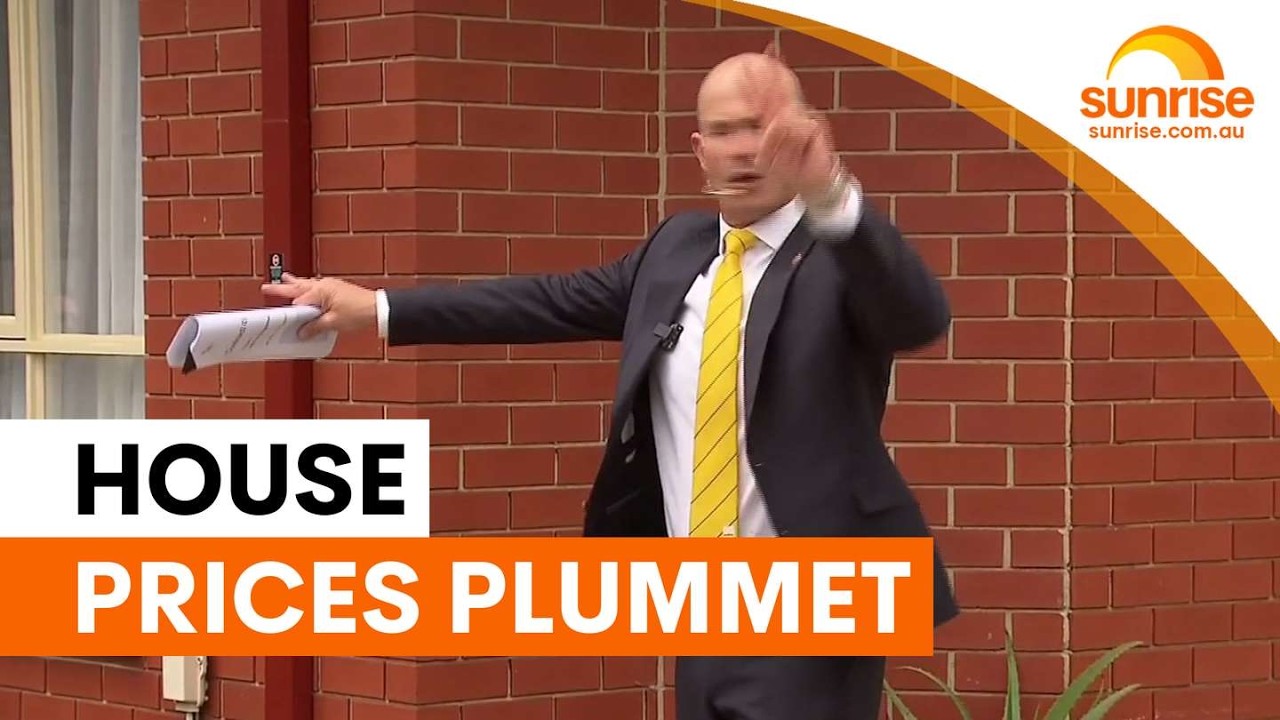
PHOTO: Australia’s property market could be heading for a much deeper correction than many expected. SUNRISE
Global banking giant HSBC has forecast that Australian house prices may fall by up to 8% by the end of 2027, warning that recent price declines may be only the beginning of a broader downturn.
The bank’s outlook comes as lending conditions tighten, buyer confidence weakens and economic uncertainty begins weighing heavily on households and businesses across the country.
For buyers, sellers and investors alike, the message is becoming increasingly clear: Australia’s housing market is entering a new phase.
HSBC: The Correction Isn’t Over Yet
While many Australians hoped falling prices would soon stabilise, HSBC believes the market still has further to fall.
The bank argues that a combination of tighter credit, weaker economic conditions and slowing demand is likely to place further downward pressure on residential property values throughout 2026 and into 2027.
Rather than viewing today’s softer market as the bottom, HSBC suggests buyers should prepare for additional price declines.
“Don’t Catch a Falling Knife”
One of the strongest warnings coming from HSBC is directed at first-home buyers.
The bank cautions against attempting to “catch a falling knife”—a phrase commonly used in financial markets to describe buying into an asset that is still rapidly losing value.
While lower prices may appear attractive, buyers who purchase too early risk seeing the value of their home decline further before the market eventually recovers.
For households borrowing with small deposits, that could increase the risk of falling into negative equity, where the mortgage exceeds the property’s market value.
Lending Conditions Continue to Tighten
Adding to the pressure is a noticeable shift in bank lending.
Mortgage brokers across Australia are reporting:
- More conservative lending policies.
- Increased scrutiny of borrowers.
- Reduced borrowing capacity.
- Loan pre-approvals being withdrawn or reduced.
- Slower approval times.
Banks are becoming increasingly cautious as economic conditions evolve.
For many buyers, qualifying for finance has become just as challenging as finding the right property.
Loan Applications Are Falling
Despite house prices becoming more affordable, demand isn’t increasing.
Mortgage brokers are reporting around a 10% decline in new home loan applications, suggesting many Australians remain hesitant to enter the market.
Higher living costs, employment uncertainty and expectations of further price falls appear to be encouraging many buyers to wait.
This creates a self-reinforcing cycle:
- Buyers delay purchasing.
- Sellers compete harder.
- Prices soften further.
- More buyers continue waiting.
Economic Uncertainty Is Affecting Confidence
The property market rarely operates in isolation.
HSBC’s outlook reflects broader concerns across the Australian economy, including:
- Slowing economic growth.
- Rising unemployment.
- Small business closures.
- Higher business costs.
- Weaker consumer confidence.
When households become uncertain about future income or employment, large financial commitments—such as purchasing property—are often postponed.
Sellers Face a More Competitive Market
For homeowners looking to sell, the market is becoming increasingly competitive.
As buyer numbers decline, sellers may need to:
- Price more realistically.
- Spend longer on the market.
- Negotiate more heavily.
- Invest in stronger marketing campaigns.
The days of multiple unconditional offers arriving within days are becoming less common across many Australian markets.
Not Every City Will Perform the Same
Although HSBC has forecast a national decline, Australia’s property markets remain highly regional.
Some cities continue to demonstrate resilience due to:
- Strong population growth.
- Limited housing supply.
- Infrastructure investment.
- Employment growth.
- Interstate migration.
Others are likely to experience larger price corrections, particularly markets that experienced exceptional growth during the pandemic boom.
Understanding local market conditions has never been more important.
Could Lower Prices Create Opportunities?
History shows that property downturns often create opportunities for buyers with secure finances.
Less competition.
More listings.
Greater negotiating power.
The ability to undertake proper due diligence.
These are conditions that many buyers haven’t experienced for several years.
However, timing remains difficult.
Attempting to perfectly predict the bottom of the market is almost impossible.
Instead, many experienced investors focus on buying quality property that they intend to hold over the long term.
What Should Buyers Do?
If you’re considering purchasing property during the current downturn, experts generally recommend:
✔ Ensure your employment is secure.
✔ Borrow within your means.
✔ Maintain an emergency financial buffer.
✔ Obtain finance approval before making offers.
✔ Focus on long-term affordability rather than short-term price movements.
Buying a home should be based on your financial position—not market headlines alone.
What Could Change the Outlook?
Several factors will determine whether HSBC’s forecast proves accurate.
These include:
- Interest rate movements.
- Inflation.
- Employment levels.
- Consumer confidence.
- Government housing policies.
- Population growth.
Should economic conditions improve more quickly than expected, buyer confidence could return sooner.
Conversely, further deterioration in employment or lending conditions could place additional pressure on prices.
The Bottom Line
HSBC’s forecast is one of the more cautious outlooks currently facing Australia’s housing market.
An 8% decline in house prices would represent a significant correction from recent highs, particularly for homeowners who purchased at the peak of the market.
Yet property history consistently shows that downturns are a normal part of the cycle.
For buyers, patience and financial discipline may prove just as valuable as timing.
For sellers, realistic expectations and careful planning will become increasingly important.
One thing is certain:
Australia’s property market is entering a period where strategy, preparation and local market knowledge may matter more than ever.
Frequently Asked Questions
Why is HSBC predicting Australian house prices will fall?
HSBC points to tighter lending conditions, weaker economic confidence, rising unemployment, reduced loan approvals and softer buyer demand as the main reasons for its forecast.
What does “catching a falling knife” mean?
It refers to buying an asset while prices are still falling, risking further losses before the market eventually stabilises.
Will every Australian city fall by 8%?
Not necessarily. Property markets perform differently across Australia, with local factors such as employment, housing supply, migration and affordability influencing price movements.