
PHOTO: Trade Me Survey Reveals Sharp Shift In Sentiment As More New Zealanders Expect Prices To Fall. SUPPLIED
New Zealand’s housing market may be entering a new phase, with fresh data revealing a dramatic collapse in property price optimism despite stable national house prices.
While the national average asking price remains largely unchanged compared to a year ago, a new survey has uncovered growing uncertainty among Kiwi homeowners, buyers and investors about where the market is headed next.
The latest figures suggest that while buyers are becoming more active, confidence in future house price growth is fading rapidly.
📉 Property Optimism Takes A Major Hit
According to a new Trade Me Property survey of approximately 2,000 New Zealanders, expectations for future house price growth have fallen sharply in just two months.
In March:
- 46% expected house prices to rise.
By May:
- Just 29% expected prices to increase.
At the same time, pessimism has surged.
The proportion of respondents expecting house prices to fall jumped from:
- 6.5% in March
- To 16% in May
That’s almost a threefold increase in negative sentiment.
The majority of New Zealanders now expect house prices to either remain flat or decline over the next 12 months.
💥 The Sharpest Confidence Drop In Years?
Trade Me Property Customer Director Gavin Lloyd described the shift as one of the most significant sentiment changes seen in recent times.
Only a few months ago, almost half of respondents expected further price growth.
Now, fewer than three in ten believe values will rise.
The change suggests many Kiwis are becoming increasingly cautious about the housing market outlook as economic pressures continue to weigh on household budgets.
📊 National House Prices Hold Steady
Despite the dramatic shift in sentiment, actual house prices remain relatively stable.
Latest figures show:
National Average Asking Price
May 2026: $833,800
- Down 2.5% from April
- Down just 0.2% year-on-year
On paper, that’s a remarkably stable market.
However, national averages often hide what is really happening at a regional level.
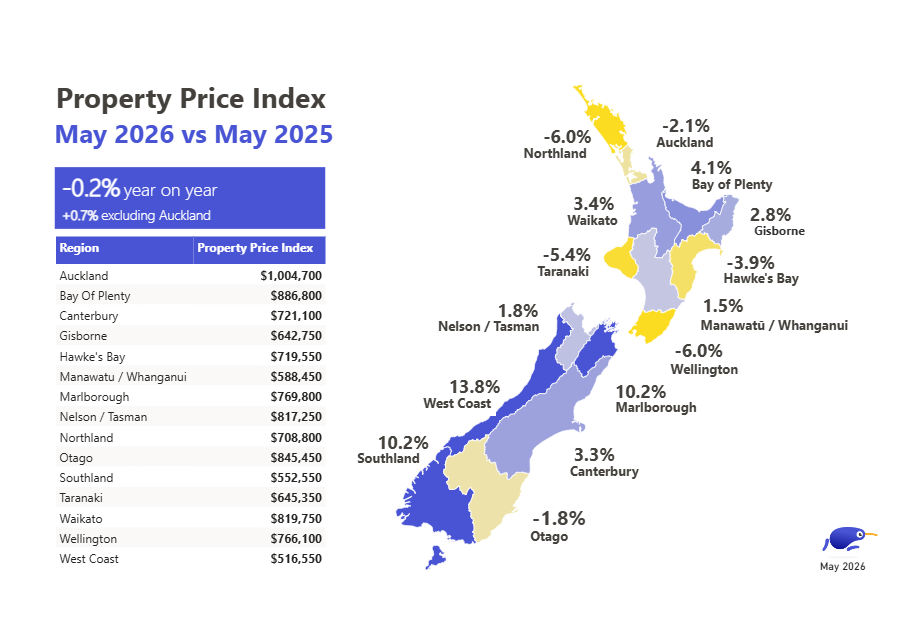
🗺️ A Tale Of Two Property Markets
The latest data highlights an increasingly fragmented property market.
Some regional and southern areas continue to perform strongly.
Meanwhile:
- Auckland remains under pressure.
- Wellington continues to soften.
- Several regional markets are proving surprisingly resilient.
This divergence means homeowners in different parts of New Zealand are experiencing very different market conditions.
A seller in Queenstown or parts of the South Island may be seeing strong demand, while sellers in Auckland or Wellington face a more challenging environment.
🏡 More Buyers Are Entering The Market
One of the more surprising findings from the survey is that falling price expectations are actually encouraging more people to consider buying.
Key findings include:
Active Buyer Intent
Up 6% since March.
First Home Buyers
Up 3% since March.
Buyers Not Considering Purchasing
Down 7% since March.
For many would-be buyers, softer prices are creating opportunities that didn’t exist during the housing boom.
Rather than waiting indefinitely, some buyers appear willing to make their move now.
💰 Cost Of Living Now The Biggest Concern
The survey also revealed a shift in buyer concerns.
In March, the biggest challenge facing buyers was a lack of suitable properties on the market.
By May, the number one concern had become:
Cost Of Living Pressures
Rising household expenses, insurance costs, food prices and mortgage repayments are increasingly influencing property decisions.
This reflects the broader economic environment many New Zealand families continue to face.
📈 More Sellers Entering The Market
At the same time buyers are becoming more active, seller activity is also increasing.
The proportion of people currently selling or intending to sell within six months increased by 3%.
However, confidence among sellers is moving in the opposite direction.
Agreement with the statement:
“Now is a good time to sell”
fell by almost 5%.
This creates an interesting dynamic:
✅ More sellers entering the market
❌ Less confidence about achieving a desired sale price
🚨 Why Price Anxiety Is Becoming A Major Issue
One theme emerged consistently across both the March and May surveys.
Sellers are increasingly worried about:
Getting The Right Price
As stock levels increase and buyer confidence remains mixed, many vendors are becoming concerned that they may need to adjust expectations.
This anxiety appears to be structural rather than seasonal.
Unlike previous short-term fluctuations, concerns about pricing are becoming deeply embedded in the market.
📦 More Listings Means More Competition
Property markets are driven by supply and demand.
Currently:
- More properties are coming to market.
- Buyer confidence remains mixed.
- Price expectations are softening.
This combination generally favours buyers.
When buyers have more choice:
🏠 Vendors face more competition.
🏠 Negotiations become tougher.
🏠 Properties may take longer to sell.
🏠 Price growth often slows.
👥 Investors Becoming Less Active
The survey also revealed a notable decline in investor activity.
Investor share of active buyers fell by 3%.
This suggests investors may be taking a more cautious approach as:
- Rental regulations evolve.
- Tax settings change.
- Interest rates remain elevated.
- Capital growth slows.
At the same time, first-home buyers appear to be becoming more active.
🔮 What Happens Next?
The next 12 months could prove crucial for the New Zealand housing market.
Several key factors will influence market direction:
Interest Rates
Future OCR decisions remain critical.
Economic Growth
Household confidence remains closely tied to employment and wage growth.
Housing Supply
More listings could place additional pressure on prices.
Migration
Population growth continues to influence demand.
Affordability
Many buyers remain highly sensitive to borrowing costs.
📍 Property Noise View
The most interesting takeaway isn’t that house prices are flat.
It’s that public sentiment has changed so quickly.
Housing markets are often driven by confidence.
When nearly half the country expects prices to rise, buyers rush in.
When confidence fades, behaviour changes.
The latest survey suggests New Zealanders are becoming more cautious, more selective and more realistic about where the market may be heading.
That doesn’t necessarily mean a crash is coming.
But it does suggest the days of automatic house price growth may be firmly behind us.
For buyers, that could create opportunity.
For sellers, it may require patience.
And for investors, it may mean adapting to a very different market than the one they became accustomed to over the past decade.