




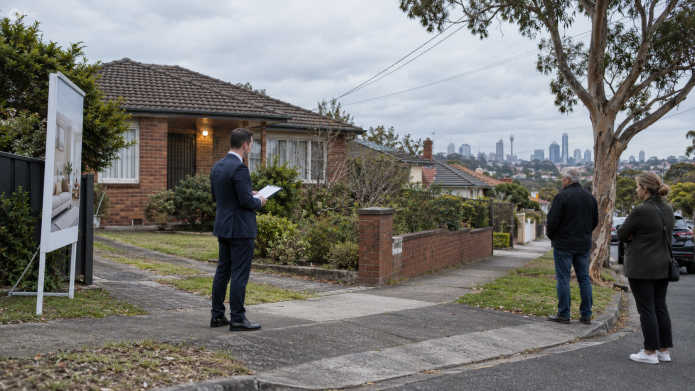






PHOTO: How can you confidently sell something that isn’t actually inside the boundary?
The tiny words in a real estate advertisement that can become a very expensive problem
“Boundary lines approximate.”
They’re the sort of words property buyers see every day.
Most probably barely notice them.
But an extraordinary Auckland real estate case has demonstrated why a few words — and a few lines drawn on an aerial photograph — should never replace actually knowing what is included in the property being sold.
A buyer paid $3.75 million for a Takapuna commercial property marketed as having “25+ carparks onsite.”
There was just one rather significant problem.
A later technical assessment concluded that, once the property’s actual legal title was taken into account, approximately 10 carparks were usable.
That is quite a difference.
And it has now resulted in a real estate salesperson being censured, fined and ordered to pay compensation and costs.
But the most interesting part of this case isn’t the punishment.
It’s the question every property professional should be asking:
How can you confidently sell something that isn’t actually inside the boundary?
NEW | Access New Zealand’s Ultimate Real Estate Agent Database — 18,000+ Agents & Agencies Included
The $3.75m lockdown purchase
The sale happened in 2021, during New Zealand’s Covid-19 lockdown.
That detail matters.
The eventual buyer couldn’t simply walk around the property, inspect every corner and compare the physical site with the title.
He visited twice but remained in his vehicle while discussing the property with salesperson Nicholas Brown, who was working for Barfoot & Thompson North Shore Commercial.
The marketing material included aerial photographs with boundary lines added and carried the qualification:
“Boundary lines approximate.”
The information memorandum promoted 25 carparks, describing the “25+ carparks onsite” as a significant drawcard.
And commercially, you can understand why.
Twenty-five carparks in Takapuna aren’t just somewhere to leave the Corolla.
They’re an asset.
They’re potentially valuable to tenants.
They can influence rental appeal.
And they can influence what a buyer is prepared to pay.
The buyer initially submitted an unconditional tender of $3.15 million.
After being told he needed to increase his offer, he lifted it the following day to:
$3.75 MILLION.
Then came the boundary problem
Months later, while arranging finance before settlement, a valuation raised concerns about the property’s boundary.
The problem?
Some of the concreted parking area wasn’t actually part of the property.
Part was Crown land.
Another section was Auckland Council reserve land.
The Tribunal said only about 15 of the advertised carparks were entirely within the legal boundary.
A subsequent technical assessment went further, concluding approximately 10 were usable when only land forming part of the property’s legal title was considered.
Suddenly, “25+ carparks” looked very different.
Here’s where the case gets uncomfortable
The Tribunal found Brown became aware during the marketing campaign that some of the concreted parking area was reserve land and therefore outside the property boundary.
But the advertising wasn’t corrected.
The eventual buyer was subsequently sent that marketing material without being told about the reserve land.
Brown also communicated with him about rental returns associated with 25 carparks.
That became crucial.
The Tribunal found the reserve land was material information because it could affect how the property could be used.
It also found Brown failed to properly investigate the boundary after becoming aware there could be a problem.
In other words, this wasn’t simply:
“Oops, the line on the photograph was slightly wrong.”
Once there was reason to question the boundary, the issue required investigation.
“Boundary lines approximate” isn’t a magic shield
And this is arguably the biggest lesson from the entire case.
Real estate advertising regularly contains qualifications.
Boundary indicative.
Boundary approximate.
Areas approximate.
Purchasers to conduct their own due diligence.
Those disclaimers have a purpose.
But they shouldn’t be interpreted as a free pass to continue promoting a material property feature once there is information suggesting it might not be correct.
The Tribunal found Brown did not know exactly where the boundaries were and didn’t make sufficient efforts to establish the area of land being sold.
Its finding was particularly pointed: after becoming aware his understanding of the boundary might be wrong and needed further inquiry, he proceeded with the sale as advertised anyway.
That’s the part agents should probably pin above their desks.
The buyer claimed the problem could have cost hundreds of thousands
Two initial valuation estimates suggested the boundary issue might have reduced the property’s value by somewhere between $450,000 and $500,000.
That’s a frightening number.
But there is an important twist.
The Tribunal did not accept that the buyer had established an actual loss in the property’s value.
Another valuation assessed the property at $3.8 million plus GST — actually $50,000 above the $3.75 million plus GST purchase price.
There was also evidence that leasing carparks to people who weren’t tenants may have required land-use consent.
So this wasn’t a case where the Tribunal simply decided:
“Buyer lost $500,000.”
It didn’t.
That distinction matters.
But the agent still received a sizeable bill
The Tribunal found Brown’s behaviour amounted to unsatisfactory conduct at the upper end of that category, rather than misconduct.
It found his failures were negligent, but not deliberate or reckless and not sufficiently serious to meet the threshold for misconduct.
Brown was:
💰 Fined $7,500
💰 Ordered to pay $15,344.19 compensation
💰 Ordered to contribute $11,700 toward disciplinary costs
📚 Required to complete professional conduct training
✍️ Required to provide the buyer with a written apology
That’s more than $34,000 in fine, compensation and costs, before considering everything else involved in defending a disciplinary proceeding.
PROPERTY NOISE TAKE: The real story isn’t 25 carparks versus 10
This story will inevitably attract headlines about a buyer paying millions for carparks that weren’t all there.
But there’s a much bigger lesson for the real estate industry.
Agents don’t sell photographs. They sell representations.
Every bullet point in an advertisement matters.
Every line drawn on an aerial image matters.
Every claim about bedrooms, floor area, development potential, access, parking or boundaries can potentially influence what someone is prepared to pay.
And the moment an agent receives information suggesting one of those claims might be wrong, the situation changes.
That’s when:
“The vendor told me.”
or
“The boundary was only approximate.”
or
“The buyer should have checked.”
may not be enough.
This case also happened during lockdown, when the buyer’s ability to physically investigate the property was severely restricted.
That makes accurate information from the professionals involved even more important.
The uncomfortable question for buyers
There is another side to this.
How many buyers actually check the legal title against the physical property before going unconditional?
A fence isn’t necessarily the boundary.
A driveway isn’t necessarily entirely yours.
A landscaped garden isn’t necessarily entirely yours.
And apparently, a concreted area containing carparks isn’t necessarily entirely yours either.
Most property transactions settle without anything remotely like this happening.
But this case is a spectacular reminder of one very old property rule:
Never assume that what looks like part of the property actually belongs to the property.
Because when you’re spending $3.75 million, an approximate line on an aerial photograph can become a very expensive line indeed.
SOURCE: STUFF