
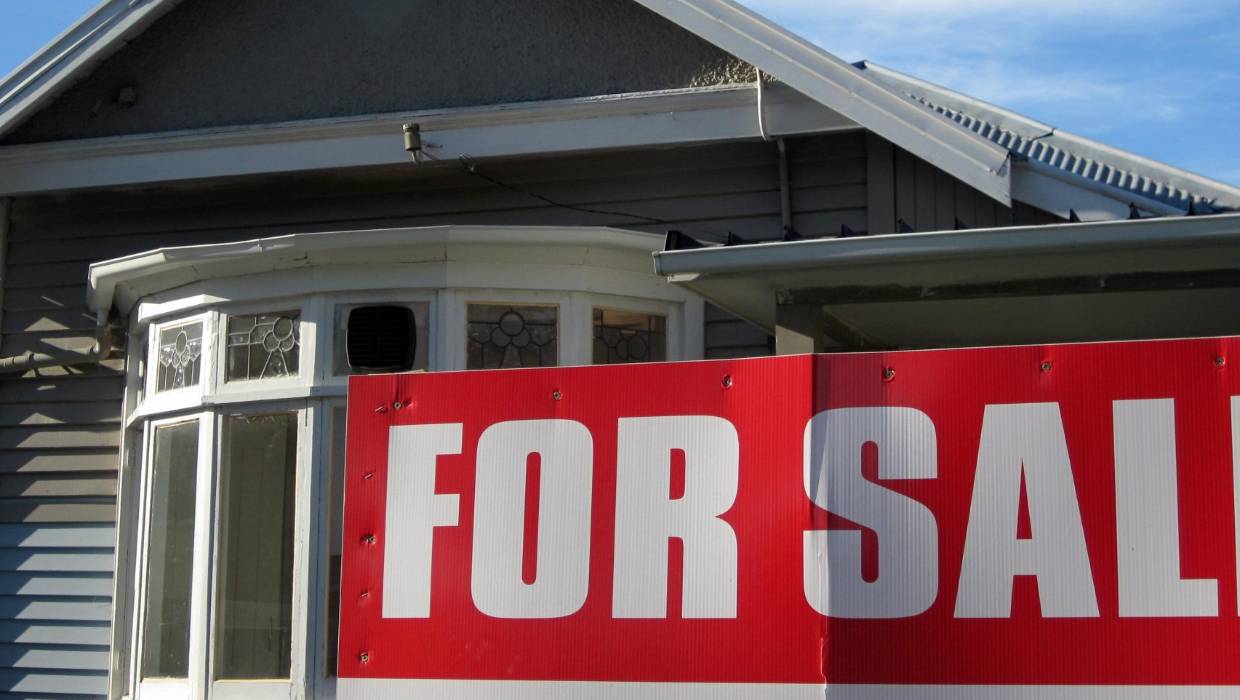
PHOTO: Almost 80% of suburbs recorded falling standalone-house values over the past three months.
Forget the national median. New suburb-level data shows New Zealand no longer has one property market. Almost 80% of suburbs are losing standalone-house value — while some townhouses have fallen more than 10% in just three months. And the biggest warning may be hiding in Auckland‘s townhouse boom.

For years, we’ve talked about “the New Zealand housing market” as though it were one giant organism.
House prices are up.
House prices are down.
The market is recovering.
The market is crashing.
But new Cotality suburb-level data suggests something far more interesting is happening.
There may no longer be a meaningful “NZ housing market” at all.
Because depending on what you own — and exactly where you own it — your experience right now could be completely different from somebody living just a few kilometres away.
In one suburb, standalone house values have risen more than 5% in three months.
Elsewhere, townhouse values have fallen more than 11%.
And across the country?
Almost 80% of suburbs recorded falling standalone-house values over the past three months.
For townhouses, approximately 74% of suburbs declined.
That’s not a property boom.
That’s not even much of a recovery.
That’s a market increasingly divided into winners, losers — and a very large group going nowhere.
THE NUMBER THAT SHOULD GET EVERY PROPERTY OWNER’S ATTENTION: 80%
Cotality analysed 1,422 New Zealand suburbs in its latest data.
Of those, around 750 recorded house-value declines greater than 1% over the three months to September.
Only about 300 suburbs were flat or rising, according to data reported by RNZ.
Cotality chief property economist Kelvin Davidson describes the current conditions as “broad-based sluggishness.”
And there’s a simple explanation.
Too many properties. Not enough urgency.
Listings remain elevated.
Sales activity is subdued.
Buyers have choices.
And when buyers have choices, vendors lose one of the most powerful weapons of the great NZ property boom:
FOMO.
BUT LOOK WHERE HOUSE PRICES ARE ACTUALLY RISING
Here’s where the story becomes fascinating.
The strongest-performing suburbs aren’t necessarily the fashionable million-dollar locations property commentators normally obsess over.
Over the past three months:
| Suburb | Standalone house movement |
|---|---|
| Pukenui | +5.1% |
| Waimamaku | +2.9% |
| Makarewa | +2.7% |
| Kennington | +2.5% |
| Blackball | +2.3% |
| St Arnaud | +2.1% |
See the pattern?
These aren’t Herne Bay, Remuera or Oriental Bay.
They’re predominantly smaller, more affordable regional markets.
And that could be telling us something important.
HAS AFFORDABILITY BECOME THE NEW LUXURY?
For decades, New Zealand property wealth was heavily concentrated around the major cities.
Auckland was king.
Buy the Auckland house.
Leverage it.
Watch the equity increase.
Buy another.
Repeat.
But when mortgage rates rise and household borrowing capacity falls, something changes.
Buyers don’t necessarily stop wanting property.
They start wanting property they can actually afford.
That’s potentially why some relatively affordable regional markets are proving more resilient than Auckland and Wellington.
Not because thousands of Kiwis have suddenly developed an uncontrollable desire to move to Blackball.
But because price matters again.
After years when buyers seemingly asked:
“How much can the bank lend me?”
perhaps they’re finally asking:
“How much debt do I actually want?”
That’s a very different housing market.
NOW LOOK AT WHAT’S HAPPENING TO SOME TOWNHOUSES
This is where developers, investors and recent buyers should probably pay particularly close attention.
Some townhouse markets have taken an absolute hiding over the past three months.
Beachlands: -11.2%
Kelburn: -10.7%
Māngere: -9.9%
Wiri: -9.8%
Kingsland: -9.1%
Those are enormous three-month movements.
To put 11.2% into perspective:
A townhouse theoretically valued at $800,000 before an 11.2% decline would be around:
$710,400
after an equivalent percentage movement.
That’s nearly:
$90,000 GONE ON PAPER.
Of course, suburb-level valuation movements don’t mean every individual townhouse has fallen exactly that amount.
Property type, condition, age, location, parking and individual sales all matter.
But an 11.2% suburb-level movement deserves attention.
WELCOME TO THE GREAT TOWNHOUSE EXPERIMENT
Here’s the angle Property Noise thinks deserves considerably more discussion.
New Zealand — particularly Auckland — has undergone an extraordinary townhouse construction boom.
Drive through parts of Auckland and you’ll see what happened.
One house disappeared.
Three townhouses appeared.
Another house disappeared.
Six townhouses appeared.
Old sections were intensified.
Developers piled in.
Planning rules encouraged density.
Investors bought.
First-home buyers bought.
Banks financed.
And an enormous amount of relatively similar housing entered the market.
That worked while demand was strong.
But what happens when demand stops growing fast enough?
Economics 101 arrives.
Supply increases.
Demand stays subdued.
Buyers become picky.
And suddenly the townhouse isn’t competing against three alternatives.
It’s competing against 30.
THE MIDDLE TOWNHOUSE PROBLEM
This may be one of the most fascinating micro-trends in New Zealand property.
Davidson says anecdotal evidence suggests some townhouse configurations are proving harder to sell.
Particularly:
The middle one.
You know the property.
Three nearly identical townhouses.
One at the front.
One at the back.
And one sandwiched in the middle.
Then add:
❌ No garage.
❌ Limited parking.
❌ Three storeys.
❌ Awkward internal layout.
❌ Limited outdoor space.
❌ Similar developments nearby.
Suddenly buyers have leverage.
Why buy yours?
DEVELOPERS HAVE ANOTHER PROBLEM: THE DISCOUNT THEY DON’T WANT YOU TO SEE
This is particularly interesting.
Cotality says anecdotal reports indicate sales incentives are becoming increasingly common.
Rather than officially dropping the advertised price, a developer might offer something else.
Perhaps assistance with mortgage payments.
Perhaps another financial incentive.
Perhaps a package designed to get the transaction across the line.
Why does that matter?
Because those incentives may not be obvious in headline sales-price records.
The recorded sale price might look respectable.
But economically, the buyer may have received a substantial discount.
That’s potentially creating a market where:
The headline price says one thing.
The actual deal says another.
And that’s worth watching.
THE TOWNHOUSE ISN’T DEAD
There’s an important qualification.
Cotality isn’t saying townhouses everywhere are collapsing relative to standalone homes.
Davidson specifically says their overall data doesn’t show townhouses dramatically underperforming standalone properties across the board.
And some townhouse markets are rising.
Paeroa, Castlecliff and Koutu in Rotorua were among the strongest performers.
First-home buyers also remain important townhouse purchasers.
For many buyers, townhouses provide something increasingly difficult to obtain:
A relatively affordable entry into home ownership.
So this isn’t:
“TOWNHOUSES ARE DOOMED.”
It’s something more nuanced.
Some townhouses may simply have been built in greater numbers than today’s buyers urgently need.
And those are two completely different propositions.
THE $3 MILLION HOUSE IS STILL ALIVE
At the opposite end of the spectrum sits Herne Bay.
Its median standalone-house value remains around:
$3.03 MILLION.
Meanwhile, Stonefields has the country’s highest townhouse median at approximately:
$1.3 MILLION.
Which demonstrates how absurd using a single “New Zealand house price” can become.
A $3 million Herne Bay villa and a house in Blackball aren’t competing for the same purchaser.
They aren’t exposed to identical economic forces.
They’re barely the same investment proposition.
Yet we routinely mash everything together and announce:
“NZ HOUSE PRICES FELL 0.5%.”
Increasingly, that statistic tells an individual homeowner very little.
THE OLD PROPERTY RULEBOOK MAY BE CHANGING
For years the unofficial New Zealand property strategy was remarkably simple:
Buy land.
Prefer the major centres.
Borrow heavily.
Wait.
Scarcity and population growth did much of the work.
But today’s market is asking harder questions.
How much competing stock exists?
Is there parking?
What’s the layout?
Is the property differentiated?
How much debt will the buyer need?
What else can they buy for the same money?
And perhaps most importantly:
WHY SHOULD THE BUYER RUSH?
Right now, in many suburbs, there isn’t a compelling answer.
BUYERS HAVE SOMETHING THEY HAVEN’T HAD FOR YEARS: TIME
During the frenzy, buyers were terrified.
Miss Saturday’s open home?
Someone else bought it Sunday.
Want another building inspection?
Too late.
Conditional offer?
Vendor has six unconditional ones.
That psychology has disappeared from much of the market.
High listing numbers mean buyers can inspect another property.
Then another.
Then another.
They can negotiate.
They can demand conditions.
They can walk away.
And that changes everything.
COULD WE REALLY HAVE ANOTHER SIX MONTHS OF THIS?
Possibly.
Davidson’s assessment is hardly going to excite real estate offices preparing their motivational Monday-morning sales meeting.
He expects subdued conditions could persist for at least another six months.
Higher mortgage rates remain a headwind.
Economic uncertainty persists.
The labour-market recovery has been pushed out.
And although affordability has improved, there isn’t an obvious catalyst suddenly waiting to launch house prices higher.
Davidson’s description of the market is perhaps the most telling:
A “holding pattern.”
Buyers have power.
But homeowners generally aren’t experiencing the mass unemployment that would force huge numbers to sell.
So sellers aren’t capitulating.
Buyers aren’t rushing.
And the market…
JUST SITS THERE.
PROPERTY NOISE TAKE: STOP ASKING WHAT “NZ HOUSE PRICES” ARE DOING
This may be the biggest lesson from these numbers.
There isn’t one New Zealand property market anymore.
Arguably, there never really was.
But the differences are becoming impossible to ignore.
Your affordable standalone house in regional New Zealand might be increasing.
Your Auckland townhouse could be falling.
Your neighbour’s property could behave differently because it has parking.
The front townhouse could attract buyers while the middle townhouse sits unsold.
A developer might maintain the official asking price while quietly offering incentives.
And a $3 million Herne Bay house operates in another universe entirely.
That’s why the next phase of New Zealand property may not be about picking the right city.
It may not even be about picking the right suburb.
IT COULD COME DOWN TO PICKING THE RIGHT PROPERTY.
For 20 years, a rising tide disguised plenty of mediocre property decisions.
Cheap money helped.
Scarcity helped.
FOMO helped.
Rapid capital growth helped.
But when almost 80% of suburbs are recording falling standalone-house values, those tailwinds aren’t doing the same job.
Now buyers can discriminate.
And when buyers can discriminate, properties with compromises become much harder to hide.
Perhaps that’s the real property story of 2026.
Not a crash.
Not a boom.
Not even a recovery.
A GREAT NZ PROPERTY SORTING.
The good properties.
The compromised properties.
The oversupplied properties.
The affordable properties.
The properties buyers actually want.
After years when almost everything seemed to rise together, New Zealand property is finally being forced to compete again.
🔥 HAVE YOUR SAY
Would you buy a townhouse in Auckland right now — particularly one without parking or in a large development?
Or do today’s prices make a standalone house further out or in the regions a better bet?
And if you’ve recently bought a new-build townhouse, we’d particularly like to hear what incentives developers are currently offering.
👇 Tell us what’s happening in your suburb.
Source: Based on Cotality’s latest suburb-level Home Value Index data as reported by RNZ on 9 September 2026. The figures supplied for this article cover 1,422 suburbs and the three months to September.