
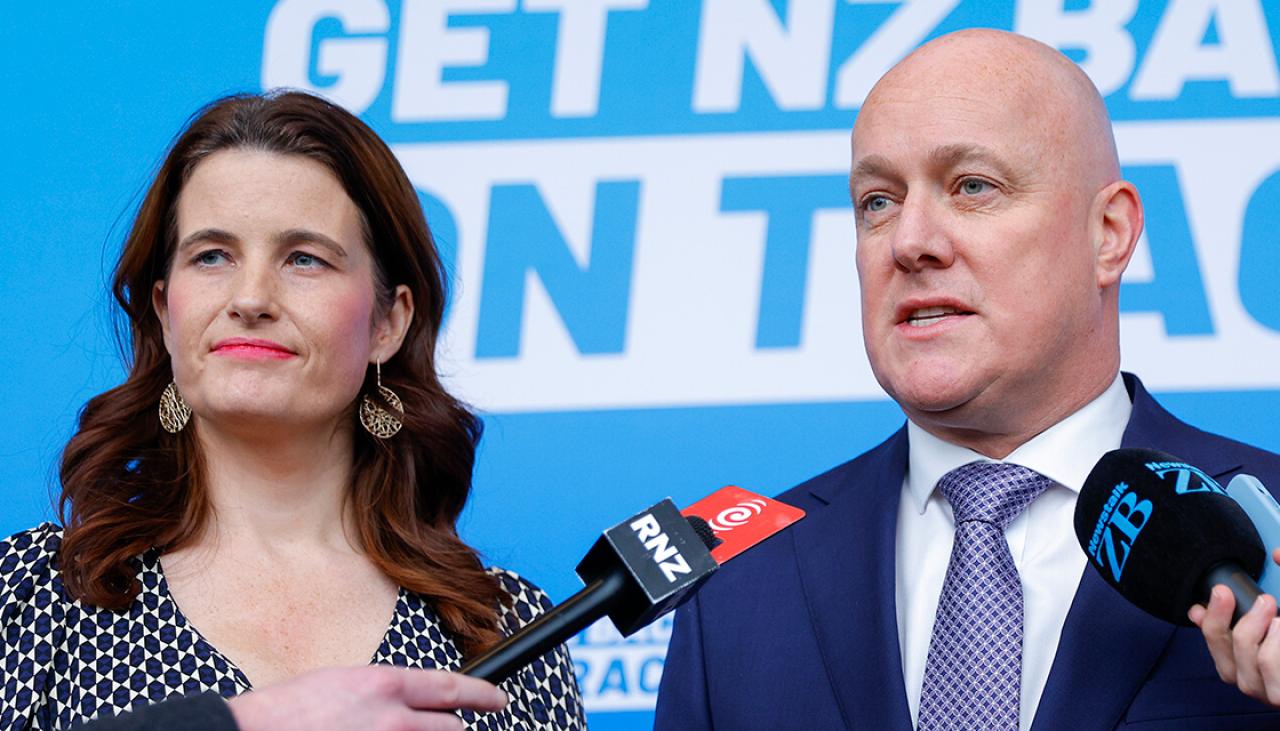
PHOTO: National thinks it has an answer. If re-elected, it is promising to dramatically widen access to the government’s First Home Loan scheme, which allows eligible buyers to purchase a property with a deposit as low as 5%.
National wants thousands more Kiwis to access government-backed 5% deposit home loans. It sounds like a ticket into home ownership. But in a market where prices can still fall, Property Noise asks an uncomfortable question: are we helping young buyers onto the ladder — or putting them dangerously close to falling off it?
For generations of New Zealanders, the hardest part of buying a first home has been brutally simple:
The deposit.
You might earn a decent salary.
You might comfortably pay $700 or $800 a week in rent.
You might have stable employment.
But accumulating a 20% deposit while simultaneously paying rent and living costs can take years.
National thinks it has an answer.
If re-elected, it is promising to dramatically widen access to the government’s First Home Loan scheme, which allows eligible buyers to purchase a property with a deposit as low as 5%.
The headline sounds fantastic:
GET INTO YOUR FIRST HOME WITH JUST 5% DOWN.
But there’s another way of writing exactly the same proposition:
BORROW UP TO 95% OF THE VALUE OF YOUR HOUSE.
And that’s where this gets interesting.
National Wants to Open the Door Much Wider
The existing Kāinga Ora First Home Loan scheme allows eligible borrowers to buy with a 5% deposit, with participating lenders issuing the mortgages and Kāinga Ora underwriting the loans.
Currently, income caps significantly restrict eligibility.
According to National’s proposal, the cap would jump to:
$300,000 combined income.
That would apply whether the application involved a single income or combined incomes.
National housing spokesperson Chris Bishop argues the existing thresholds — $95,000 for an individual without dependants and $150,000 for multiple buyers or a single buyer with dependants — no longer reflect New Zealand incomes.
His examples make the political argument compelling.
A junior doctor earning $100,000 can currently miss out.
So can an electrician earning $85,000 buying with a teacher earning $78,000.
Two recently graduated police officers earning $77,000 each can also exceed the current combined threshold.
Bishop says around half of first-home buyers earn more than $146,000.
His argument is straightforward:
These people can afford the mortgage. They just can’t accumulate the deposit.
And there’s plenty of truth in that.
But affordability and equity are two very different things.
Here’s the Part That Should Make Buyers Think
Imagine a couple buys a house for:
$700,000
With a traditional 20% deposit:
Deposit: $140,000
Mortgage: $560,000
That’s a substantial equity cushion.
Now buy the same property with 5%.
Deposit: $35,000
Mortgage: $665,000
Suddenly, your entire equity buffer is just:
$35,000.
Now imagine the market falls 5%.
Your $700,000 house is theoretically worth:
$665,000.
Your original equity has effectively disappeared before allowing for principal repayments.
Fall 10%?
The property is worth approximately:
$630,000.
Against an original mortgage of $665,000.
That’s roughly $35,000 underwater at the outset of the example, before allowing for mortgage principal subsequently repaid.
Welcome to:
NEGATIVE EQUITY.
That’s Not a Prediction
This distinction is critical.
Property Noise is not predicting house prices will fall 10%.
Nobody knows precisely where prices will be next year.
And negative equity doesn’t automatically mean financial disaster.
If you’ve got secure employment, can comfortably service the mortgage and intend to own the property for 10 or 20 years, its value on any particular Tuesday may be largely irrelevant.
You keep paying the mortgage.
Your debt gradually falls.
Eventually the market may rise.
The problem appears when life doesn’t follow the plan.
What Happens If You Have to Sell?
That’s where 95% lending becomes much more interesting.
People separate.
Jobs disappear.
People get sick.
Families relocate.
Interest rates change.
Babies arrive.
Someone needs to move overseas.
Sometimes a house simply has to be sold.
If you’ve borrowed close to the entire purchase price and the property has subsequently fallen in value, selling may not produce enough money to repay the mortgage.
Then add:
🏠 Real estate commission
⚖️ Legal expenses
📋 Marketing costs
🚚 Moving costs
🔧 Maintenance and repairs
A first-home buyer doesn’t necessarily need a housing crash to find themselves in trouble.
With only 5% starting equity, a relatively modest price movement can matter.
And Look at the Market We’re Putting Them Into
This is where National’s proposal becomes politically fascinating.
Only days ago, Property Noise reported that national average asking prices remain around 3% below August 2023 levels, while the number of properties available for sale is approximately 45% higher than three years ago.
Meanwhile, the Reserve Bank has just increased the OCR to 2.75%, citing inflationary pressure.
In other words, this isn’t a runaway housing market where buyers desperately need help catching prices before they disappear over the horizon.
We’re talking about helping buyers take on very highly leveraged mortgages in a market where prices have been broadly flat and buyers have considerably more choice.
That doesn’t automatically make the policy bad.
But it absolutely makes the risk worth discussing.
The Government Takes Risk Too
There’s another important feature of the scheme.
These aren’t simply ordinary 95% bank mortgages.
First Home Loans are issued by participating lenders and underwritten by Kāinga Ora, which reduces some of the risk faced by lenders.
That’s precisely why lenders can offer qualifying buyers lower-deposit loans they might otherwise decline.
So National isn’t simply saying:
“Banks should lend more money.”
It’s effectively using a government-backed mechanism to help overcome the deposit hurdle.
Around 4,000 of approximately 25,000 first-home buyers last year used the scheme, according to Bishop.
National expects widening eligibility could allow thousands more to participate.
That’s potentially significant.
But Here’s the $300,000 Question
National proposes allowing households earning up to:
$300,000
to access the scheme.
And this is where critics will reasonably ask:
At what point does a first-home assistance programme stop helping people who need assistance and start helping relatively high-income households leverage themselves into property sooner?
A household earning $280,000 isn’t poor.
Their problem may genuinely be accumulating a deposit — particularly in Auckland.
But should taxpayers underwrite a low-deposit pathway for households earning nearly $300,000?
That’s a legitimate policy debate.
National Says the Deposit IS the Problem
And Chris Bishop has a strong counterargument.
A household’s income doesn’t tell you how much cash it has sitting in the bank.
A couple might earn $160,000 or $200,000 combined but simultaneously face:
💸 High rent
👶 Childcare
🍎 Food inflation
🚗 Transport costs
📈 Insurance and rates
💰 Other household expenses
Saving $150,000 for a conventional Auckland deposit can remain extremely difficult.
Meanwhile, that same household might comfortably demonstrate it can service a mortgage.
So why force them to spend another five years renting simply because they haven’t accumulated an arbitrary 20%?
That’s the strongest argument for National’s policy.
And Remember What National Scrapped
There’s also an interesting political contradiction.
The coalition abolished Labour’s First Home Grant in 2024.
That programme provided qualifying first-home buyers with up to $10,000 towards buying a property.
National’s argument is that handing buyers cash was a blunt and ineffective intervention.
Instead, it wants to attack what it sees as the real barrier:
The deposit requirement itself.
The philosophical difference is fascinating.
Rather than helping buyers accumulate more equity, the new approach makes it easier for them to purchase with less equity.
Read that again.
Because that’s essentially the policy.
Is 5% Actually Enough Skin in the Game?
There’s nothing inherently reckless about a 5% deposit mortgage.
For the right borrower, buying the right property at the right price, it can be transformational.
Someone who would otherwise spend another five years renting could start building equity immediately.
But there’s a danger in turning:
“You don’t need a 20% deposit”
into:
“You should buy with a 5% deposit.”
Those are completely different messages.
A government scheme can make somebody eligible to borrow.
It doesn’t necessarily mean borrowing the maximum amount available is financially wise.
Could The Policy Actually Push Prices Higher?
There’s another uncomfortable possibility.
If National makes thousands more people eligible to buy without simultaneously increasing housing supply enough, those buyers don’t magically create additional houses.
They compete for existing ones.
More purchasing power chasing the same homes can support prices.
So a policy designed to solve housing affordability could, at least at the margin, increase demand for housing.
That’s been one of New Zealand’s great housing-policy contradictions for decades:
We keep trying to make houses more affordable by giving people more ability to pay for them.
The Real Winner Could Be the Property Industry
There will certainly be one group unlikely to complain about thousands of additional qualified buyers entering the market.
Real estate agents.
More eligible purchasers potentially means:
More open-home traffic.
More offers.
More competition.
More transactions.
More commissions.
Mortgage advisers and lenders potentially benefit too.
That doesn’t invalidate the policy.
But let’s not pretend increasing the pool of people able to purchase property doesn’t have commercial winners.
Property Noise Take: Help Them Buy — But Don’t Sell Them a Fairytale
Helping young New Zealanders own homes is a worthy objective.
New Zealand’s home-ownership rate is around 66%, and National wants to push it towards 74%.
If someone has a strong income, secure employment, manageable expenses and the ability to comfortably service their debt, preventing them from buying solely because they have 10% rather than 20% may make little sense.
But 5% equity leaves almost no room for error.
That’s the part politicians shouldn’t gloss over.
If we’re going to encourage thousands more first-home buyers into highly leveraged mortgages, those buyers deserve to understand exactly what happens if prices move against them.
Because getting somebody into a house isn’t the ultimate measure of successful housing policy.
Keeping them there is.
The question isn’t simply:
“Can they afford to buy?”
It should also be:
“Can they afford for things to go wrong?”
And when the government is helping people purchase homes with just 5% equity, that’s a question worth asking very loudly.
🔥 HAVE YOUR SAY
Is National finally tackling the real barrier stopping first-home buyers?
Or are we potentially encouraging young Kiwis to take on 95% mortgages with virtually no protection against falling house prices?
👇 Would YOU buy a house today with only a 5% deposit?