
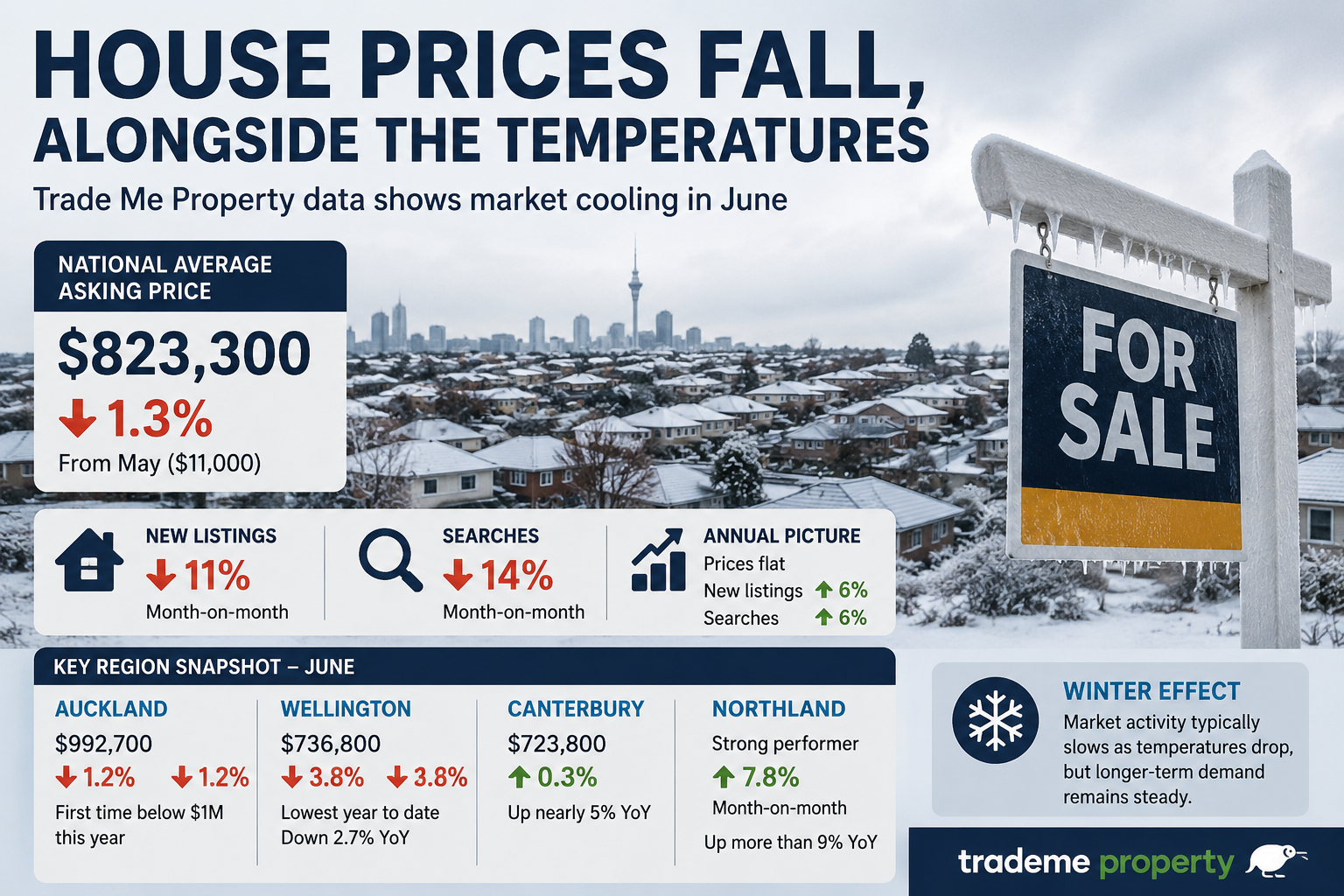
PHOTO: One of the more interesting aspects of today’s market is the difference in messaging coming from major property organisations.
New Zealand’s property market appears to be sending mixed signals, leaving buyers, sellers and investors wondering which narrative best reflects reality.
The latest Trade Me Property Price Report shows a market that cooled noticeably during June, with national asking prices, new listings and buyer demand all falling as winter took hold.
The figures contrast with increasingly optimistic commentary from other parts of the property industry, raising questions about whether some market commentary is getting ahead of the underlying data.
Prices Continue to Ease
According to Trade Me Property, the national average asking price fell 1.3% during June, dropping around $11,000 to $823,300.
The softer pricing was accompanied by declining market activity:
- New listings fell 11% month-on-month.
- Buyer searches declined 14%.
- Auckland‘s average asking price slipped below $1 million for the first time this year.
- Wellington recorded one of the largest monthly declines, with asking prices falling 3.8%.
While seasonal slowdowns are common during winter, the report suggests the market remains subdued in many parts of the country.
Regional Picture Remains Mixed
Not every region followed the national trend.
Northland recorded a strong monthly increase in asking prices, while Canterbury remained relatively stable with modest annual growth.
However, isolated regional strength does not necessarily indicate a nationwide recovery.
Regional markets often experience greater price volatility because relatively small numbers of higher-value listings can significantly influence average asking prices.
Why Are Market Messages So Different?
One of the more interesting aspects of today’s market is the difference in messaging coming from major property organisations.
Some industry commentary has increasingly focused on improving confidence, stronger enquiry levels and signs that the market is turning.
Meanwhile, Trade Me’s latest figures point to:
- Lower asking prices
- Reduced buyer activity
- Fewer new listings
- Continuing caution in major metropolitan markets
Both sets of information can technically be correct.
Confidence may indeed be improving, while prices remain under pressure.
Buyer enquiry can increase without immediately translating into higher sale prices.
Likewise, lower interest rates may encourage more people to inspect properties, yet affordability constraints and higher housing supply can still limit price growth.
Asking Prices Are Not Sale Prices
Another important point is that asking prices are only one measure of the market.
The amount a seller hopes to achieve does not always reflect what buyers are ultimately prepared to pay.
Actual sale prices, auction clearance rates, inventory levels and days on market all contribute to a fuller picture of market conditions.
This is why property analysts often caution against relying on any single indicator in isolation.
A Market Still Searching for Direction
There is little doubt that conditions have improved compared with the sharp downturn experienced over recent years.
Interest rates have eased from their peak, inflation has moderated and buyer confidence has gradually improved.
However, many buyers remain cautious.
Higher living costs, tighter lending requirements than previous cycles and relatively high housing supply continue to place pressure on prices in many areas.
What Does It Mean for Buyers?
For buyers, the current environment may still offer opportunities.
Negotiating power generally improves when:
- Listings remain plentiful.
- Competition between buyers is limited.
- Vendors are motivated to sell.
While some commentators continue to predict stronger price growth ahead, the latest Trade Me data suggests the market has yet to establish a broad-based recovery.
Property Markets Rarely Move in Straight Lines
Property cycles are influenced by many factors, including:
- Interest rates
- Employment
- Population growth
- Housing supply
- Consumer confidence
- Bank lending policies
Rather than moving steadily upward or downward, markets often experience periods of mixed and conflicting signals.
Today’s housing market appears to be one of those periods.
As always, buyers and sellers are likely to benefit most by looking beyond headlines and considering multiple data sources before making significant property decisions.