
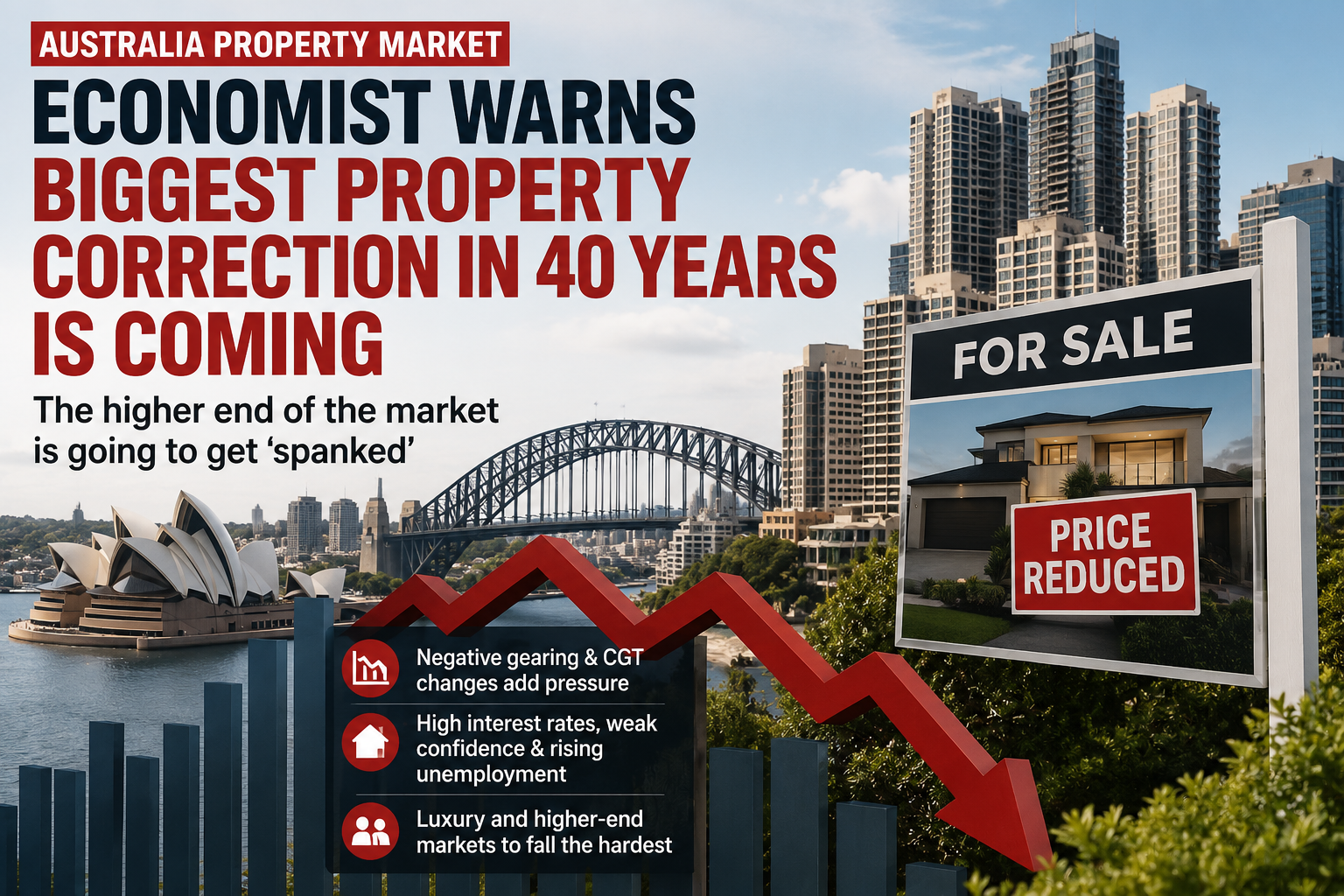
PHOTO: Higher-priced property markets tend to be more sensitive to changes in borrowing capacity.
Australia could be heading towards its largest national property price correction in four decades, with prestige homes and expensive inner-city markets potentially facing the sharpest falls.
MacroBusiness economist Leith van Onselen has warned that changes to negative gearing and capital gains tax concessions could intensify a housing downturn already being driven by high interest rates, weak consumer confidence and rising unemployment.
His forecast challenges the long-held belief that Australia’s chronic housing shortage will continue protecting property prices from a significant fall.
While affordable homes may remain supported by first-home buyer demand and limited supply, van Onselen believes the upper end of the Australian property market could experience a much more painful correction.
Australia’s Real Estate Agent Shakeout Has Begun: “Get Better or Get Out”
Economist Predicts Australia’s Biggest Housing Correction in Decades
Speaking on the Follio Property Podcast, van Onselen predicted that Australia could experience its largest property downturn in approximately 40 years.
Australia’s biggest national decline over that period has reportedly been about 8.2%, according to property data referenced during the discussion.
Van Onselen believes the next correction could exceed that figure.
However, he does not expect every property type or price bracket to be affected equally.
The most affordable 40% of the housing market may prove relatively resilient because buyers remain concentrated in lower price ranges. First-home buyers, downsizers and investors searching for higher rental yields could continue competing for these properties.
The top end of the market may face a different reality.
Luxury houses, expensive inner-city apartments and properties bought during peak conditions could be particularly vulnerable if highly leveraged buyers retreat and vendors are forced to lower their expectations.
Why Australia’s Prestige Property Market Could Fall Hardest
Higher-priced property markets tend to be more sensitive to changes in borrowing capacity.
When mortgage rates increase, the amount buyers can borrow falls. This matters most in premium suburbs where purchasers may require multimillion-dollar loans to complete a transaction.
A relatively small change in borrowing power can remove hundreds of thousands of dollars from a buyer’s maximum budget.
The prestige market can also be affected by:
- Lower business and consumer confidence
- Falling investment portfolios
- Reduced bonus and commission income
- Higher mortgage repayments
- Fewer foreign and investor buyers
- Longer selling periods
- Vendors remaining anchored to peak-market prices
Affordable homes may continue receiving multiple offers because a large section of the buyer pool is competing within the same limited price range.
At the top end, demand can disappear more quickly.
When fewer buyers are willing or able to purchase a $2 million or $3 million home, vendors may need to accept substantial discounts to secure a sale.

MacroBusiness economist Leith van Onselen (pictured) predicted Australia will have the biggest property price correction in decades during an interview on the Follio Property Podcast
Negative Gearing and Capital Gains Tax Changes Under Scrutiny
Van Onselen’s warning centres partly on the Albanese government’s planned changes to property investor tax concessions.
Under the reforms described in the economist’s interview, investors would no longer be able to offset property losses against wage income in the same way, while the capital gains tax discount would also be reduced.
The changes are scheduled to take effect from July 1, 2027.
The policy is intended to reduce speculative investor demand and improve opportunities for first-home buyers.
However, critics argue that removing investment incentives during a housing downturn could accelerate price declines and discourage the construction or purchase of rental properties.
Van Onselen believes the reforms have been introduced at an especially dangerous point in the property cycle.
He argues that similar changes may have been easier for the market to absorb during a period of strong price growth, falling interest rates and high consumer confidence.
Instead, Australia is facing the reforms while property values are already under pressure.
Interest Rates Are Already Hitting Australian House Prices
The property market is also adjusting to a much tougher interest-rate environment.
Higher rates affect house prices in several ways.
Existing homeowners must allocate more of their income to mortgage repayments. New buyers are assessed against stricter serviceability requirements. Investors face higher holding costs, while developers encounter more expensive construction and financing conditions.
Van Onselen said Australia’s cash rate was already at its highest level in approximately 15 years following multiple increases from the Reserve Bank of Australia.
Financial markets had also been considering whether another rate rise might be required.
Even without further increases, the full impact of previous rate hikes can take time to flow through the property market.
Fixed mortgage terms expire, borrowers refinance and household budgets are gradually squeezed.
This can result in:
- Reduced borrowing capacity
- Fewer buyers attending inspections
- Weaker auction competition
- Longer days on market
- Higher property listings
- More distressed or motivated vendors
- Lower offers becoming more common
The combination of investor tax reforms and restrictive monetary policy has led van Onselen to describe the timing as particularly poor.
Australia’s 25-Year Property “Super Cycle” May Be Ending
Australian property prices have experienced extraordinary long-term growth.
Over the past 25 years, falling interest rates, easier credit, population growth, tax incentives and limited housing supply have helped push values sharply higher.
Van Onselen believes this extended property super cycle may now be reaching its conclusion.
He argues that easy access to credit has played a greater role in house price growth than migration alone.
Population growth increases the need for housing, but buyers still require access to finance before that demand can be converted into higher prices.
When banks lend more generously and interest rates are falling, buyers can bid more.
When credit conditions tighten, even severe housing shortages may not prevent prices from falling.
This is why borrowing capacity remains one of the most important influences on Australian property values.
New Zealand’s Housing Crash Offers a Warning
Van Onselen also pointed to New Zealand as a possible warning for Australia.
New Zealand introduced tighter investor rules before experiencing one of the steepest property downturns in its recent history.
A later government subsequently reversed or softened several of those policies.
Van Onselen suggested Australia could eventually follow a similar political cycle.
If property values fall significantly and homeowners begin feeling poorer, pressure could build on the federal government to reconsider its investor tax policies.
Property policy can be politically difficult because measures intended to improve affordability may also reduce household wealth.
Younger Australians and aspiring buyers may welcome falling prices. Existing homeowners, investors and retirees may be much less enthusiastic once the value of their own properties begins declining.
AMP Forecasts a More Moderate Australian Property Downturn
Not every economist expects a historic housing collapse.
AMP chief economist Shane Oliver has also forecast further property price falls, but his outlook is considerably less severe.
National dwelling values had reportedly fallen about 1% from their peak after rising approximately 26% over the previous three years.
Oliver expects prices to decline around 2% during the calendar year and approximately 6% over the following 12 months.
He warned that the correction could become larger if unemployment rises significantly.
This highlights the importance of the labour market.
Australian homeowners can often manage high repayments while they remain employed. The risk of forced sales increases when borrowers lose jobs or experience reduced income.
A rise in unemployment could therefore transform a manageable property slowdown into a deeper correction.
Australia’s Housing Shortage Could Limit Price Falls
Australia continues to face a chronic shortage of homes.
Housing construction has failed to keep pace with population growth, while building approvals remain below the target of 240,000 new homes per year under the national Housing Accord.
High interest rates may make the shortage worse.
Developers are less likely to launch projects when construction costs are elevated, credit is expensive and presales are difficult to secure.
Builders are also dealing with labour shortages, insolvencies, material expenses and compressed profit margins.
This limited supply could prevent Australian property prices from collapsing as dramatically as they might in a better-supplied market.
Even in a downturn, people still need somewhere to live.
Strong rental demand and low vacancy rates may continue supporting investor interest in selected suburbs, particularly where properties offer attractive yields.
The market could therefore become increasingly divided.
Affordable homes in undersupplied areas may remain competitive, while expensive properties in discretionary markets experience substantial falls.
Falling House Prices Could Improve Affordability for Younger Australians
Although homeowners may fear a correction, van Onselen believes lower property prices would ultimately benefit younger Australians.
He said he was more concerned about his children’s ability to purchase a home than preserving the paper value of his own debt-free property.
This reflects a broader debate about housing affordability.
Australia’s property boom has rewarded existing homeowners while making it increasingly difficult for younger buyers to enter the market without family assistance.
A lower purchase price can reduce:
- The deposit required
- Mortgage repayments
- Interest paid over the life of the loan
- Lenders mortgage insurance
- Household financial stress
- Dependence on parental support
However, falling prices do not automatically make homes affordable.
If prices decline because interest rates and unemployment are rising, buyers may still struggle to obtain finance.
The ideal outcome for first-home buyers would be lower prices combined with secure employment and gradually falling mortgage rates.
Could the Reserve Bank Stop Raising Interest Rates?
Van Onselen also broke with economists expecting further rate rises.
He believes unemployment may increase more sharply than the Reserve Bank currently anticipates.
If the labour market weakens, the RBA may decide that further rate increases would place too much pressure on households and the wider economy.
This could bring the rate-hiking cycle to an end sooner than financial markets expect.
A pause in interest rates would provide some support for property prices, but it might not immediately reverse the downturn.
Housing markets respond to confidence as well as borrowing costs.
Buyers may remain cautious if they believe prices have further to fall, while vendors can take months to accept that market conditions have changed.
Which Australian Property Markets Are Most at Risk?
A nationwide correction would not produce identical results across every suburb.
Areas at greater risk may include:
- Prestige suburbs with highly leveraged owners
- Apartment markets with large levels of new supply
- Locations heavily dependent on investors
- Suburbs where prices rose fastest during the boom
- Markets with weak rental yields
- Regions exposed to job losses
- Properties purchased recently with small deposits
- Homes requiring extensive renovations or maintenance
More resilient markets may include:
- Affordable suburbs close to employment
- Areas with limited listings
- Properties offering strong rental yields
- Family homes in established school zones
- Locations receiving major infrastructure investment
- Markets with diverse local employment
- Entry-level homes attracting first-home buyers
The result may be less of a uniform national crash and more of a two-speed property correction.
What Australian Property Owners Should Watch
Homeowners and investors should avoid making decisions based on a single dramatic forecast.
However, several indicators could reveal whether the downturn is deepening:
- Unemployment: A sharp increase could lead to more forced sales.
- Auction clearance rates: Persistently weak results may indicate falling buyer demand.
- New property listings: Rising supply can place additional pressure on vendors.
- Days on market: Longer campaigns suggest buyers are gaining negotiating power.
- Mortgage arrears: Increasing arrears may signal household stress.
- Interest-rate expectations: Lower rate forecasts could stabilise confidence.
- Investor lending: A major decline may affect rental supply and property demand.
- Prestige sales: Large discounts at the top end can influence sentiment across the wider market.
Is Australia Really Facing Its Biggest Property Crash in 40 Years?
The warning from Leith van Onselen is among the most bearish property forecasts currently being discussed.
His prediction rests on several risks occurring together: high interest rates, weakening employment, poor sentiment, investor tax changes and reduced borrowing power.
Other economists expect a more moderate decline, arguing that Australia’s severe housing shortage, population growth and limited construction pipeline will continue putting a floor under prices.
Both outcomes remain possible.
What appears increasingly clear is that Australia’s housing market is no longer being supported by the powerful combination of cheap credit, investor tax incentives and widespread buyer FOMO.
The next phase is likely to reward buyers with strong finances and punish vendors who refuse to adjust their expectations.
For the premium end of the market, the correction could be particularly uncomfortable.
And if van Onselen is correct, Australia may be approaching a property downturn not seen in four decades.