








PHOTO: Australia’s housing market has turned sharply.
Australian homeowners have become accustomed to one seemingly reliable rule.
House prices might fall – but they always come roaring back.
For decades, property downturns have generally been relatively short-lived before lower interest rates, government stimulus, population growth or another wave of buyers sent prices climbing again.
But what if this time really is different?
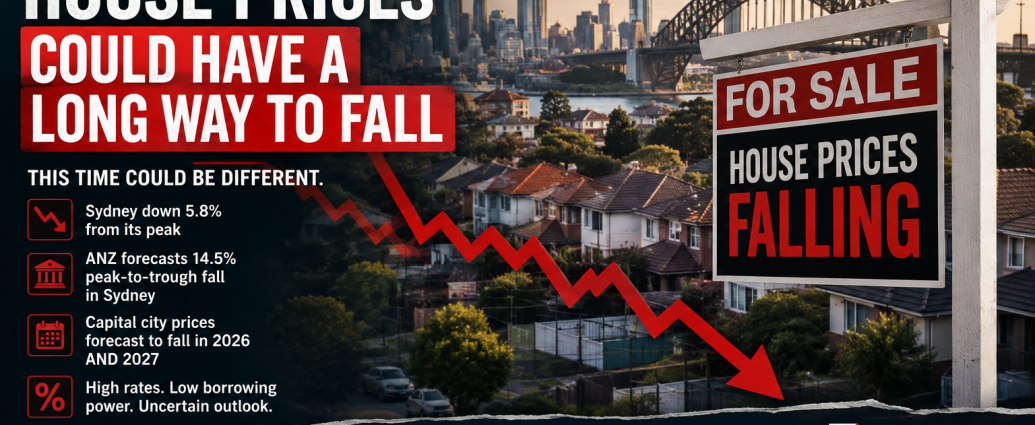
Australia’s housing market has turned sharply in 2026, with Sydney already down around 5.8% from its February peak, national prices falling and some major bank economists now forecasting considerably larger declines ahead.
And Australians looking across the Tasman might want to pay attention.
Because New Zealand has already experienced what many Australian homeowners once thought virtually impossible:
A major housing correction that lasted for years.
Could Australia be heading down the same road?
Australian House Prices Are Already Falling
The downturn is no longer theoretical.
Across Australia’s five major capital cities, dwelling values have fallen around 3.2% from their peak, according to figures cited by Yahoo Finance Australia.
But the national figure hides some significant differences.
Sydney has led the decline.
The city’s median dwelling value is already approximately 5.8% below its early-February peak.
Adelaide, by comparison, has proven considerably more resilient, falling only around 0.6% from its June high.
Recent Cotality data also shows the momentum changing quickly. By late June, combined capital-city values were falling on a rolling basis, with Sydney and Melbourne among the markets recording declines.
And some economists think this is only the beginning.
Sydney House Prices Could Fall Almost 15%
Perhaps the number that will make Sydney homeowners pay attention is:
14.5%.
ANZ economists reportedly expect Sydney property values to decline around 14.5% from peak to trough.
Across the capital cities, ANZ has forecast prices falling 4.3% during 2026, followed by another 3.4% decline in 2027.
If those forecasts prove correct, Australia’s housing correction won’t simply be a short-lived dip.
It could stretch across multiple years.
And that’s where the comparison with New Zealand becomes interesting.
Australians Should Look Across the Tasman
New Zealand provides a useful warning about what happens when an extraordinary housing boom finally runs out of steam.
NZ property prices exploded during the pandemic.
Cheap money, extraordinarily low mortgage rates and intense buyer FOMO pushed values to levels few would have imagined only a few years earlier.
Then interest rates rose.
And everything changed.
New Zealand property values subsequently suffered one of their largest corrections in decades.
Even in 2026, the recovery many homeowners expected has failed to properly materialise.
House prices remain substantially below their previous peak in many areas.
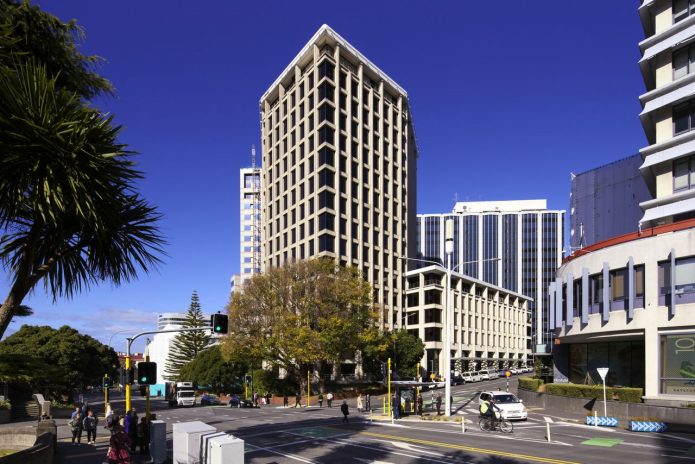
Auckland and Wellington have been particularly weak.
And rather than another property boom, buyers have been greeted by large amounts of housing stock and considerably greater negotiating power.
Australia isn’t New Zealand.
But neither is it immune from the forces that drove the NZ correction.
Why This Australian Downturn Could Be Different
Historically, Australian governments and the Reserve Bank have had plenty of ammunition when property markets weakened.
Interest rates could be cut.
First-home buyer incentives could be expanded.
Government stimulus could be introduced.
Credit conditions could improve.
And buyers would return.
But 2026 presents a different problem.
Inflation.
The Reserve Bank still needs to bring inflation sustainably back towards its 2–3% target.
That limits how aggressively monetary policy can be used simply because house prices are falling.
The RBA has repeatedly emphasised that monetary policy is directed towards inflation and employment – not maintaining property values.
That matters enormously.
Homeowners shouldn’t necessarily assume the cavalry will arrive simply because Sydney house prices fall 10%, 15% or even more.
The RBA Has Already Done Plenty
Australian borrowers have already been hit hard.
The RBA has tightened monetary policy, reducing borrowing capacity and increasing repayments for heavily indebted households.
And interest rates work with a lag.
A rate rise today doesn’t instantly flow through every household budget.
It takes time.
Borrowers roll off fixed rates.
Households refinance.
Potential buyers discover banks will lend them less.
Investors reconsider whether the numbers still stack up.
Eventually, those changes feed through into property prices.
That process may still be playing out.
Falling House Prices Could Actually Help the RBA
There’s another interesting twist.
A weaker property market could make the Reserve Bank’s job easier.
When house prices rise strongly, homeowners can feel wealthier.
They borrow.
They renovate.
They spend.
When property prices decline, the reverse can happen.
Households become cautious.
Consumer spending slows.
And that reduces demand within the wider economy.
So while homeowners may desperately want the RBA to rescue property prices, falling house prices themselves could help achieve the economic slowdown required to bring inflation under control.
That creates an unusual situation.
The RBA may not actually want to stop the correction.
Australia Has Spent Decades Protecting Property
Australian property has benefited from an extraordinary collection of structural supports.
Population growth.
Tax concessions.
Negative gearing.
Capital gains tax treatment.
First-home buyer assistance.
Government grants.
Restricted housing supply.
Falling interest rates.
Easy credit.
All of these have contributed, in different ways and at different times, to one of the world’s most expensive residential property markets.
But political attitudes towards housing are changing.
Prime Minister Anthony Albanese recently cited criticism of what has been described as “taxpayer-funded landlord welfare” while defending government measures aimed at improving housing affordability.
That language would have been almost unthinkable from an Australian prime minister during previous property downturns.
The political priority may increasingly be housing affordability, rather than protecting existing homeowners from falling prices.
Is a 15% Fall Really a Property Crash?
It sounds dramatic.
But context matters.
Australian property values have increased enormously over the past two decades.
In many markets, a 10% or even 15% correction would simply erase a portion of relatively recent gains.
For a homeowner who bought 15 years ago, that may be uncomfortable but manageable.
For someone who purchased at the top of the market with a small deposit?
That’s a very different story.
A buyer purchasing a $1.5 million Sydney property with a 10% deposit starts with $150,000 of equity.
If that property falls 15%, its theoretical value becomes around $1.275 million.
That’s a $225,000 decline.
The owner’s original equity can disappear remarkably quickly.
They still own the house.
They still owe the mortgage.
But selling becomes much more difficult.
Australia Has Been Here Before – Sort Of
Sydney experienced a substantial correction during the previous interest-rate cycle.
Between February 2022 and January 2023, values fell around 12.4%.
Then the market recovered.
That’s precisely why many Australian homeowners may not be particularly worried today.
They’ve seen this movie before.
Prices fall.
Buyers return.
Prices recover.
But the international examples show that recovery isn’t guaranteed to happen quickly.
America Learned This During the GFC
American homeowners discovered that lesson brutally during the Global Financial Crisis.
US property prices fell substantially after the housing bubble burst, leaving millions of homeowners with properties worth less than their mortgages.
In some markets it took years for prices to recover.
Australia avoided anything remotely comparable.
Its banking system remained relatively strong and the economy benefited enormously from China’s resources boom and significant government stimulus.
But the lesson remains relevant.
Property prices can fall much further – and stay down much longer – than homeowners expect.
New Zealand May Be the More Relevant Warning
For Australians, New Zealand is arguably an even more interesting comparison.
Both countries have:
Expensive housing.
High household debt.
Large mortgages.
Strong cultural attachment to property investment.
Banking systems dominated by many of the same institutions.
High immigration.
And property markets that experienced extraordinary pandemic-era booms.
New Zealand’s correction demonstrated that none of those factors guarantees continuously rising house prices.
Once borrowing capacity collapsed and buyers disappeared, prices adjusted.
And years later, the market is still dealing with the aftermath.
The Biggest Change Could Be Psychological
Housing markets aren’t driven solely by interest rates and spreadsheets.
They’re also driven by psychology.
During a boom:
“Buy now before prices rise again.”
During a downturn:
“Why buy today if it might be cheaper in six months?”
That second question can become extremely powerful.
Buyers wait.
Auction clearance rates weaken.
Properties sit longer.
Vendors become more negotiable.
Comparable sales establish lower prices.
Banks value neighbouring properties lower.
And the cycle feeds on itself.
That’s exactly how a relatively modest property correction can become something larger.
First-Home Buyers May Finally Get Their Opportunity
There is, of course, another side to falling property prices.
Australia has spent years talking about its housing affordability crisis.
Young Australians have watched property prices climb dramatically faster than wages while deposits became increasingly difficult to accumulate.
If prices genuinely fall 10%, 15% or even 20%, there will undoubtedly be homeowners who suffer.
But there will also be people who finally get an opportunity to enter the market.
That’s the uncomfortable reality of housing affordability.
You cannot simultaneously demand dramatically more affordable housing while insisting that existing property values must never decline.
Could Australian House Prices Fall 20%?
Nobody knows.
And anyone claiming they know exactly where the bottom sits should probably be treated cautiously.
Australia still has significant factors supporting property.
Population growth remains strong.
Housing remains undersupplied in many locations.
Construction costs are high.
Rental markets remain tight.
And quality property in desirable locations will always attract buyers.
But none of those factors means prices cannot fall.
New Zealand proved that.
America proved that.
Canada has experienced its own substantial housing corrections.
The question for Australia isn’t whether property values can fall significantly.
They can.
The question is how far policymakers will allow the correction to run before economic conditions force them to intervene.
This Time Really Could Be Different
For decades, betting against Australian residential property has generally been a losing strategy.
Every correction eventually ended.
Every downturn eventually became another buying opportunity.
And every new record price made the previous one look cheap.
That history understandably gives Australian homeowners confidence.
But history doesn’t guarantee what happens next.
Sydney is already down around 5.8%.
Major banks are forecasting substantially larger declines.
Borrowing capacity has been squeezed.
Inflation is restricting the RBA’s options.
And Australia’s political conversation is increasingly focused on making housing more affordable, not protecting property investors from every downturn.
Perhaps prices rebound again.
Perhaps Australia’s enormous housing shortage puts a floor underneath the market.
Or perhaps Australians are about to learn the same lesson their neighbours across the Tasman have learned over the past few years.
House prices don’t always bounce back quickly.
And if this correction has only just begun, Australia’s property market could still have a long way to fall.
SOURCE: YAHOO