
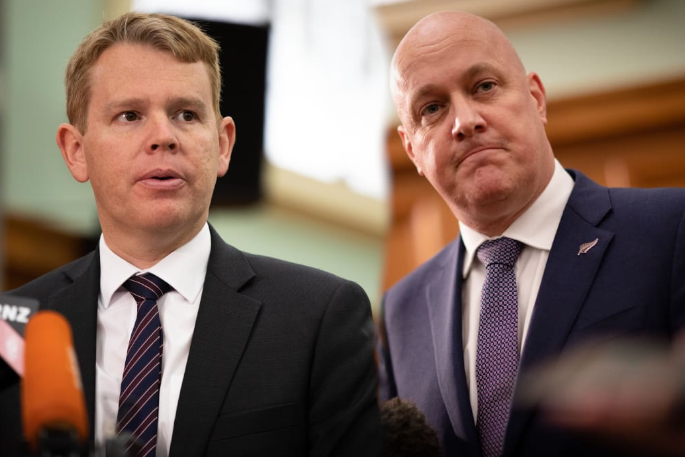








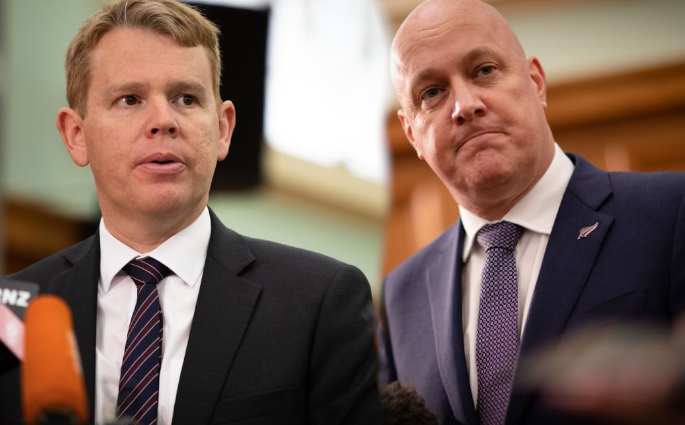
PHOTO: National may win the most votes – but that does not guarantee Christopher Luxon will remain prime minister.
With the 2026 New Zealand general election scheduled for Saturday, November 7, the campaign has entered its decisive final weeks.
The latest polls do not show a simple race between National and Labour. They reveal a fractured electorate, historically weak support for both major parties and a rapidly expanding group of voters looking elsewhere.
National and Labour are tied at just 28% in the latest 1News Verian poll. The Greens have surged to a record 16%, ACT sits on 11%, New Zealand First is on 9%, and the Opportunity Party has reached 6%.
If repeated on election day, neither the National-led nor Labour-led bloc could govern without a complicated coalition deal.
So, who will actually win the 2026 New Zealand election?
After examining the latest polling, the final polls from 2023, the actual 2023 election result, minor-party thresholds and the likely impact of special votes, the Property Noise prediction is:
National is slightly more likely to finish as the largest party, but the race to form the next government is effectively too close to call. Our narrow pick is a National–ACT–NZ First government returning with the smallest of majorities.
That is not a confident prediction.
It could be overturned by one party: Opportunity.
The latest 2026 New Zealand election poll
The 1News Verian poll conducted between September 23 and 27 produced the following party-vote result:
| Party | Latest 1News Verian poll |
|---|---|
| National | 28% |
| Labour | 28% |
| Green Party | 16% |
| ACT | 11% |
| New Zealand First | 9% |
| Opportunity | 6% |
| Te Pāti Māori | 1.2% |
| Others | 1% |
National and Labour would each receive approximately 34 seats under a conventional 120-seat calculation.
The Greens would secure around 19 seats, ACT 14, New Zealand First 11 and Opportunity seven.
That would leave the established blocs at approximately:
- National, ACT and NZ First: 59 seats
- Labour, Greens and Te Pāti Māori: approximately 54 seats
- Opportunity: seven seats
A government normally requires at least 61 seats, although electorate results and overhang seats could increase the size of Parliament and move the majority line.
The poll is not predicting a clean Labour victory. It is predicting a Parliament in which Opportunity could decide who becomes prime minister.
One poll says the left can govern—another gives the right 64 seats
The biggest warning against treating a single survey as a forecast is the enormous variation between reputable polls.
The September Taxpayers’ Union–Curia poll recorded:
| Party | September Curia poll |
|---|---|
| National | 29.0% |
| Labour | 25.9% |
| Green Party | 13.9% |
| ACT | 10.5% |
| New Zealand First | 8.4% |
| Opportunity | 4.5% |
| Te Pāti Māori | 2.0% |
Because Opportunity fell below the 5% threshold in that poll, it was allocated no seats. National, ACT and New Zealand First consequently reached a projected 64 seats, enough to retain government.
The latest 1News poll puts the Government parties on only 59 seats.
That five-seat difference is not principally caused by a huge movement between National and Labour.
It is caused by Opportunity crossing the 5% threshold.
That is the brutal mathematical reality of MMP: a movement of half a percentage point could effectively decide the government.
What the recent polling average tells us
Taking six significant polls conducted from August through late September—including 1News Verian, Freshwater Strategy, Anacta, Curia, Roy Morgan and RNZ–Reid Research—produces an approximate average of:
| Party | Recent six-poll average |
|---|---|
| National | 29.0% |
| Labour | 28.2% |
| Green Party | 13.6% |
| ACT | 9.5% |
| New Zealand First | 10.0% |
| Opportunity | 6.4% |
| Te Pāti Māori | 2.0% |
The average provides several important conclusions.
First, National retains a small but measurable lead over Labour.
Second, the combined National–ACT–NZ First vote sits at approximately 48.5%.
Third, Labour and the Greens together average only around 41.8%. Even after including Te Pāti Māori, the established opposition bloc remains several points behind the governing bloc.
Fourth, Opportunity is averaging above the threshold.
That means the most likely Parliament is one in which:
- National finishes slightly ahead of Labour.
- Neither traditional bloc has a guaranteed majority.
- Opportunity holds between seven and nine seats.
- The Māori electorate results potentially create an overhang.
- Coalition negotiations—not election night—determine the government.
What the 2023 polls got right
The final polls before the 2023 election correctly identified the broad result.
They showed:
- National clearly ahead of Labour.
- Labour heading for a major defeat.
- New Zealand First returning to Parliament.
- ACT remaining an essential part of the right bloc.
- The Greens comfortably clearing the threshold.
The final 1News Verian poll had National on 37%, Labour on 28%, the Greens on 14%, ACT on 9% and New Zealand First on 6%.
The official result was:
| Party | Final 1News poll | 2023 actual result | Difference |
|---|---|---|---|
| National | 37.0% | 38.08% | National +1.08 |
| Labour | 28.0% | 26.91% | Labour −1.09 |
| Greens | 14.0% | 11.60% | Greens −2.40 |
| ACT | 9.0% | 8.64% | ACT −0.36 |
| NZ First | 6.0% | 6.08% | NZ First +0.08 |
| Te Pāti Māori | 1.7% | 3.08% | Te Pāti Māori +1.38 |
| TOP | 2.3% | 2.22% | TOP −0.08 |
The final 1News poll came impressively close on National, Labour, ACT, New Zealand First and TOP.
Its largest error among the established parties was overstating Green support and understating Te Pāti Māori.
The final Newshub–Reid Research poll put National on only 34.5%, more than three points below its eventual result, while showing the Greens at 14.9%, more than three points above their actual vote.
Curia had National on 35.9%, Labour on 27.9%, the Greens on 10.6%, ACT on 9.1% and New Zealand First on 6.9%.
Across the late polling, National was generally underestimated, Labour was close, and the Greens were often overestimated.
If the same pattern occurred in 2026, it would favour the current Government.
The 2023 result provides a warning for the Greens
The Green Party’s 16% result in the latest 1News poll is extraordinary.
It would be the party’s strongest general-election performance and could deliver approximately 19 MPs.
But the 2023 evidence provides a warning.
The final 1News poll overstated Green support by 2.4 percentage points. Newshub overstated it by more than three points. If the Greens slipped from 16% to 13% or 14% on election day, their result would remain historically strong—but several projected left-bloc seats could disappear.
Some of that support may return to Labour as progressive voters make a late tactical decision about which party should lead a government.
But some Green support could also prove softer than it appears, particularly if the election campaign becomes dominated by economic management, taxation and the cost of living.
The Greens are currently the great success story of the campaign.
They are also carrying a substantial portion of the centre-left’s hopes.
Why National remains the slight favourite
National is polling dramatically below its 38.08% result in 2023.
A result of 28% or 29% would normally be disastrous for a governing party. Yet National can still win because ACT and New Zealand First are collectively polling close to 20%.
National’s advantage is not its own popularity.
It is the combined strength of the right bloc.
Across the recent six-poll average:
- National, ACT and NZ First total approximately 48.5%.
- Labour, Greens and Te Pāti Māori total approximately 43.8%.
- Opportunity sits between them on approximately 6.4%.
National therefore begins coalition negotiations with a larger established bloc.
It also benefits if Opportunity falls even slightly below 5%. Votes cast for a party that fails to qualify are excluded when proportional seats are allocated, increasing the share distributed among parties that enter Parliament.
If Opportunity receives 4.9%, the centre-right could win comfortably.
If Opportunity receives 5.1%, the centre-right could lose its majority.
This election may be decided by two-tenths of one percentage point.
Why Labour still has a genuine path to power
Labour does not need to beat National to form a government.
Under MMP, the winner is the leader capable of commanding the confidence of Parliament—not necessarily the party receiving the most votes.
Labour’s path is:
- Hold its support close to 28% or lift it during the campaign.
- Preserve the Greens’ unusually strong vote.
- Ensure Te Pāti Māori retains enough electorate representation.
- Get Opportunity safely above 5%.
- Negotiate an agreement involving as many as four parties.
The latest 1News calculation showed a Labour, Green, Te Pāti Māori and Opportunity grouping potentially reaching 65 seats under one Māori-electorate scenario.
The obstacle is political compatibility.
Labour has rejected Opportunity’s land-tax and universal-income package. National has gone further and ruled out working with Opportunity in a coalition, citing incompatible tax policies.
If National continues to exclude Opportunity, a strong Opportunity result could effectively leave the party with only one realistic route to influence: negotiating with Labour and the Greens.
That would make a Labour-led government possible even if Labour finishes second.
The Opportunity Party could decide the election
Opportunity is the single largest source of uncertainty in the 2026 election.
Recent polling has placed it anywhere from 4.5% to 9.5%.
That range covers three completely different outcomes:
Opportunity finishes below 5%
Its votes are effectively wasted for list-seat allocation unless it wins an electorate.
This would strongly favour National, ACT and New Zealand First and would probably return the current Government.
Opportunity clears 5% narrowly
It enters Parliament with approximately six or seven MPs and becomes the likely kingmaker.
Coalition negotiations could take weeks.
Opportunity reaches 7% or more
It gains a meaningful parliamentary bloc and may be able to demand substantial policy concessions.
The party’s support cannot be dismissed as a polling curiosity. Voter dissatisfaction with National and Labour is real, and Opportunity is occupying the political space created by that frustration.
But polling for a new or previously unsuccessful minor party is especially vulnerable to tactical voting during the final campaign.
Some supporters may abandon Opportunity because they fear it could miss the threshold.
Others may move towards it precisely because the polls show it can win seats.
The Māori seats could change the majority line
National party-vote polling is not enough to forecast the final Parliament.
Te Pāti Māori won six electorate seats in 2023 despite receiving only 3.08% of the party vote.
If a party wins more electorate seats than its party-vote entitlement, Parliament expands through an overhang.
In 2026, uncertainty across the Māori electorates means Parliament could contain more than 120 MPs. If that happens, the number required for a majority could rise from 61 to 62 or 63.
The latest 1News poll presented two seat scenarios because national party-vote polling cannot reliably determine individual Māori electorate contests.
In one scenario, Parliament expands to 124 seats and requires 63 for a majority. In another, Parliament remains at 120 and requires 61.
A bloc appearing to have 61 seats on election night might therefore discover it does not have a majority at all.
Special votes could punish the right again
In 2023, approximately 567,000 special votes remained uncounted on election night.
When the official results were declared, National lost two seats, while the Greens gained one and Te Pāti Māori gained two. Christopher Luxon consequently needed both ACT and New Zealand First to govern.
The 2026 special vote could be even more important.
Overseas enrolments have reportedly risen by around 60% from 2023 to more than 104,000. Overseas and special voters have historically been more favourable to progressive and minor parties than the ordinary election-night count.
If the preliminary result gives the Government a majority of only one or two seats, National cannot safely celebrate.
The final count could still remove it.
Our 2026 NZ election projection
As of October 1, our central party-vote projection is:
| Party | Property Noise projection |
|---|---|
| National | 30% |
| Labour | 28% |
| Green Party | 14% |
| ACT | 10% |
| New Zealand First | 9% |
| Opportunity | 5.5% |
| Te Pāti Māori | 2.5% |
| Others | 1% |
This would probably produce:
- National as the largest party
- A centre-right bloc close to 60 seats
- A Labour-led bloc in the mid-50s before Opportunity
- Opportunity holding approximately seven seats
- A government determined by coalition negotiations and Māori electorate results
The Property Noise verdict: who will win?
If forced to make the call today, we predict:
National will win the largest party vote
National’s underlying polling average remains slightly stronger than Labour’s, and the 2023 polling experience suggests National could perform marginally better than its final campaign polling.
The current coalition has a narrow advantage
ACT and New Zealand First are polling strongly enough to compensate for National’s dramatic decline from 2023.
If Opportunity misses the threshold, the current coalition is highly likely to retain power.
But Labour may have the stronger negotiation path if Opportunity enters Parliament
National has ruled out working with Opportunity.
Labour has rejected Opportunity’s flagship tax policies but has not closed the door as firmly on negotiating a governing arrangement.
If Opportunity clears 5% and the National-led bloc falls below the majority line, Chris Hipkins could become prime minister despite Labour finishing behind National.
Final prediction
National–ACT–NZ First to retain government—by the narrowest possible margin.
Our estimated probabilities as of October 1 are:
- National-led government: 45%
- Labour-led government involving the Greens and likely Opportunity: 35%
- Unresolved or highly complicated result requiring prolonged negotiations: 20%
The most likely party winner is National.
The most likely prime minister remains Christopher Luxon.
But neither conclusion is secure.
The decisive questions are no longer simply whether National beats Labour or whether Luxon beats Hipkins.
They are:
- Does Opportunity clear 5%?
- Do the Greens hold their record support?
- Can New Zealand First remain near 9% or 10%?
- How many Māori electorates does Te Pāti Māori win?
- Does Parliament expand through an overhang?
- Do special votes again move seats from right to left?
The 2023 election was largely settled before voting day. Pollsters correctly identified National as the clear winner and Labour as heading for defeat.
The 2026 election is fundamentally different.
This time, New Zealand may know which party received the most votes on election night—but still have no idea who has won the government.