

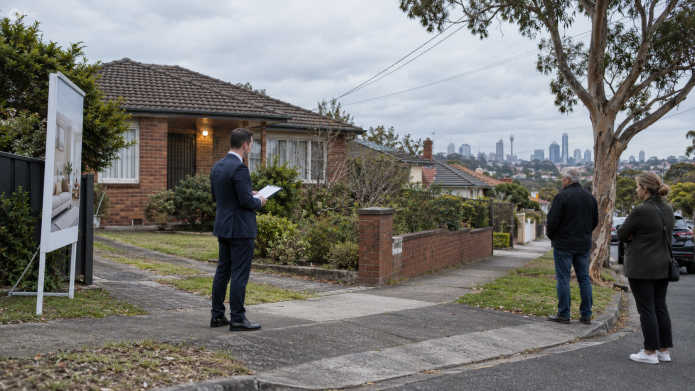








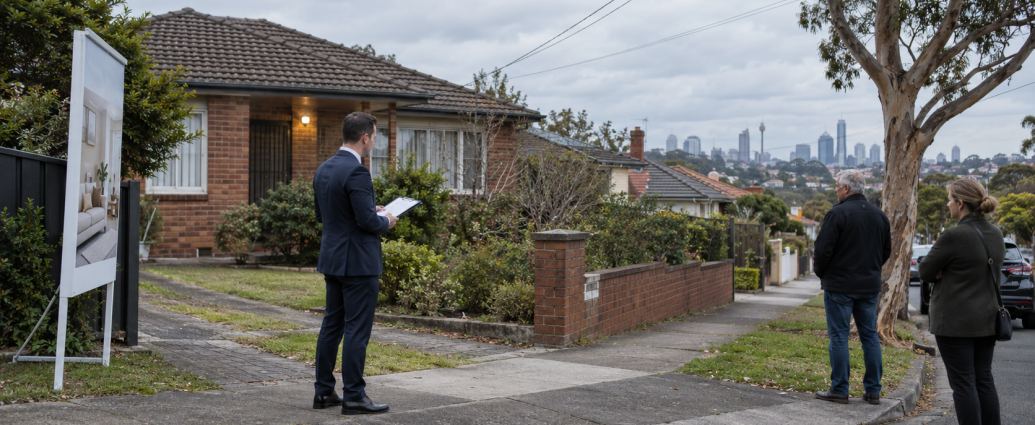
PHOTO: Westpac’s latest Housing Pulse report forecasts Australian home values will fall 6 per cent during 2026
Australia’s property downturn is no longer a minor correction that agents can dismiss as a quiet patch.
One of the country’s biggest banks has doubled its national house-price decline forecast in only three months, warned of a potential “air pocket” beneath the market and predicted that sales volumes could collapse by almost one-quarter.
Westpac’s latest Housing Pulse report forecasts Australian home values will fall 6 per cent during 2026—double the 3 per cent decline it predicted in June.
The bank now expects a total national peak-to-trough fall of 7.3 per cent, comparable with the severe downturn created by the 2022 interest-rate tightening cycle.
Sydney is forecast to suffer a 10 per cent peak-to-trough fall, while Melbourne is expected to decline by 8 per cent.
But the most worrying number for Australian real estate agents may not be the predicted fall in values.
It is this:
Sales volumes are forecast to plunge 24 per cent
That means fewer listings sold, fewer commissions generated and more agents competing for every available vendor.
For an industry built around transaction volume, the downturn threatens to become brutal.
This is no longer just a forecast
Prices are already falling.
Australian home values declined for a fifth consecutive month in August, with national values falling 0.9 per cent during the month. Sydney declined 1.4 per cent and Melbourne fell 1.1 per cent.
National values were already approximately 7 per cent below their peak, according to market data reported at the end of August.
That means Westpac is not warning about a downturn that might begin sometime next year.
The downturn is already here.
The question is how much worse it becomes before interest rates stabilise, buyer confidence returns and vendors accept that peak prices may no longer be achievable.
Sydney faces a double-digit fall
Westpac’s most severe forecast is reserved for Sydney.
The bank expects the country’s largest housing market to suffer a 10 per cent peak-to-trough decline—effectively wiping out several years of price growth.
Sydney’s most expensive homes are leading the fall.
Top-tier houses have reportedly declined by approximately 9.5 per cent over the past year, and further weakness is expected.
Separate market analysis has found that upper-tier homes in Sydney and Melbourne have already fallen by more than 10 per cent from their respective peaks.
Luxury property led the boom.
Now it is leading the correction.
That has serious implications for prestige agents whose businesses depend on large commissions from multimillion-dollar sales.
A 10 per cent reduction on a $3 million home represents $300,000 in lost property value.
On a $5 million home, it represents $500,000.
The agent’s percentage commission may remain lucrative if the property sells—but convincing vendors to accept those reductions will be increasingly difficult.
Melbourne could be pushed back to 2021
Westpac forecasts an 8 per cent fall for Melbourne, potentially returning property values to levels last seen around 2021.
Melbourne is already struggling with cautious buyers, weaker auction conditions and declining confidence.
Recent figures showed a clearance rate of approximately 55 per cent, while the number of auctions scheduled across Victoria was reportedly 24 per cent lower than at the same point last year.
That is not the picture of a healthy spring selling season.
When clearance rates weaken, properties pass in.
When properties pass in, days on market increase.
When days on market increase, vendors begin reducing prices—or blaming their agents.
Either outcome creates pressure inside real estate offices.
Brisbane, Perth and Adelaide are not collapsing—but they are slowing
The downturn is not identical across Australia.
Westpac still expects Brisbane values to finish 2026 approximately 2 per cent higher, largely because of the city’s strong start to the year.
But Brisbane listings have reportedly jumped almost 30 per cent since May.
That means the balance between supply and demand is changing quickly.
A city can record a modest annual price rise while still experiencing a sharp deterioration during the second half of the year.
Perth is forecast to produce approximately 3 per cent growth, but prices have already fallen for four consecutive months. Limited housing supply is preventing a more significant decline.
Adelaide is also forecast to rise by around 3 per cent, although investor activity is reportedly retreating rapidly.
For agents in those cities, the message is clear:
The boom conditions may be over even if annual price growth remains marginally positive.
Low listings are preventing a more serious collapse
Australia’s unusually low number of properties available for sale is currently acting as a brake on the downturn.
Ordinarily, weaker demand combined with a large flood of listings would create much steeper price falls.
So far, the limited supply of available homes has prevented that scenario from fully developing.
But this creates a fragile market—not necessarily a safe one.
Westpac warned that the combination of rising borrowing costs, uncertainty and thin trading conditions could produce more volatile outcomes and what it described as an “air of panic.”
In a thin market, a relatively small number of distressed or heavily discounted sales can influence wider price expectations.
Buyers see the lower comparable sales and reduce their offers.
Banks and valuers use those transactions when assessing other homes.
Vendors then discover that the price their neighbour achieved last year may no longer be relevant.
The cycle feeds itself.
Buyers are retreating
Interest-rate pressure is doing what rate increases are designed to do: reduce borrowing capacity and suppress demand.
But housing is especially sensitive because most buyers do not purchase according to what they want to pay.
They purchase according to what a bank will lend them.
When interest rates rise, borrowing capacity falls.
A buyer who could previously borrow $1 million may suddenly qualify for substantially less. Unless the buyer has more cash available, the property price must fall or the transaction does not happen.
Westpac believes buyer demand is unlikely to recover properly until further interest-rate increases are taken off the table.
Australian consumer confidence data supports that concern.
The Westpac–Melbourne Institute consumer sentiment index fell 5.2 per cent in September to 84.4. Sentiment among mortgage holders plunged 13 per cent as interest rates, fuel prices and falling home values intensified financial anxiety.
Pessimistic households do not rush to make the largest purchase of their lives.
They wait.
They negotiate harder.
Or they withdraw completely.
Australia could face a transaction crash before a price crash
Property headlines traditionally focus on prices.
Agents should focus on transactions.
A national price fall of 6 or 7 per cent would be painful for recent buyers, but it would not erase the enormous gains recorded in many locations since 2020.
A 24 per cent decline in sales volumes is a much more immediate threat to real estate businesses.
Agents are paid when properties transact.
If the number of completed sales falls by almost one-quarter, the available commission pool also shrinks sharply.
That creates an industry with:
- More agents chasing fewer listings
- Longer periods between commission payments
- Greater pressure to discount fees
- Increased spending required to win vendors
- More withdrawn listings
- More failed auctions
- Harder negotiations over realistic pricing
- Greater risk of agents leaving the industry
Large agencies may survive through scale, property management revenue and strong cash reserves.
Individual agents and smaller offices operating with high overheads may not have the same protection.
Vendors remain anchored to yesterday’s prices
One of the biggest problems during a downturn is the delay between market reality and vendor expectations.
Buyers respond to rate rises immediately because their borrowing limits change.
Vendors respond more slowly because they remember what their property was worth at the peak.
That creates a widening gap.
The buyer says the home is worth $1.2 million.
The vendor remembers an appraisal of $1.4 million.
The agent becomes trapped between them.
Some agents will give vendors an honest appraisal and risk losing the listing.
Others will promise an unrealistic price to secure the business, then spend the next two months conditioning the seller down.
That practice damages confidence in the entire industry.
In a falling market, an inflated appraisal is not harmless optimism.
It can cost the vendor money.
A property that sits unsold for months can become stale. Buyers begin wondering what is wrong with it. The eventual selling price may be lower than what could have been achieved had the home been realistically priced from the beginning.
Recent buyers face the greatest risk
Homeowners who purchased years ago may still have substantial equity despite the downturn.
Recent buyers are in a much more vulnerable position.
Analysis reported earlier this month found approximately one-third of Australian homes purchased since August 2025 were estimated to be worth less than their purchase price.
Around 2.7 per cent were reportedly more than 10 per cent below their purchase value.
That does not automatically mean those owners are in negative equity because deposits, mortgage reductions and individual property circumstances differ.
But the risk is increasing—particularly for buyers who entered the market with small deposits.
A homeowner who bought with a 5 per cent deposit could see that entire equity position erased by a relatively modest decline.
If they are then forced to sell because of redundancy, divorce, illness or mortgage stress, the problem becomes real rather than theoretical.
Prestige agents could be hit hardest
Australia’s upper property tier has so far experienced the largest declines.
That creates a strange contradiction for prestige agencies.
The commission on each completed transaction may still be substantial, but the number of willing buyers is shrinking, negotiations are lengthening and vendors are resisting lower offers.
Luxury homes are also more discretionary.
A buyer seeking a basic family home may still need to purchase.
A buyer considering a $6 million waterfront upgrade can simply wait.
That makes the top end vulnerable to sudden gaps in demand.
When those buyers disappear, even highly regarded agents cannot manufacture genuine competition.
Beautiful photography, cinematic videos and enormous social-media profiles do not replace qualified purchasers.

Westpac issued its housing market update Friday.
The industry’s real test is beginning
Australian agents have spent years selling property in markets where rising prices did much of the work.
Listings attracted crowds.
Auctions generated emotional competition.
Vendors achieved prices that sometimes exceeded even the agent’s expectations.
That environment made average agents look exceptional.
The current market will expose the difference between genuine skill and boom-time confidence.
Agents will now need to:
- Price properties honestly
- Explain falling comparable sales
- Manage disappointed vendors
- Find buyers rather than simply process inquiries
- Negotiate transactions that might otherwise collapse
- Control marketing costs
- Defend their commission
- Maintain income through longer sales cycles
This is the market in which professional ability actually matters.

Historically low listings are what’s standing in the way of a complete market crash.
Is this really a crash?
The word “crash” attracts attention, but it must be used carefully.
Westpac is forecasting a national fall of 6 per cent during 2026 and a 7.3 per cent peak-to-trough decline.
Those are serious numbers, but they are not equivalent to a catastrophic collapse across every Australian market.
Some cities are still forecast to record modest annual growth.
More affordable properties are proving more resilient than prestige homes.
Employment also remains an important line of defence. A major rise in unemployment would be the development most likely to turn a controlled correction into a genuine housing crisis.
But a downturn does not have to resemble the Global Financial Crisis to cause serious damage.
For highly leveraged owners, a 7 or 10 per cent fall can be devastating.
For an agent whose sales volume falls 24 per cent, it can threaten their livelihood.
For an agency carrying expensive offices, staff, vehicles, subscriptions and marketing commitments, it can expose a business model constructed for a boom that no longer exists.
Westpac issued its housing market update Friday.
The Property Noise view
The most significant part of Westpac’s forecast is not that national values may fall 6 per cent.
It is that the bank doubled its prediction in only three months.
That shows how quickly conditions have deteriorated.
Sydney is facing a possible double-digit fall.
Melbourne could be pushed back towards 2021 values.
Sales volumes may collapse by 24 per cent.
Consumer confidence is weak.
Mortgage holders are increasingly anxious.
Buyers are retreating while vendors remain attached to peak prices.
And historically low listings—not strong demand—may be the main factor preventing an even steeper decline.
Australian real estate agents should not pretend this is business as usual.
The market that rewarded aggressive appraisals, expensive campaigns and percentage-based commissions is changing beneath them.
The next year will not be about celebrating record prices.
It will be about persuading vendors to face reality, finding buyers with reduced borrowing power and surviving on fewer completed transactions.
Australia’s housing market may not yet be in a full-scale crash.
But for thousands of agents whose incomes depend on houses actually selling, it could already feel like one.