

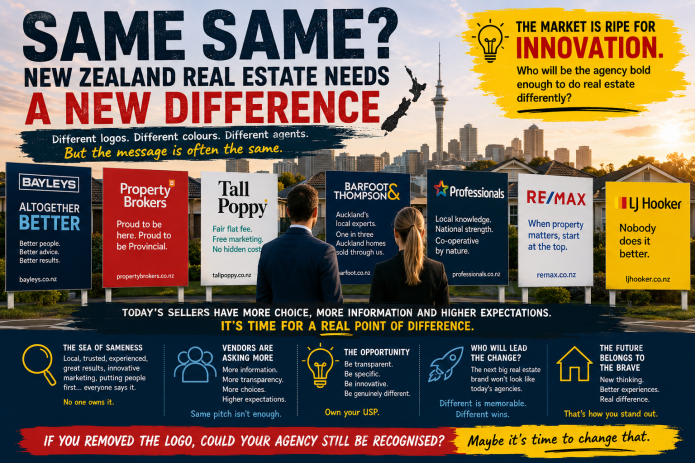

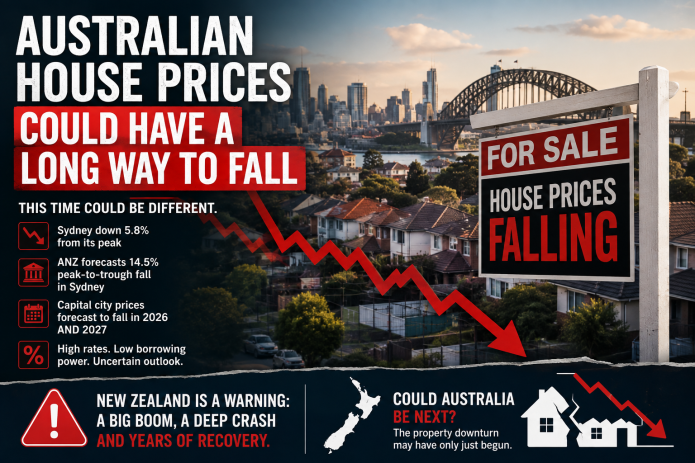


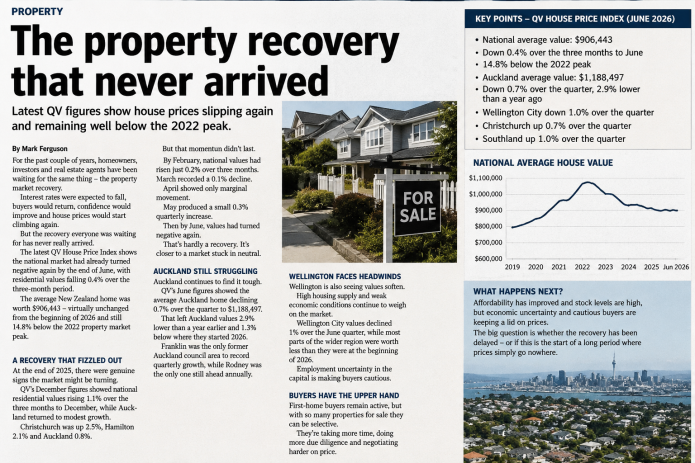




PHOTO: New Zealand has no shortage of real estate brands.
Walk down almost any main street in New Zealand and you’ll see them.
Different colours. Different logos. Different names.
But increasingly, the same message.
Local experts. Great results. Exceptional service. Trusted advice. Powerful marketing. Extensive networks. Putting people first.
New Zealand has no shortage of real estate brands.
What it may be short of is genuine differentiation.
NEW | Access New Zealand’s Ultimate Real Estate Agent Database — 18,000+ Agents & Agencies Included
For an industry that spends enormous amounts of money marketing other people’s properties, there is an interesting question worth asking:
How well are real estate agencies actually marketing themselves?
If You Removed the Logo, Could You Tell Which Agency It Was?
That’s perhaps the simplest test.
Take an advertisement from a New Zealand real estate company and remove the logo, corporate colours and agent’s photograph.
Could the average homeowner identify the company behind it?
Probably not.
Much of the industry’s marketing revolves around variations of the same promises:
We know the market.
We care about our clients.
We get results.
We have great people.
We have a large network.
We use innovative marketing.
There is nothing wrong with any of those things.
The problem is that when everyone says them, nobody owns them.
What Are New Zealand’s Big Real Estate Brands Actually Saying?
There are exceptions, and some brands have worked harder than others to establish a recognisable proposition.
Bayleys has built its positioning around “Altogether Better” and more recently the idea of bringing greater “energy” to everything it does. Its proposition also leans heavily on being a large, full-service, New Zealand-owned property business spanning residential, commercial, rural and property services.
Property Brokers has arguably carved out one of the clearer geographic identities with “Proudly Provincial”. Rather than trying to look like every metropolitan agency, it has made regional New Zealand part of its identity.
Tall Poppy has taken a more tangible approach. Its proposition centres heavily on a fair flat fee and free marketing package. Whatever competitors think of the model, a homeowner can quickly understand what is supposedly different about it.
Barfoot & Thompson has something competitors cannot easily replicate: its Auckland scale and non-franchised structure. The company says around one in three Auckland homes is sold through it, while its agents can work across the company’s branch network. That is a genuine structural point of difference rather than simply a marketing slogan.
Professionals New Zealand has another potentially distinctive proposition: it operates as a co-operative rather than a traditional franchise network. Interestingly, Professionals also unveiled a refreshed brand in 2026 as it sought to strengthen its market presence and modernise its consumer identity.
RE/MAX New Zealand currently leads its website with “When property matters, start at the top”, while emphasising its international network and independently owned offices.
And LJ Hooker New Zealand still has ownership of one of real estate’s best-known lines: “Nobody does it better”.
So there are differences.
But move beyond those top-level propositions and much of the language starts becoming remarkably familiar.
The Sea of Sameness
Look through agency and salesperson marketing and certain words appear again and again.
Professional.
Passionate.
Trusted.
Experienced.
Local.
Results.
Integrity.
Communication.
Innovative.
Client-focused.
They’re good qualities.
They’re just not necessarily a Unique Selling Proposition.
A USP answers a much harder question:
Why should I list my $800,000 or $1.5 million property with you instead of the agency across the road?
“Because we provide excellent service” isn’t enough.
The agency across the road says exactly the same thing.
Even the Agent Marketing Is Becoming Identical
The sameness becomes even more obvious at salesperson level.
Open almost any agent biography and you can probably predict what’s coming.
Passionate about property.
Strong negotiator.
Local knowledge.
Exceptional communication.
Going above and beyond.
Client-focused.
Achieving outstanding results.
Then comes the professional headshot, the sold sticker, testimonials and an invitation to request a free appraisal.
Again, none of this is bad marketing in isolation.
But collectively, it creates a marketplace where hundreds of salespeople are effectively presenting variations of the same product.
Changing the photograph doesn’t change the proposition.
Real Estate Has Become Very Good at Copying Real Estate
There is another issue.
The industry watches itself.
An agency launches slick property videos.
Everyone starts making property videos.
One salesperson uses drones.
Everyone buys a drone.
Someone produces cinematic agent introduction videos.
Suddenly everyone is walking towards a camera in slow motion.
An agency begins posting “JUST LISTED”, “JUST SOLD” and “ANOTHER GREAT RESULT” tiles.
Within months every Facebook feed looks identical.
Technology changes.
The templates improve.
The photography gets better.
But the underlying proposition often doesn’t.
Vendors Are Asking a Different Question
Today’s seller has access to considerably more information than a vendor had 20 years ago.
They can research recent sales.
They can obtain automated property estimates.
They can compare agents.
They can read reviews.
They can see an agent’s sales history.
They can watch auctions online.
They can advertise privately.
They can compare commission structures.
They can follow property markets through multiple digital platforms.
That makes “we know your local market” less powerful as a standalone proposition than it once was.
Of course an agent should know the market.
That’s increasingly the entry ticket — not the USP.
Tall Poppy Demonstrates Why a USP Matters
Whether you love or hate the model, Tall Poppy illustrates the point.
Fair flat fee. Free marketing.
A consumer immediately understands the pitch.
You don’t need three paragraphs of corporate language to explain it.
That doesn’t automatically mean it’s the best agency or the best option for every vendor.
It means it has given consumers a reason to consider it.
And that’s what differentiation is supposed to achieve.
Property Brokers Has Done Something Similar
“Proudly Provincial” is clever for another reason.
It effectively says:
We know who we are.
Rather than pretending every New Zealand property market is Auckland, Property Brokers has historically built much of its identity around provincial and regional New Zealand. Its current material continues to emphasise that provincial footprint and community connection.
Again, consumers can understand the positioning.
That’s branding.
The Opportunity Is Bigger Than a New Logo
This is where the New Zealand market starts becoming interesting.
Perhaps the next disruptive real estate company doesn’t need another blue, red, yellow or green logo.
It needs a fundamentally different proposition.
Imagine an agency built around one powerful promise.
Complete fee transparency.
Or:
Every listing includes premium marketing at no additional charge.
Or:
One suburb. Genuine hyper-local specialists.
Or:
Vendor communication guaranteed every 24 hours.
Or:
No long agency agreements.
Or:
A technology-first agency where vendors can see every enquiry, viewing, buyer comment and campaign metric live.
Or:
An agency specialising exclusively in first-home-buyer properties.
Or perhaps:
An agency where the salesperson who wins the listing must personally conduct every open home and negotiation.
Some of those models would have practical complications.
That’s not the point.
The point is that you immediately know what the business stands for.
Could Technology Create the Next Major NZ Real Estate Brand?
Possibly.
The interesting disruption may not come from cheaper commissions at all.
It could come from transparency.
Imagine a vendor dashboard showing in real time:
23 buyer enquiries
14 groups through the open home
7 follow-up calls completed
4 buyers requested documents
2 buyers indicating offers
Advertising spend remaining: $846
Agent activity today: 11 buyer contacts
Suddenly “we work hard for our vendors” isn’t a marketing claim.
The vendor can actually see it.
That is the sort of tangible difference that could create a genuine USP.
AI Could Make the Sameness Even Worse
There’s another challenge coming quickly.
Artificial intelligence can now produce property descriptions, social-media posts, email campaigns, prospecting letters, video scripts and marketing plans almost instantly.
That should create more creativity.
It could easily create the opposite.
If every agency feeds roughly the same property information into similar technology, real estate marketing could become even more homogenised.
Beautifully written.
Perfectly formatted.
Completely forgettable.
Human personality, originality and brand positioning may therefore become more valuable, not less.
The Next Big Real Estate Brand May Look Nothing Like Today’s Agencies
New Zealand real estate remains dominated by established brands with enormous networks, databases, technology and marketing resources.
Taking them on directly would be difficult.
But disruption rarely starts by trying to become a slightly smaller version of the incumbent.
It starts by asking:
What frustrates consumers about the existing model?
Then building the company around fixing it.
Perhaps that’s fees.
Perhaps it’s transparency.
Perhaps it’s communication.
Perhaps it’s trust.
Perhaps it’s technology.
Perhaps it’s the way agents are paid.
Perhaps it’s how properties are marketed.
Perhaps it’s providing vendors with significantly more control over the process.
Whatever it is, “great service and great results” isn’t enough of a difference anymore.
New Zealand Real Estate Is Ripe for Someone Brave
There are some genuinely strong brands operating in New Zealand real estate.
There are also thousands of excellent salespeople.
But from the consumer’s perspective, much of the industry is beginning to look remarkably same same.
Same promises.
Same listing presentations.
Same social posts.
Same photography.
Same “local expert” positioning.
Same appraisal call-to-action.
And often, very similar commission structures.
That creates opportunity.
Because when a market becomes crowded with businesses saying essentially the same thing, the company prepared to say — and actually do — something substantially different becomes very noticeable.
New Zealand might not need another real estate agency.
It might need a completely different kind of one.