PHOTO: Bayleys agent John McColl reportedly said the buyers wanted a substantial Queenstown property.
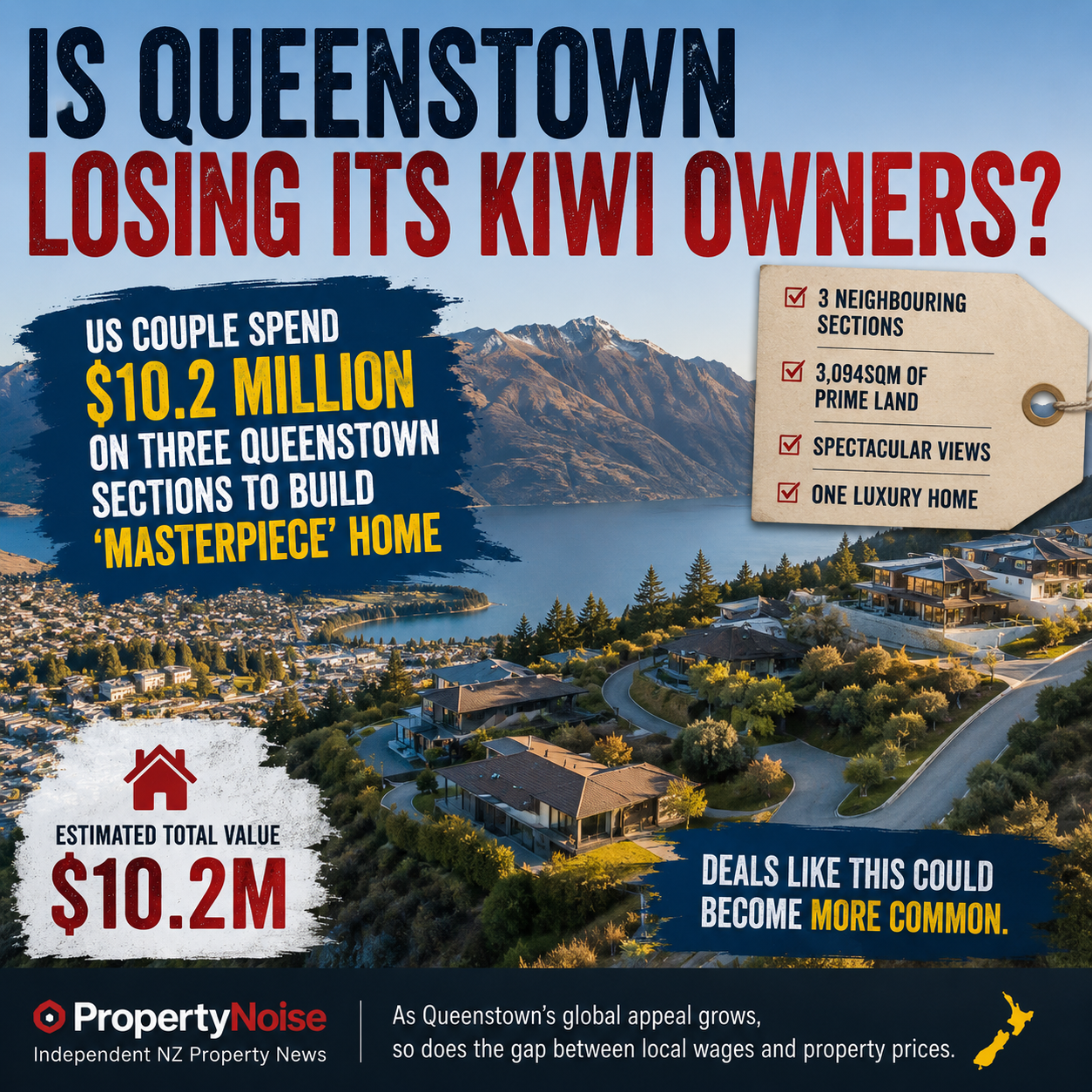
Three neighbouring Queenstown Hill properties. One US couple. A reported combined value of $10.2 million. And plans to turn more than 3,000 square metres of prime Queenstown land into a single “masterpiece” home. It is an extraordinary property deal — but it also highlights a much bigger question: is Queenstown gradually becoming a luxury enclave increasingly beyond the reach of ordinary New Zealanders?
Queenstown has always been different.
The mountains.
Lake Wakatipu.
Ski fields.
International airport.
Restaurants.
Luxury lodges.
And some of the most spectacular residential real estate in New Zealand.
But there is another Queenstown story increasingly difficult to ignore.
The people who can afford its best property increasingly operate in an entirely different financial universe from the average Kiwi.
The latest example is extraordinary.
A United States couple with New Zealand residency have reportedly assembled three neighbouring properties on Queenstown Hill with a combined estimated value of approximately:
$10.2 MILLION.
And they aren’t planning three houses.
According to the report, the combined 3,094sqm holding is intended to become the site of a single spectacular residence described as a future “masterpiece” home.
Perfectly legal.
Potentially fantastic architecture.
And clearly a great result for the property owners involved.
But zoom out from this one transaction and it becomes part of a much more interesting story.
What exactly is Queenstown becoming?
They weren’t even for sale
Perhaps the most revealing aspect of this transaction is how the land was assembled.
Bayleys agent John McColl reportedly said the buyers wanted a substantial Queenstown property.
Initially, he and a colleague identified three suitable existing homes.
There was one problem.
None of them was for sale.
Offers reportedly went to the owners at levels “well above market value”.
They still wouldn’t sell.
So the agents changed strategy.
Instead of finding one sufficiently large property, they assembled neighbouring sites that could be combined into what the purchasers wanted.
Three properties.
Three different owners.
A combined 3,094sqm.
And a reported estimated value of $10.2m.
That tells you something about the level at which Queenstown’s prestige market now operates.
If the property you want doesn’t exist, apparently you can simply create it.
NZ’S LUXURY PROPERTY BOOM SHIFTS SOUTH – QUEENSTOWN OVERTAKES AUCKLAND
$5.5 million for one of the sites
According to the supplied report, property website OneRoof records 9 Galway Court selling for $5.5m in June.
Neighbouring 8 Galway Court carries a QV valuation of $2.45m, while number 10 is valued at $2.25m.
Combined, that’s around $10.2m worth of Queenstown Hill real estate.
The sites overlook Queenstown and Lake Wakatipu.
For the purchasers, it is the opportunity to create something exceptional.
For the sellers, presumably, it was an opportunity too good to refuse.
For the agents, it’s an extraordinary piece of real estate work.
But for the wider Queenstown market, it is another sign of just how far the resort’s property economy is moving from normal New Zealand.
Let’s be clear: these purchasers are NZ residents
This distinction matters.
It would be misleading to describe this simply as “foreigners buying New Zealand land” without explaining the circumstances.
The US couple reportedly have New Zealand residency.
They are therefore not simply anonymous offshore purchasers swooping into Queenstown in defiance of New Zealand’s overseas-buyer rules.
And nationality alone shouldn’t determine whether someone belongs in a community.
New Zealand is an immigrant nation.
Thousands of people have arrived here from overseas, become residents or citizens, built businesses, raised families and contributed enormously to the country.
That’s not the issue.
The issue is what happens when a small, globally desirable New Zealand property market increasingly attracts people with international levels of wealth.
Because local wages have to compete with global money.
And that’s a competition ordinary Queenstown households are unlikely to win.
The agent expects more
Perhaps the most important sentence in the original story isn’t the $10.2m figure.
It’s what McColl reportedly said about offshore enquiry:
“With the inquiries we’re getting from offshore now, I think it’ll become more common.”
That’s the story.
This isn’t necessarily an extraordinary one-off.
The people actually dealing with premium Queenstown buyers are saying they expect more of it.
And if that’s correct, Queenstown needs to think seriously about what the next decade looks like.
Queenstown isn’t competing with Christchurch anymore
For decades, we tended to think about New Zealand property markets in domestic terms.
Auckland was expensive.
Wellington was expensive.
Queenstown was very expensive.
Christchurch offered comparatively better value.
But premium Queenstown property isn’t necessarily competing against other New Zealand cities.
It’s competing for buyers who might also consider:
Aspen.
Lake Tahoe.
Whistler.
The Swiss Alps.
Colorado.
European ski resorts.
Australian prestige markets.
For a wealthy international buyer, a multimillion-dollar Queenstown home isn’t necessarily outrageous.
It may look comparatively attractive.
That’s wonderful if you own the property they’re trying to buy.
It’s considerably less wonderful if you’re a Queenstown worker trying to buy your first home.
The two Queenstowns
There is an increasingly uncomfortable contrast at the heart of the district.
One Queenstown sells multimillion-dollar hillside homes overlooking Lake Wakatipu.
The other needs:
teachers,
nurses,
police officers,
hospitality workers,
builders,
cleaners,
retail staff,
ski-field workers,
tourism employees,
drivers,
and countless other ordinary working people.
Those workers make Queenstown function.
Yet they’re participating in a housing market increasingly influenced by people whose purchasing power bears little relationship to Queenstown salaries.
That’s the paradox.
The more globally successful Queenstown becomes, the harder it risks becoming for the people who actually make Queenstown work to live there.
When $10m buys land before you’ve even built the house
Consider the economics of this particular project.
The estimated property value is already around $10.2m.
Then comes the house.
A residence worthy of being described as a Queenstown Hill “masterpiece” will presumably involve substantial architecture, engineering, earthworks, construction and landscaping.
The eventual completed value could therefore be significantly higher.
Again, there is nothing inherently wrong with that.
High-end construction creates work.
Architects get paid.
Builders get paid.
Tradespeople get paid.
Local suppliers benefit.
Rates get paid.
Luxury homeowners spend money locally.
Prestige development can bring genuine economic benefits.
But it also resets expectations about what land is worth.
And once land establishes a new value benchmark, it rarely asks whether local wages have kept up.
There’s another interesting issue: three properties becoming one
This transaction also raises a subtle housing question.
Three neighbouring properties are being assembled for a single-home landholding.
One reportedly already contains a house.
The others are bare sections.
So this isn’t simply another wealthy buyer purchasing an expensive existing home.
It’s an example of scarce premium land being consolidated to create one much larger private estate.
In most New Zealand housing debates, we’re talking about doing the opposite.
Intensification.
More homes.
Smaller sections.
Townhouses.
Density.
Using land more efficiently.
At the very top of Queenstown’s market, extraordinary wealth can produce the reverse:
More land. Fewer owners. One enormous home.
That contrast is hard to miss.
Great news if you already own Queenstown property
There is, of course, another side to this story.
If you’re a Queenstown homeowner, wealthy international demand could be exactly what you want.
A purchaser prepared to pay well above perceived market value can change an owner’s life.
Imagine someone knocking on your door when you aren’t even selling and making an offer substantially above what you thought your house was worth.
Most homeowners wouldn’t slam the door in moral outrage.
They’d get the calculator out.
Higher-end demand can also flow through valuations and strengthen confidence in surrounding property.
So let’s not pretend existing owners universally dislike wealthy newcomers.
Many will welcome them enthusiastically.
That’s how markets work.
But today’s extraordinary sale can become tomorrow’s benchmark
Here’s where things become complicated.
A property sells at an exceptional price.
The sale becomes comparable evidence.
Neighbouring owners adjust expectations.
Agents quote it.
Buyers know about it.
Valuers consider it.
The market recalibrates.
One unusual transaction doesn’t automatically increase every house in the neighbourhood by 20%.
But repeated prestige sales gradually establish a new normal.
And if McColl is right that this type of offshore enquiry is likely to become more common, that matters.
Particularly in a geographically constrained market such as Queenstown.
You can’t manufacture another Queenstown Hill
This is the fundamental supply problem.
Queenstown isn’t Hamilton.
You can’t simply keep expanding relatively flat residential subdivisions in every direction.
Geography matters.
Mountains matter.
The lake matters.
Infrastructure matters.
Planning matters.
Hazard zones matter.
And the very views making Queenstown Hill internationally desirable are inherently scarce.
There are only so many properties overlooking Lake Wakatipu.
There are only so many premium hillside sites.
There will never be unlimited supply.
Combine fixed supply with international wealth and basic economics takes over.
Prices rise until somebody stops bidding.
For the world’s wealthy, that stopping point can be considerably higher than it is for a New Zealand household earning New Zealand wages.
Is Queenstown becoming less New Zealand-owned?
That’s the provocative question.
But it requires nuance.
We shouldn’t confuse foreign-born with foreign-owned.
A US-born New Zealand resident owning a house here is not the same thing as an overseas investor with no meaningful connection to the country.
Nor should people who obtain New Zealand residency somehow be regarded as permanently less entitled to participate in New Zealand society.
But there is still a legitimate broader question about ownership, wealth and access.
How much of Queenstown’s premium housing stock will eventually be controlled by:
internationally wealthy residents,
dual-country households,
global entrepreneurs,
ultra-high-net-worth migrants,
and people who spend only part of their year in New Zealand?
And what does that do to the character and accessibility of the town?
That’s a conversation worth having without turning it into xenophobia.
Queenstown risks becoming a place Kiwis visit rather than own
This is perhaps the greatest long-term concern.
New Zealanders already joke that ordinary Kiwis can’t afford Queenstown.
Eventually that joke stops being funny.
Imagine another 20 years of international wealth flowing into a geographically constrained prestige market.
The best lakefront and hillside property becomes progressively more valuable.
Existing Kiwi owners sell — understandably — to whoever offers the most.
Those buyers build extraordinary homes.
Values rise further.
The next generation of local New Zealanders faces an even higher barrier.
Slowly, ownership changes.
Nobody orchestrated it.
Nobody broke the law.
No single transaction caused it.
The market simply did what markets do.
But the end result could still be a Queenstown increasingly disconnected from the incomes and lives of ordinary New Zealanders.
And then there’s the “Billionaire’s Playground” problem
Queenstown’s international prestige is an enormous asset.
We should be proud that people around the world regard this part of New Zealand as somewhere extraordinary.
Tourism depends on that desirability.
Investment follows it.
Businesses benefit from it.
But global resort towns have repeatedly faced the same dilemma.
They become so successful that the workforce gets pushed further and further away.
Homes become investments or second residences.
Local ownership declines.
Service workers commute greater distances.
Businesses struggle to recruit because employees can’t afford accommodation.
Eventually, the very community that made the place attractive begins disappearing.
Queenstown should pay attention to that warning.
This isn’t an argument for shutting the gates
There will be readers who interpret any discussion of overseas wealth as an argument against immigration or investment.
It isn’t.
New Zealand benefits enormously from talented and successful people choosing to live here.
Someone investing millions into building a spectacular Queenstown home will generate considerable local economic activity.
And people with legitimate New Zealand residency are entitled to purchase property within the rules applying to them.
The question isn’t:
“How do we stop wealthy Americans buying houses?”
The better question is:
“How does Queenstown remain a functioning New Zealand community while also being one of the world’s most desirable places to own property?”
That’s much harder.
Because Queenstown still needs normal houses
For every $15m architectural masterpiece, Queenstown still needs a teacher to turn up at school on Monday.
It needs nurses at the hospital.
Someone needs to serve breakfast.
Someone needs to maintain the roads.
Someone needs to clean the hotel.
Someone needs to drive the bus.
Someone needs to police the town.
Someone needs to build the masterpiece.
Those people need somewhere to live too.
A genuinely successful Queenstown housing market cannot simply be measured by record sales.
It should also be measured by whether the people essential to the community can afford to remain part of it.
$10.2 million is more than a property story
Taken alone, this Galway Court transaction is fascinating.
Three neighbouring sites.
Three owners.
None initially being marketed as one combined holding.
A determined US couple with New Zealand residency.
Agents assembling the puzzle.
More than 3,000sqm of Queenstown Hill.
And plans for a “masterpiece” home.
It’s precisely the kind of deal that makes Queenstown property unique.
But perhaps it is also a glimpse of the future.
A future where increasingly wealthy internationally connected buyers don’t simply purchase the best Queenstown properties.
They create them.
Where an ordinary luxury house isn’t large enough, several sites can be assembled.
Where a property isn’t for sale, enough money might eventually change the conversation.
And where local buyers can’t compete, ownership naturally migrates towards those who can.
No villain is required.
No law necessarily needs to be broken.
It’s simply global wealth meeting one of the most beautiful — and finite — pieces of real estate on Earth.
The question for New Zealand is whether we are comfortable with where that ultimately leads.
Because Queenstown may belong geographically to New Zealand.
But if its best property increasingly becomes accessible only to the internationally wealthy, we may eventually need to ask:
Will Queenstown still belong to New Zealanders in anything other than name?
SOURCE: RNZ