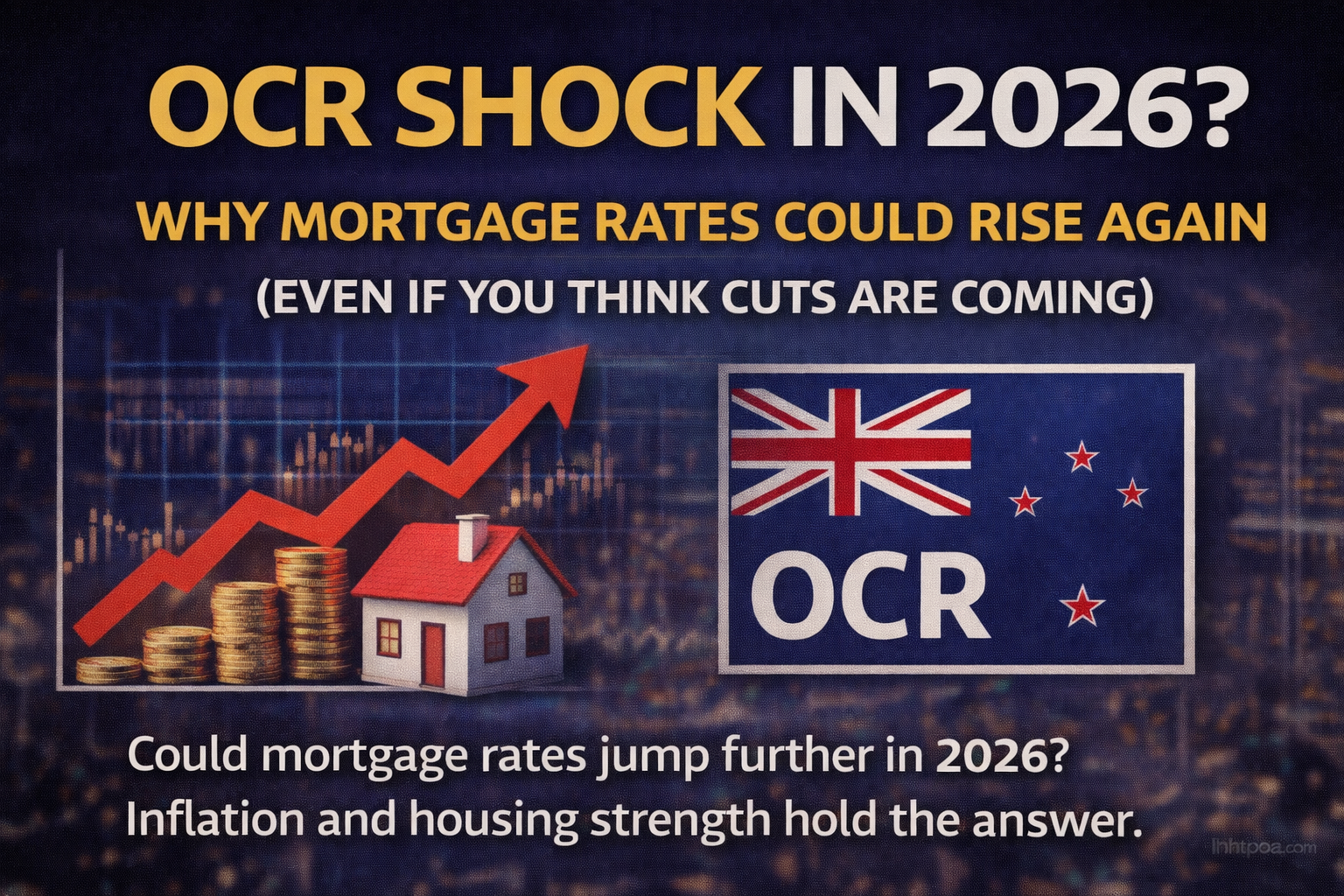
PHOTO: The Summer Property Market “Holding Strong” Might Be Exactly What Keeps Rates Higher for Longer. PROPERTY NOISE
New Zealand’s housing market ended 2025 in a surprisingly resilient position — sales up year-on-year, median prices steady, and buyer engagement stronger than last summer (per the REINZ December 2025 commentary you provided).
That matters, because when the property market stabilises and confidence returns, the Reserve Bank gets less incentive to keep the Official Cash Rate (OCR) low. And if inflation refuses to behave, the conversation can flip fast:
👉 From “when’s the next cut?” to “could the next move actually be up?”
This is the investigative question for 2026:
Will we see an OCR lift — and will mortgage rates rise with it?
🧠 First: What the OCR Actually Does (And Why Mortgage Rates Follow)
The OCR is the Reserve Bank’s main lever to influence:
-
wholesale borrowing costs for banks
-
floating mortgage rates
-
short-term fixed rates (indirectly)
-
overall spending and inflation
Even when banks don’t move rates one-for-one with the OCR, the OCR strongly shapes the direction of travel, and—crucially—market expectations can push mortgage rates around before the OCR moves.
That’s why borrowers can see mortgage rates lift even while the OCR is unchanged:
the wholesale market starts pricing in future hikes.
🔥 The Core Problem: Inflation Can Force the Reserve Bank’s Hand
Here’s the basic equation:
-
If inflation drops and stays in the target range → OCR can stay low or fall
-
If inflation sticks above target or re-accelerates → OCR hikes return to the table
The most important detail for 2026 is not just “inflation”—it’s what kind:
-
Non-tradables inflation (domestic costs like rents, insurance, council rates, wages, services) is the stubborn one
-
That’s the type most likely to keep the Reserve Bank uneasy
And several big-ticket household costs—rents, power, insurance, local authority rates—have been persistent pressure points.
🏠 How the REINZ Market Update Connects Directly to OCR Risk
Your REINZ summary shows three signals that matter for monetary policy:
1) Sales volumes lifted year-on-year
More transactions usually means:
-
confidence returning
-
easier credit conditions
-
more buyer activity
2) Median prices remained stable or rising in many regions
If house prices begin rising consistently again, the Reserve Bank worries about:
-
wealth effects (people feel richer → spend more)
-
renewed leverage
-
a re-heating housing cycle
3) “First-home buyers and owner-occupiers dominate”
This group is highly sensitive to rates. If they’re re-entering the market, it can be interpreted as:
-
affordability improving
-
conditions stabilising
-
demand re-building
In other words: the market “holding strong” is good news for property… but it can be the exact reason rate relief slows or reverses.
🏦 Why Mortgage Rates Could Rise Even Without an OCR Hike
Even if the OCR stays flat through parts of 2026, mortgage rates can still rise due to:
1) Wholesale funding costs increasing
Banks price fixed mortgages off swap rates and global funding conditions.
2) Markets pricing “higher-for-longer”
If traders and economists become convinced inflation won’t drop enough, wholesale rates can jump ahead of the Reserve Bank.
3) Competitive strategy shifts
Banks move rates based on:
-
appetite for lending
-
deposit competition
-
margin protection
-
funding pressures
So you can get the weird outcome:
✅ OCR unchanged
❌ fixed rates rising
…and borrowers feel like they’ve been hit by a hike anyway.
🔍 The Three Most Likely OCR Scenarios for 2026
Scenario A: OCR stays flat most of 2026 (the “pause and watch” year)
This happens if:
-
inflation cools back into range
-
the economy improves but doesn’t boom
-
unemployment stabilises without wage pressure exploding
Mortgage impact:
Fixed rates can still drift up or down depending on wholesale markets, but spikes are less likely.
Scenario B: One or two OCR hikes late 2026 (the “inflation won’t quit” scenario)
This becomes likely if:
-
inflation prints stay too high
-
domestic inflation (non-tradables) remains sticky
-
consumer spending rebounds strongly
-
housing activity firms faster than expected
Mortgage impact:
Floating rates rise quickly; fixed rates often rise before the OCR move.
Scenario C: OCR cuts resume (the “growth rolls over” scenario)
This requires:
-
inflation falling convincingly
-
demand weakening
-
labour market deteriorating again
-
global shocks hitting growth
Mortgage impact:
Rates trend down, but banks may be slower passing it through if funding costs don’t cooperate.
⚠️ The “Hidden Driver” Most People Miss: The Next Housing Cycle
New Zealand’s economy has a long history of housing-driven recoveries. If 2026 starts to look like:
-
rising sales
-
stabilising prices
-
improving sentiment
-
renewed investor interest
…then the Reserve Bank becomes more cautious about staying loose.
Because if housing runs hot again, inflation risks re-emerge — and the OCR tool gets used.
✅ What Borrowers Should Watch in 2026
If you want to predict OCR direction before headlines catch up, watch:
-
inflation (especially non-tradables)
-
rents, power, insurance, rates
-
wage growth and labour market tightness
-
retail spending rebound
-
housing turnover and price momentum
-
swap rates (they often move before OCR decisions)
🧨 The Bottom Line
Based on the property-market resilience shown in your REINZ summary, plus the reality that inflation pressures can re-accelerate quickly, an OCR lift in 2026 cannot be ruled out — and mortgage rates could rise even earlier via wholesale funding markets.
If 2025 ended with “confidence building,” then 2026’s risk is simple:
👉 Confidence returns… and the Reserve Bank stops being friendly.