
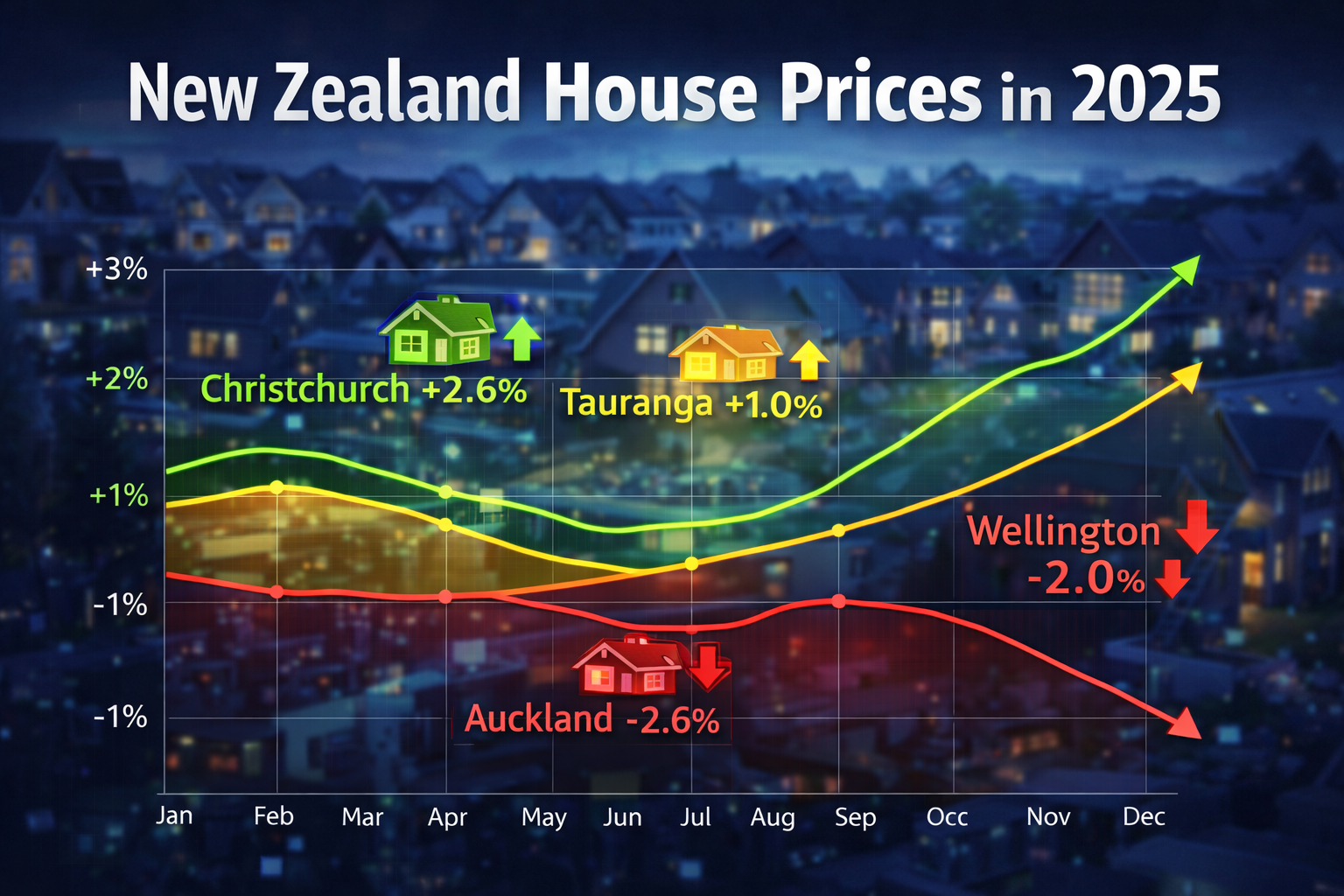
PHOTO: New Zealand House Prices In 2025. Property Noise
New Zealand’s housing market limped through another difficult year in 2025 — but beneath the headline numbers, the story is far from uniform. Some regions continued to slide, while others quietly defied gravity and kept climbing.
Here are five key things you need to know about where house prices fell the most in 2025, where they rose, and what could come next.
1️⃣ House prices fell nationally — but only just
According to the latest Cotality Home Value Index, national property values slipped 1.0% over 2025, with a further 0.2% decline in December alone.
That makes 2025 another soft, sideways year, following a similar pattern in 2024 after the sharp downturn of 2022–23.
The reasons were familiar:
Lower mortgage rates offered some support
But a weak economy and rising unemployment kept buyers cautious
In short: fewer forced sellers, but not enough confidence to drive a meaningful rebound.
2️⃣ The biggest losers: Auckland and Wellington
Some of the country’s largest markets were also its weakest performers in 2025.
Auckland: median values down 2.6% year-on-year
Wellington: median values down 2.0%
These declines reflect:
Higher exposure to public sector job losses (especially in Wellington)
Greater sensitivity to interest rates
Large volumes of listings competing for cautious buyers
Despite population growth, confidence in both cities remained fragile.
3️⃣ The quiet winners: Christchurch and Tauranga
While headlines focused on falling prices, a few centres quietly pushed higher.
Christchurch: +2.6% in 2025
Tauranga: +1.0%
These markets benefited from:
Better affordability relative to incomes
Ongoing population inflows
More resilient local economies
They didn’t boom — but in a flat national market, any growth matters.
https://www.propertynoise.co.nz/the-real-estate-agents-offices-brands-to-watch-in-2026/
4️⃣ 2026 could be the year confidence returns
Looking ahead, economists are cautiously optimistic. With the economy expected to improve, house prices could rise by around 5% nationally in 2026.
But the next phase won’t be straightforward.
Key variables to watch:
Debt-to-income (DTI) ratio caps
Election-year politics (including capital gains tax debates)
How borrowers behave now that mortgage rates appear to have hit a floor
2026 is shaping up as a year of rebuilding confidence, not runaway growth.
5️⃣ Jobs, building and inflation will decide the pace
Several data points this year will heavily influence property sentiment:
Employment: early signs suggest hiring may be stabilising again
Building consents: construction activity appears to be lifting off its lows
Inflation: rents are already flat to falling — good news for tenants, less so for landlords
Meanwhile, many borrowers are starting to fix mortgages for longer terms, suggesting households believe the worst of rate rises is behind them.
🔍 The bigger picture
2025 wasn’t a crash — but it wasn’t a recovery either.
It was another holding pattern year, where:
Premium markets underperformed
Affordable, lifestyle-driven regions quietly held ground
Confidence remained the missing ingredient
The question now isn’t whether prices will rise again — it’s where, how fast, and who gets left behind.
Bottom line:
Some parts of New Zealand are already turning the corner. Others are still searching for the floor. In 2026, the gap between winners and losers is likely to widen — and that’s where the real property stories will be found.