
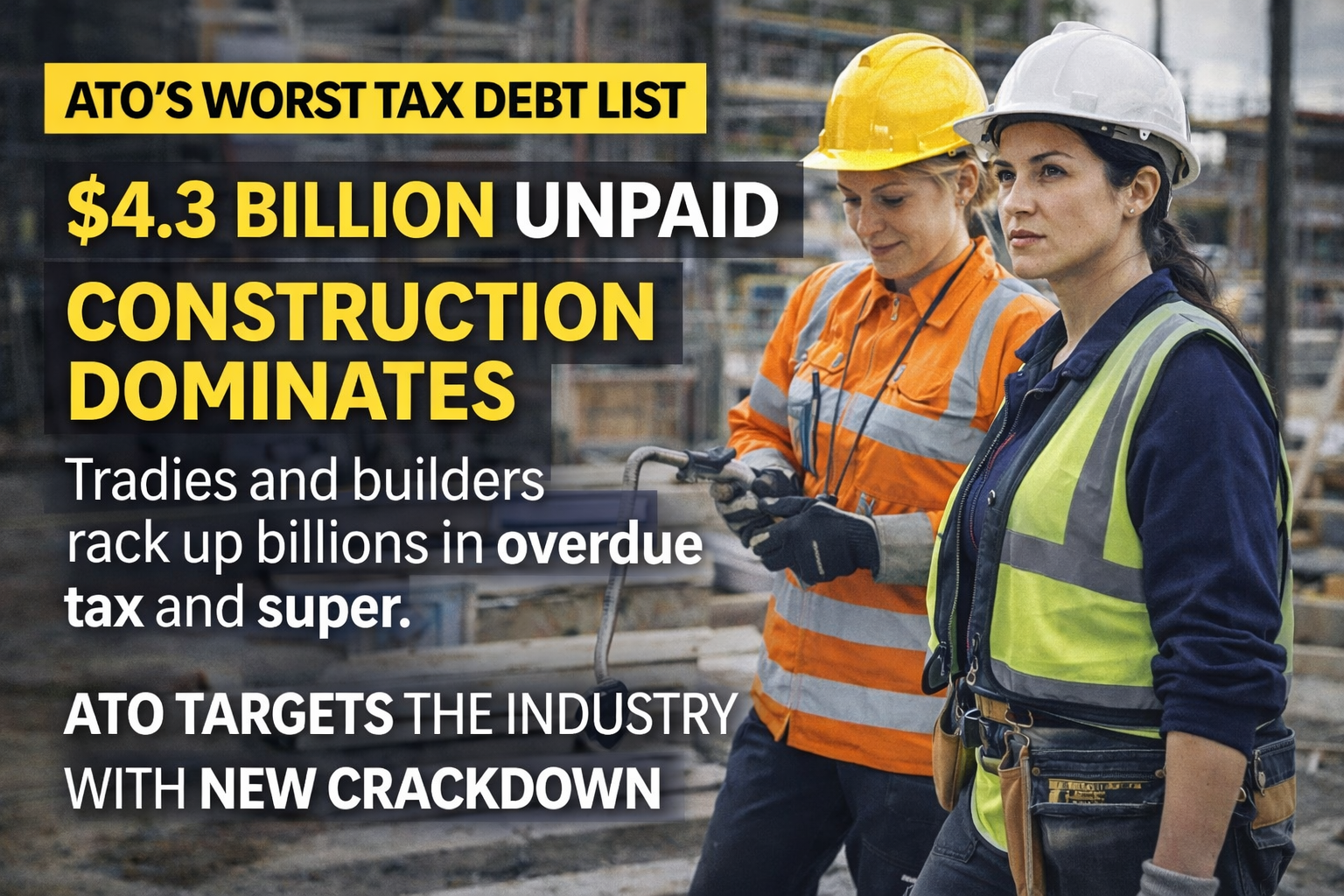
PHOTO: 🏗️ Tradies, builders and developers are now front and centre of the ATO’s biggest debt crackdown — with billions in unpaid tax and super outstanding.
💸 Construction Firms Lead Australia’s Worst Tax Debt Rankings
Australia’s construction sector has emerged as the single worst industry for unpaid tax, with a staggering $4.3 billion in overdue obligations racked up in the last financial year.
The figures come from a breakdown released by the Australian Taxation Office (ATO), which shows 14,600+ construction businesses were classified as “disengaged taxpayers” — companies that have failed to meaningfully engage with the tax office to resolve their debts.
Unlock 1.2 Million+ Aussie Business Contacts — No Subscriptions, No Limits
📊 What Does the $4.3 Billion Cover?
The $4.3b figure includes:
-
❌ Tax and super debts over $100,000
-
⏳ More than 90 days overdue
-
🚫 Excludes firms with:
-
Active payment plans
-
Insolvency or liquidation proceedings
-
Disputed debt arrangements
-
In other words, this is serious, long-overdue money — not minor arrears or administrative delays.
👷 Why Construction Is in the Spotlight
An ATO spokesperson said most of the unpaid debt relates to:
-
GST
-
PAYG withholding
-
Superannuation guarantee charges
“These are amounts withheld from employees or customers that have not been passed on to employees or the government.”
Unpaid GST linked to property transactions and developments has been singled out as a major contributor — putting builders, developers and property-related entities squarely under the microscope.
✈️ ATO Turns Up the Heat: Travel Bans & Director Penalties
The tax office is now escalating enforcement action against directors and business owners across all industries, targeting more than $50 billion in long-overdue tax and super nationwide.
Tools being actively used include:
-
🚫 Departure Prohibition Orders (DPOs) — stopping people from leaving Australia
-
📄 Director Penalty Notices
-
💳 Garnishee actions
-
📉 Credit reporting referrals
-
⚖️ Wind-up and liquidation applications
“Where there is evidence of deliberate non-payment and a risk to revenue, firmer actions such as DPOs may be applied,” the ATO said.
📈 Travel Bans Surge
In just the past six months, the ATO has issued 21 Departure Prohibition Orders — more than the total number issued in the entire previous financial year.
That sharp increase signals a much tougher stance from the regulator.
🏠 Assets, Property & Ability to Pay Under Review
When asked whether asset holdings — including property portfolios — are considered when assessing a taxpayer’s ability to pay, the ATO confirmed:
“We take a holistic view of a person’s financial position, including assets, income and overall circumstances.”
In short: owning property won’t shield you if debts remain unpaid.
📉 Which Other Industries Are in Trouble?
While construction topped the list, several other sectors followed closely:
| Rank | Industry | Disengaged Taxpayers |
|---|---|---|
| 🥇 | Construction | 14,674 |
| 🥈 | Professional, scientific & technical services | 4,850 |
| 🥉 | Accommodation & food services | 4,195 |
| 4️⃣ | Administrative & support services | 3,290 |
| 5️⃣ | Transport, postal & warehousing | 2,936 |
🧠 The Bigger Picture
The ATO says it is taking a consistent, industry-wide approach, with one clear objective:
“Ensuring that taxpayers meet their obligations.”
Each case will still be assessed on its individual merits, but the message is unmistakable — ignoring the ATO is no longer an option.
⚠️ What This Means for Construction & Property
For tradies, builders and developers already under pressure from:
-
Rising construction costs
-
Tight margins
-
Higher interest rates
-
Slower project pipelines
…the tax office’s intensified crackdown adds another layer of risk.
Cash flow management, compliance and early engagement with the ATO are now critical survival factors.
SOURCE: NEWS.COM.AU