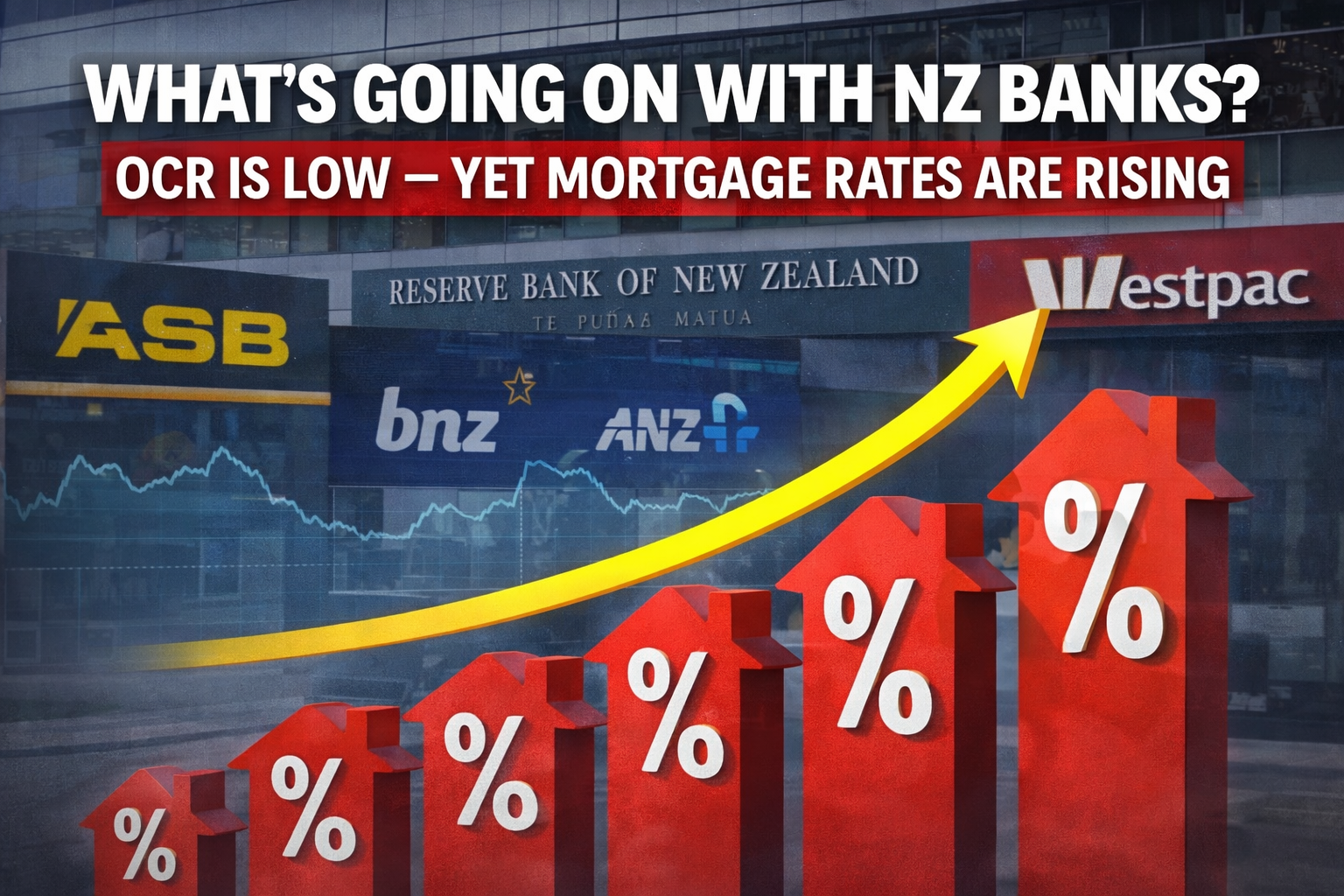
PHOTO: 📉 New Zealand’s economy is trying to take the pressure off borrowers — but banks still aren’t passing the savings on.
🏦 Sluggish Market, Falling OCR — But Higher Mortgage Costs?
Despite the Reserve Bank of New Zealand (RBNZ) cutting the Official Cash Rate (OCR) to 2.25%, one of the country’s biggest lenders has lifted multiple home loan interest rates — even as the property market softened in 2025.
That’s left many homeowners wondering:
➡️ If the OCR is low,
➡️ Why are mortgage rates creeping up instead of down?
Let’s unpack what’s really happening in the NZ housing and banking market.
📉 What the Reserve Bank Is Doing
The RBNZ has aggressively cut the OCR over the past year to stimulate the economy and support the housing market. In November 2025, the cash rate was trimmed again to 2.25% — a move designed to lower borrowing costs for households and businesses.
The theory is simple:
Lower OCR → cheaper bank funding → cheaper mortgages.
But in reality? The link between the OCR and actual mortgage rates is far less direct.
📊 Why Banks Are Raising Mortgage Rates Anyway
Here are the key forces pushing mortgage interest rates higher, even though the OCR is low:
🔹 1. Wholesales Rates Have Climbed
Banks don’t price mortgages solely off the OCR — they also look at wholesale interest rates — the cost banks pay to borrow money themselves. These have risen recently, forcing banks to hike some fixed-rate mortgages.
🔹 2. Markets Expect Future Tightening
Even with a low OCR today, financial markets are pricing in future interest rate increases — which pushes up the cost of lending now.
🔹 3. Risk Premiums Are Higher
Borrower risk — including the possibility of slower economic growth or inflation surprises — can lead banks to charge higher margins on loans to protect profits and balance sheets.
🔹 4. Term Structure Does Not Move with OCR
Longer-term home loan rates often reflect expectations about future OCR changes — not just the current rate. In other words, banks price mortgages based on forecasts rather than today’s official rate.
📈 So What Are Kiwis Really Paying?
Even though the OCR is low:
✅ One-year fixed mortgage rates in NZ are around 4.50%+ — substantially above the 2.25% cash rate.
✅ Longer-term fixed rates (2–5 years) are moving higher, not lower.
✅ This gap between OCR and mortgage rates means many borrowers face higher repayments even as the economy tries to cool.
📉 But the Property Market Lost Ground in 2025
House prices generally lag rate changes — and in 2025 the NZ property market stalled and even fell in places after years of strong gains.
Yet mortgage rates haven’t fallen as fast as the OCR would suggest, which has squeezed affordability for buyers and squeezed existing homeowners on refinancing.
🧠 What Economists Are Saying
Some economists see this as a disconnect:
💬 The RBNZ’s cuts were meant to lower borrowing costs.
💬 But wholesale costs and expectations for future higher rates have kept retail mortgage rates stubbornly higher.
In fact, some analysts believe banks price mortgages on what they expect the OCR to be in the future, not where it is today.
⚠️ The Big Picture: Borrowers Caught in the Middle
✔️ RBNZ is pushing down the OCR to boost growth.
✔️ But banks are reacting to market signals, wholesale costs and risk pricing.
✔️ As a result, mortgage rates are higher than many Kiwis expected.
✔️ And with the property market yet to fully recover, this disconnect continues to hurt affordability.
💡 So What Now?
If you’re a homeowner or buyer:
📌 Don’t assume mortgage rates will track directly with the OCR.
📌 Shop around — different lenders are reacting differently to wholesale costs.
📌 Consider locking in if future rates are expected to rise.
📌 Watch swap and wholesale rate trends — they often signal what mortgage rates may do next.