
PHOTO: PROPERTY NOISE
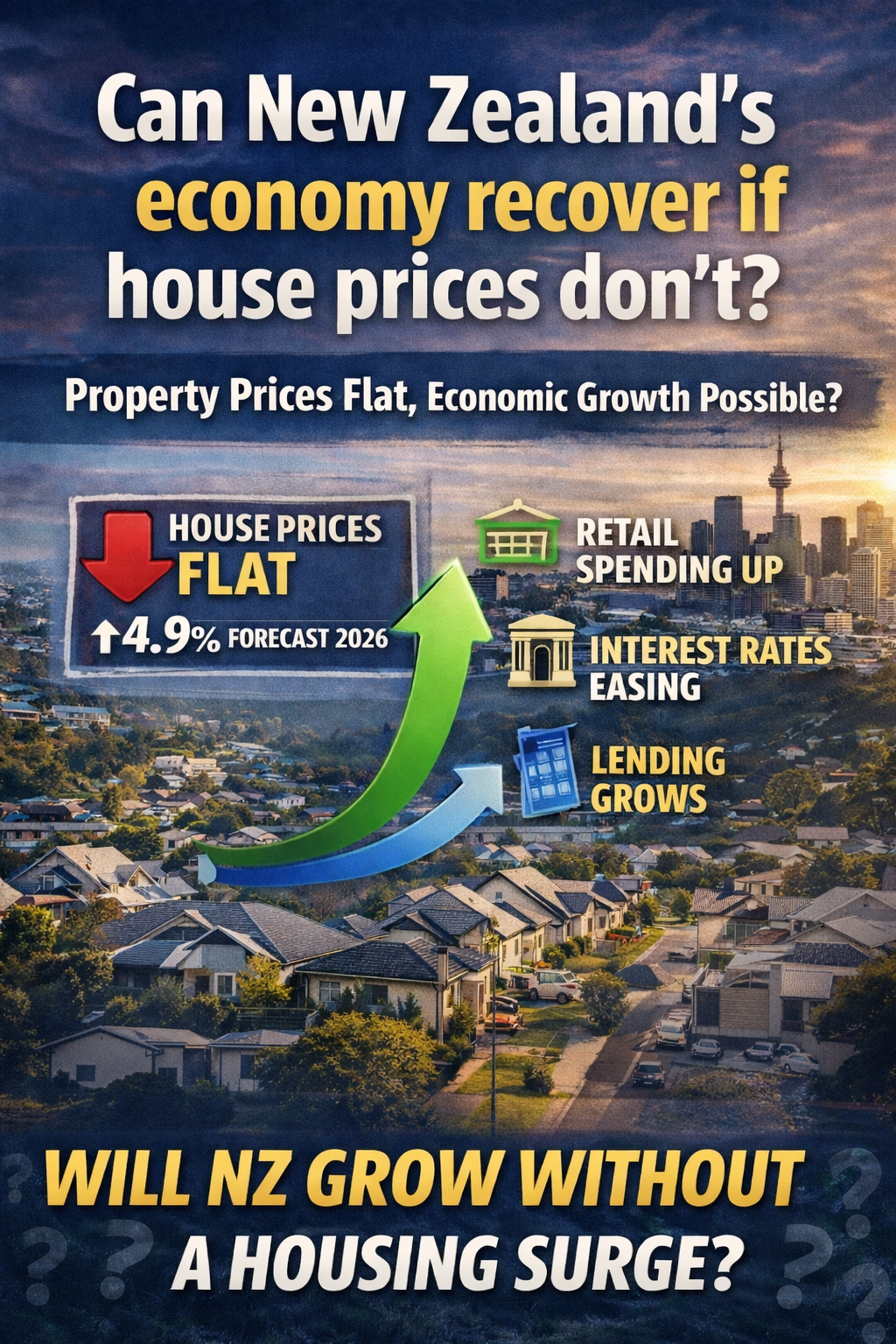
House Prices Flat. Retail Spending Rising. Is the “Wealth Effect” Overrated?
For decades, New Zealand’s economy has leaned heavily on one powerful engine:
🏠 Rising house prices.
When property values climb, confidence surges.
Spending increases.
Credit flows.
Growth accelerates.
But 2026 is shaping up differently.
Most forecasts expect house prices to rise less than 5% this year — with some economists predicting closer to 2–3%.
So here’s the billion-dollar question:
👉 Can the economy recover if house prices don’t?
📉 The Numbers: A Recovery Without a Property Boom?
According to Westpac senior economist Michael Gordon, something interesting is already happening.
Despite flat house prices:
-
🛍️ Retail spending has risen for five consecutive quarters
-
📈 Retail sales volumes rose 0.9% in December
-
💰 Interest rates have eased
-
🏦 Mortgage pre-approvals are ticking higher
That challenges the long-held belief that property gains are essential for growth.
💡 The “Housing Wealth Effect” — Myth or Multiplier?
Historically, New Zealand has shown one of the strongest links in the developed world between housing wealth and household spending.
When house prices rise:
✔ People feel richer
✔ They borrow more
✔ They spend more
✔ The economy accelerates
But Gordon argues the real driver might not be housing wealth at all.
Instead, it could be income expectations.
When people expect their incomes to rise:
-
They spend more
-
They invest
-
They bid up house prices
In other words, rising house prices might be a symptom — not the cause.
📊 Spending Forecast: 3–4% Growth Achievable?
Westpac believes household spending growth of 3–4% over the next year is achievable — even without a major lift in house prices.
Why?
-
Lower interest rates
-
Spare capacity in the economy
-
Stabilising inflation
-
Pent-up demand
Recessions don’t eliminate plans — they postpone them.
Cars still need replacing.
Homes still need maintenance.
Businesses still need expansion capital.
🌾 Provinces Powering Ahead
According to Simplicity chief economist Shamubeel Eaqub, parts of regional New Zealand are already growing — without runaway house prices.
Positive catalysts include:
🐄 Strong dairy payouts
🐑 Improved sheep and beef returns
🧶 Higher wool prices
💰 Capital flowing from asset sales
📉 Falling interest rates
He notes that some of New Zealand’s strongest historical growth periods occurred before house prices began their post-2000 surge.
In fact, not all growth fuelled by housing was high quality.
🏦 The Real Unknown: Will Banks Lend?
Both economists agree on one critical factor:
👉 Credit availability.
It’s not just the price of houses that matters — it’s the quantity of lending.
Small businesses often borrow against their homes to:
-
Expand operations
-
Hire staff
-
Invest in equipment
If house prices stall, that capital channel tightens.
But if banks are willing to lend — even without rapid price gains — growth can still build.
Debt supercharges the economic cycle.
⚖️ A Two-Speed Economy?
While many households have felt squeezed by:
-
Rising essentials
-
Reduced disposable income
-
Higher mortgage costs
Not everyone is struggling equally.
Some households:
✔ Have savings
✔ Have stable incomes
✔ Have investment plans ready
For them, a softer housing market may present opportunity rather than risk.
🧠 So… Can NZ Recover Without Rising House Prices?
Short answer: Yes.
Faster? Maybe not.
House prices may amplify economic cycles — but they may not be essential to them.
What matters more:
-
Income growth
-
Interest rates
-
Bank lending
-
Rural sector performance
-
Business investment
If those align, New Zealand can recover — even without a housing boom.
But if credit tightens?
That’s when recovery slows.
📌 The Bottom Line
New Zealand’s economy may be entering a new phase:
📉 Modest house price growth
📈 Gradual consumer recovery
🏦 Credit-driven acceleration
🌾 Provincial momentum
The housing market may no longer be the only engine.
But it remains a powerful amplifier.
The real question now is:
👉 Will lending and income growth pick up fast enough to carry the cycle?