
PHOTO: So why is Wellington in such rough shape while other centres are stabilising or even lifting? PROPERTY NOISE
📰 Property | 📊 Data & Trends | 🇳🇿 Wellington | 💼 Jobs | 💸 Mortgages
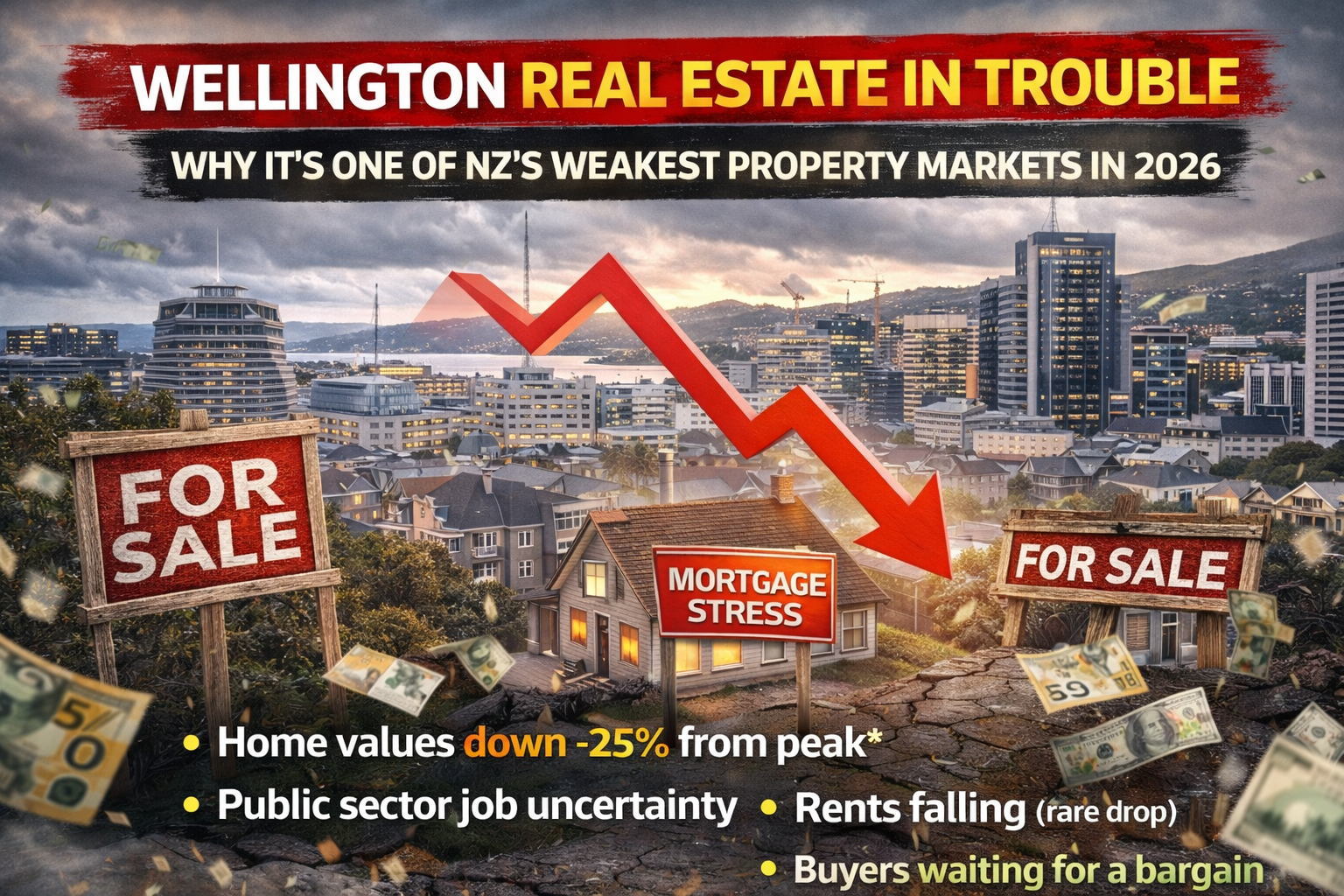
Wellington’s property market isn’t just “slow” — it’s become one of New Zealand’s softest housing patches, and the numbers backing that up are hard to ignore. Cotality’s January 2026 Home Value Index shows the wider Wellington area (Wellington City + Porirua + Upper Hutt + Lower Hutt) is still down -25.5% from its early-2022 peak, with an estimated median value around $784,547.
So why is Wellington in such rough shape while other centres are stabilising or even lifting?
It comes down to a unique mix of job insecurity, a public-sector-led economy, weaker buyer confidence, and a rental market that’s had a rare drop — all while listings remain plentiful and buyers stay cautious.
🧊 The Big Headline Stat: Wellington Is Still a Long Way Below Peak
If you want the simplest “state of play” metric:
Wider Wellington values: -25.5% from peak, -1.6% year-on-year (Jan 2026)
Wellington City: -25.2% from peak, and -1.0% year-on-year (Jan 2026)
That’s a big psychological anchor. When a city is still 25% down from peak, homeowners feel it, investors remember it, and buyers hesitate because they think they can negotiate harder (or wait longer).
💼 The Core Reason: Wellington Is a Jobs Market First, a Housing Market Second
Wellington isn’t like Auckland (private sector + population churn) or Christchurch (rebuild legacy + affordability). Wellington’s economy leans heavily on government and professional services, so employment confidence matters more here than almost anywhere.
Recent reporting has directly linked public sector job cuts and uncertainty to subdued housing demand in Wellington.
RNZ has also highlighted Wellington’s ongoing weakness across confidence, house prices, and sales, reinforcing the same theme: when the capital’s economy is shaky, property activity cools.
And the hard data supports that “soft confidence” story. Stats NZ employment indicators (Dec 2025) show filled jobs in Wellington down 1.1% (2,814 jobs) compared to the same time a year earlier.
Translation: buyers pause big decisions (like upgrading, investing, or stretching serviceability) when their workplace is restructuring or their sector is under pressure.
🏦 High Mortgage Rates Hurt Everywhere — But Wellington Has an Extra Problem
Yes, higher mortgage rates hit every region. But Wellington got the double-whammy:
Rates rose sharply after the boom, pushing affordability down
Job security weakened, making banks and borrowers more conservative
Cotality also calls Wellington (alongside Auckland) a key “soft patch”, noting economic uncertainty could keep that trend in play through much of 2026.
So even when interest rates start easing, Wellington doesn’t automatically “bounce” like other places — because confidence and income security are still the limiting factors.
🏘️ The Rental Market Did Something Unusual: Rents Dropped
Wellington’s rental market did a rare thing in 2025: it went backwards.
1News reported the median rent dropped from $650 to $595 in the year to last November.
That matters because falling rents can:
weaken investor returns
reduce urgency for renters to “buy at any cost”
increase negotiation power for tenants (and buyers)
It also reinforces the broader theme: Wellington demand has been softer than usual.
🧾 Listings, Leverage, and “Wait-It-Out” Buyers
Even with rates easing, buyers often won’t bid prices up if:
there’s plenty of stock to choose from
they feel no urgency
they believe vendors will blink first
Cotality notes there’s still a good stock of listings and a cautious attitude persists nationally—conditions that keep price growth muted.
In Wellington specifically, first home buyers were a record 37% of purchases in 2025 — a sign that the market is being held up more by value-seeking entry buyers than confident upgraders and investors.
🧠 The Real Reason Wellington Feels “Worse” Than the Rest of NZ
Put simply:
Wellington’s downturn isn’t just cyclical — it’s structural.
🏛️ Public-sector uncertainty hits confidence harder than in other cities
📉 Job numbers have slipped (filled jobs down year-on-year)
🏠 Values are still ~25% below peak, keeping sentiment suppressed
🏘️ Rents fell (reducing investor momentum)
That combination produces a market where people can buy, but many choose to wait — and waiting is poison for “hot” pricing.
🔮 What to Watch in 2026: The 5 Signals That Decide Wellington’s Next Move
If Wellington turns a corner, it’ll likely be led by these indicators:
Public sector stabilises (fewer restructures, improved hiring clarity)
Employment stops falling (watch Stats NZ filled jobs updates)
Net migration into Wellington improves (demand pressure returns)
Listings tighten (less choice forces competitive bidding)
Rents firm up again (investor confidence returns)
✅ Bottom Line
Wellington is in bad shape because the city’s housing market is being dragged by what Wellington relies on most: job security and confidence.
Until the public sector outlook steadies and employment momentum improves, Wellington is likely to remain a market where:
buyers negotiate hard
sellers need realistic pricing
the “bounce” is slower than the rest of NZ