
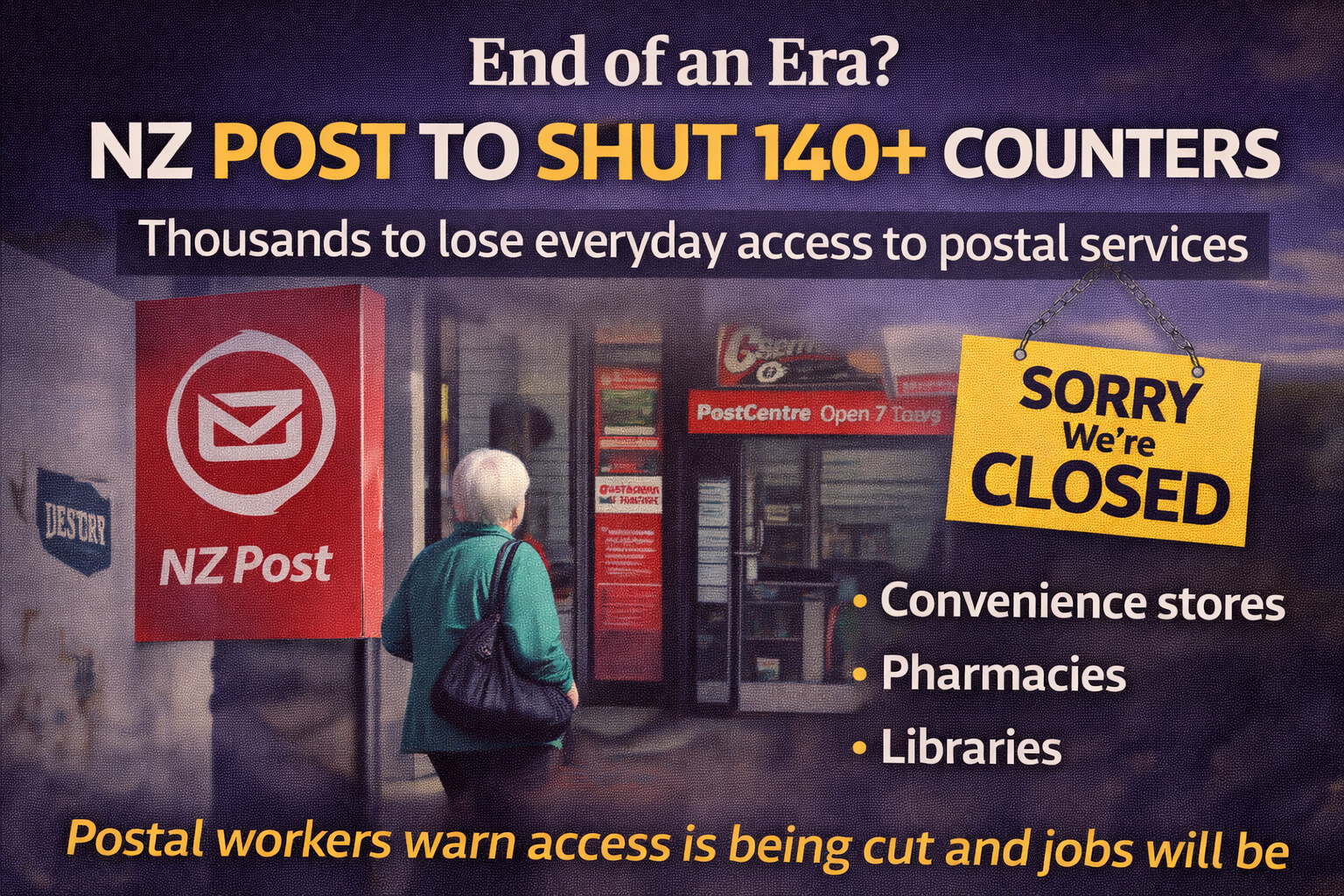
PHOTO: Convenience Stores, Pharmacies and Libraries Among Sites Losing Postal Services. PROPERTY NOISE
New Zealand’s postal network is undergoing its biggest shake-up in decades, with NZ Post confirming it will close 142 service counters across the country.
The closures will affect post counters located inside convenience stores, pharmacies and libraries, significantly reducing everyday access to postal services in many communities — particularly for those without easy transport.
NZ Post says 567 post shops will remain open nationwide, and that rural post shops will not be affected.
🔄 Why Is This Happening Now?
The move follows an update to NZ Post’s deed of understanding with the Government, which resets minimum post shop requirements for the first time since the 1980s.
According to NZ Post, the review reflects how dramatically customer behaviour has changed over the past four decades.
General Manager Consumer Sarah Sandoval said demand has shifted away from letters and toward parcels.
“A lot has changed since the 1980s, when our minimum store requirements were last set.
Customers now rely far more on NZ Post stores for collecting and sending parcels compared to letters.”
NZ Post says its retail network needs to be “rebalanced” to better suit modern usage patterns.
📦 Fewer Counters, More Parcel Hubs
Rather than maintaining a large number of smaller counters, NZ Post is pivoting toward larger parcel-focused retail hubs.
Two such hubs are already operating in Newmarket and Hardinge Street, with new hubs planned for Christchurch and Palmerston North later this year.
These hubs are designed for:
-
Sending and collecting parcels
-
Returns handling
-
Higher-volume transactions
NZ Post says it will also upgrade some remaining stores as part of the transition.
📍 “Four Kilometres Away” — But Is That Close Enough?
NZ Post argues that access will remain strong despite the closures.
“Ninety percent of Kiwis living in urban areas will still be within four kilometres of a New Zealand Post store,” Sandoval said.
But critics say that statistic ignores real-world realities, particularly for elderly residents, people with disabilities, and those without cars.
⚠️ Union Warns of Reduced Access and Job Losses
The Postal Workers Union has raised serious concerns about the impact of the closures.
Union organiser John Maynard said the changes follow the earlier removal of hundreds of roadside post boxes and represent another step back in service accessibility.
“Living within four kilometres of a post shop is not necessarily walking distance,” Maynard said.
“There are practical considerations — walking, parking, transport — that this approach overlooks.”
He also warned that stores losing post counters will likely lose foot traffic, revenue and staff.
🏪 Local Businesses Caught in the Middle
Many post counters operate inside small, locally owned businesses that rely on postal services to bring customers through the door.
Maynard cited cases where:
-
Franchisees are losing viable businesses
-
Elderly residents previously walked to local counters
-
Customers will now need to travel into city centres and find parking
“There are rest homes in some of these areas. People walk there. Now they’ll have to go into the city to do postal transactions — if they can find a carpark.”
He also questioned what will happen to staff who have been trained specifically to provide postal services.
🔮 Is This Just the Beginning?
The union fears the closures may signal further reductions to NZ Post’s retail footprint in coming years, as letter volumes continue to decline and cost pressures increase.
While NZ Post insists communities will be informed well ahead of local changes, critics argue the shift reflects a broader trend: centralisation of services at the expense of neighbourhood access.
🧠 The Bigger Picture
The move highlights a growing tension facing many state-owned and legacy service providers:
-
adapting to digital and parcel-driven demand
-
while maintaining equitable access for all communities
For some, the changes represent overdue modernisation.
For others, they mark another erosion of everyday public services.