PHOTO:
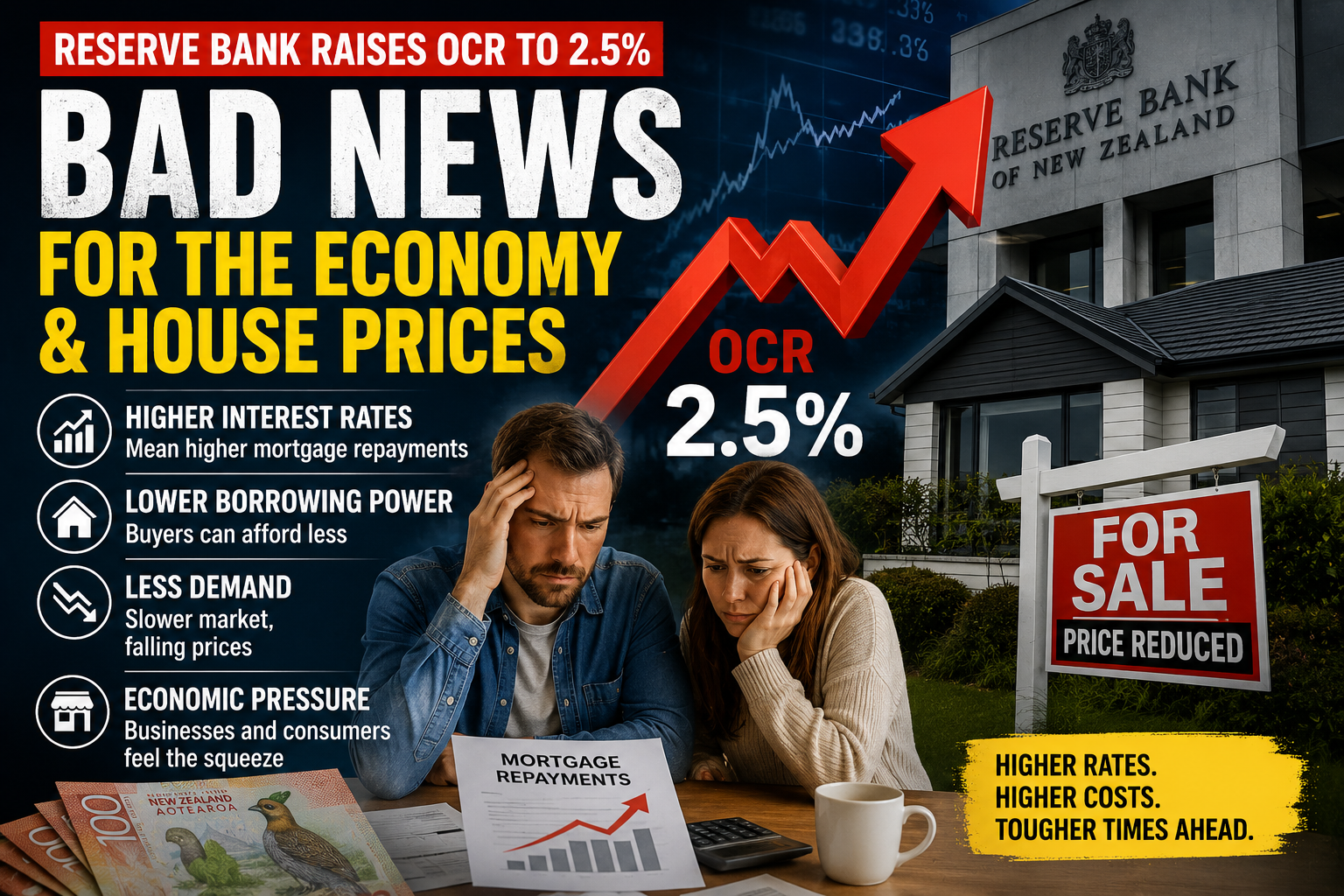
The Reserve Bank of New Zealand (RBNZ) has delivered its first Official Cash Rate (OCR) increase since April 2023, lifting the benchmark interest rate by 25 basis points to 2.5%.
While a quarter-of-a-percent increase may appear modest, the message behind the decision is anything but.
The Reserve Bank has made it clear that more interest rate increases are likely before the end of 2026, as it attempts to bring inflation back to its 2% target midpoint.
For homeowners, property investors and businesses, that could mean a more challenging road ahead.
Why Did the Reserve Bank Raise Interest Rates?
According to the Reserve Bank’s Monetary Policy Committee, inflation remains above its target range despite easing pressures following the ceasefire in the Middle East.
The committee said:
- Inflation remains too high.
- The New Zealand economy is recovering.
- Businesses may begin increasing prices again.
- A weaker New Zealand dollar could increase imported inflation.
- More monetary tightening may be required.
Although the recent conflict in the Middle East temporarily disrupted global markets, the Reserve Bank believes the New Zealand economy is regaining momentum.
Ironically, stronger economic growth is one of the reasons interest rates are now rising.
Higher Mortgage Rates Are Likely
For many homeowners, the immediate impact will be felt through mortgage interest rates.
Most major banks adjust their lending rates following OCR increases.
Even small increases can significantly affect repayments.
Example
A homeowner with a $700,000 mortgage could see repayments increase by hundreds of dollars each month if banks continue lifting fixed mortgage rates over the coming year.
For households already dealing with:
- Higher insurance costs
- Rising council rates
- Increased grocery bills
- Higher electricity prices
another increase in borrowing costs is unlikely to be welcomed.
Why This Is Bad News for House Prices
Property markets are driven by affordability.
When interest rates rise:
- Buyers can borrow less.
- Monthly repayments increase.
- Investor returns weaken.
- First-home buyers struggle to qualify.
- Demand softens.
When demand slows, house price growth typically slows as well.
Some regions may even experience renewed price declines.
Buyers Become More Cautious
Higher interest rates also change buyer psychology.
People become less willing to stretch their budgets.
Instead of competing aggressively at auctions, buyers negotiate harder.
Many delay purchasing altogether.
That usually leads to:
- Longer days on market.
- More price reductions.
- Greater negotiating power for buyers.
- Increased housing supply.
Investors Face More Pressure
Property investors are also likely to feel the impact.
Higher mortgage costs reduce cash flow.
At the same time:
- Insurance premiums continue rising.
- Maintenance costs remain elevated.
- Council rates are increasing in many regions.
- Compliance costs remain significant.
For highly leveraged investors, profitability becomes increasingly difficult.
Some may decide to sell.
Others may postpone purchasing additional investment properties.
Which Regions Could Feel It Most?
Markets already under pressure could experience further weakness.
These may include:
Wellington
Already dealing with weaker buyer confidence and public sector job uncertainty.
Auckland
Large housing stock levels continue giving buyers greater choice.
Hawke’s Bay
Still recovering from recent market corrections.
Meanwhile, regions with stronger affordability and population growth, such as Hamilton and Christchurch, may prove more resilient.
Businesses Will Also Feel the Pain
The effects extend well beyond housing.
Higher interest rates make it more expensive for businesses to:
- Expand.
- Purchase equipment.
- Invest.
- Employ staff.
Consumers also tend to spend less when mortgage repayments rise.
That can affect:
- Retail
- Hospitality
- Construction
- Trades
- Professional services
Economic growth may therefore slow, even as the Reserve Bank attempts to reduce inflation.
The Reserve Bank’s Balancing Act
Central banks face a difficult challenge.
Raise rates too quickly…
…and risk pushing the economy into recession.
Leave rates too low…
…and inflation may become entrenched.
The Reserve Bank believes the economy no longer requires the same level of monetary stimulus that supported recovery in recent years.
However, there is always a lag between raising rates and seeing the full economic effects.
Today’s decisions may not be fully felt for many months.
What Happens Next?
Financial markets and many economists are now expecting at least two further OCR increases before the end of 2026.
If that occurs, mortgage rates are likely to remain elevated for longer than many borrowers had hoped.
The Reserve Bank has indicated that future decisions will depend on:
- Inflation data.
- Consumer spending.
- Employment.
- Business pricing behaviour.
- Economic growth.
Nothing is guaranteed, but the direction of travel currently points toward tighter monetary policy.
Is There Any Good News?
Not all consequences are negative.
Higher interest rates can:
- Reduce inflation over time.
- Strengthen long-term economic stability.
- Prevent unsustainable house price booms.
- Encourage household savings.
- Reduce speculative borrowing.
For first-home buyers, slower price growth may also improve affordability—provided they can still secure finance.
The Bottom Line
The Reserve Bank’s decision to lift the OCR to 2.5% marks an important turning point for New Zealand’s economy.
It signals that the era of easier monetary policy is ending, at least for now.
While the move is designed to bring inflation under control, it also creates new challenges for homeowners, businesses and the property market.
Higher mortgage costs, reduced borrowing capacity and more cautious buyer behaviour are all likely consequences.
For those hoping for a rapid rebound in house prices, this latest decision may delay that recovery.
For buyers with secure employment and strong finances, however, it could create opportunities as sellers adjust to a market where money is no longer as cheap as it once was.
One thing is clear:
The next few Reserve Bank meetings will be watched more closely than ever.
Frequently Asked Questions
What is the Official Cash Rate (OCR)?
The OCR is the interest rate set by the Reserve Bank that influences borrowing costs throughout New Zealand, including many mortgage and business lending rates.
Why did the Reserve Bank increase the OCR?
The Bank says inflation remains above target and believes higher interest rates are needed to help return inflation to its 2% midpoint over time.
Will mortgage rates rise?
Many lenders review their rates after OCR changes. While each bank makes its own decisions, higher OCR settings often place upward pressure on mortgage rates.
Will house prices fall?
There is no guarantee, but higher borrowing costs generally reduce affordability and demand, which can slow price growth or contribute to price declines in some markets.