
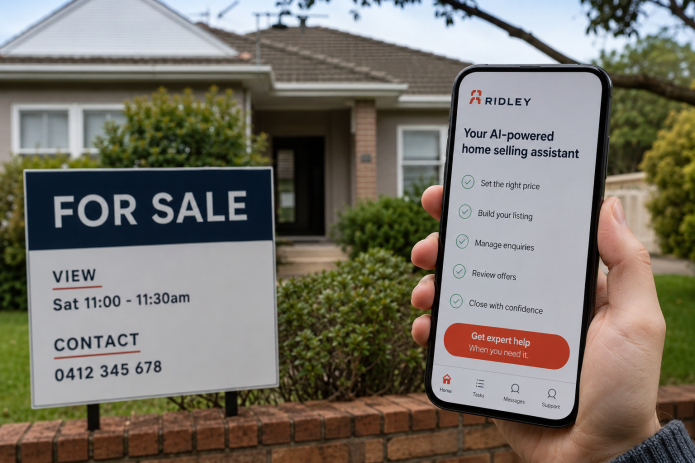











PHOTO: It sounds radical — but in New Zealand and Australia, it’s not only possible… it’s increasingly inevitable.
🧠 The Question the Industry Is Avoiding
What if a real estate brand didn’t need salespeople at all?
No commissioned agents.
No suits.
No door-knocking.
No inflated fees to support large offices.
Just AI, automation, compliance, and outsourced services.
It sounds radical — but in New Zealand and Australia, it’s not only possible… it’s increasingly inevitable.
🏗️ What an AI-Only Real Estate Brand Would Look Like
At its core, an AI-first agency would operate more like a technology platform than a traditional real estate office.
Here’s the structure:
🔹 No Salespeople
No commissioned listing agents
No individual agent brands
No commission splits
Instead, the brand owns the relationship — not individuals.
🔹 Centralised AI Engine
AI would handle:
Buyer enquiries (24/7 chat & voice)
Automated follow-ups
Price guidance using live market data
Campaign optimisation
Contract workflow reminders
Compliance checks
Human involvement becomes exception-based, not default.
📸 Outsourced, On-Demand Services
Instead of in-house staff, the model uses specialist contractors, including:
Photography & videography
Drone operators
Floor plan services
Signage installation
Auctioneers (where required)
Each service is booked automatically via the platform — Uber-style — when a listing goes live.
This dramatically reduces overheads.
💸 Ultra-Low Commissions (And Why They Work)
With no salespeople and minimal fixed costs, commissions could realistically sit at:
NZ: 0.5% – 1.0%
Australia: 0.75% – 1.2%
Why?
No agent splits
No franchise fees
No bricks-and-mortar offices
No recruitment churn
No underperforming staff to subsidise
The value proposition shifts from “relationship selling” to efficiency and transparency.
⚖️ Can This Be Legal? Yes — Here’s How
🇳🇿 New Zealand Compliance
Under Real Estate Authority rules:
Every agency must have a licensed Agent in Charge
Sales activity must be supervised
Consumer protections must be upheld
An AI agency can comply by:
Employing a small number of salaried, licensed supervising agents
Using AI for operational work, not legal authority
Logging all interactions for auditability
Maintaining complaints and disclosure processes
AI does the work — humans hold the licence.
🇦🇺 Australia Compliance
In Australia, regulation sits with state bodies such as:
NSW Fair Trading
Consumer Affairs Victoria
Requirements include:
Licensed agency principals
Trust account compliance
Disclosure obligations
Again, an AI-first model works if:
Licences sit with the company, not individuals
Trust accounting is automated and audited
Human oversight exists for regulated decisions
Automation doesn’t remove responsibility — it reduces error.
🧾 Where AI Actually Excels (Better Than Humans)
AI outperforms traditional agents in:
Responding instantly to buyer enquiries
Following up consistently (no forgetting)
Analysing comparable sales objectively
Removing emotional pricing bias
Running A/B-tested marketing campaigns
Tracking buyer behaviour across platforms
What it doesn’t do?
Negotiate emotionally charged edge cases
Handle disputes requiring judgement
That’s where a small human compliance team steps in.
📊 Why Sellers Would Choose This Model
For many sellers, especially in 2026 and beyond:
They already find homes online
They already understand market data
They already distrust high commissions
What they want is:
✔ Lower fees
✔ Transparency
✔ Speed
✔ Control
✔ Fewer sales theatrics
An AI-first agency delivers exactly that.
🧨 Why Traditional Agencies Should Be Nervous
This model attacks the industry’s biggest pain points:
Commission resentment
Agent turnover
Inconsistent service
Brand dilution
Rising marketing costs
And it does so without breaking the law.
Just like online banking didn’t remove banks — it removed tellers — AI real estate won’t remove property transactions.
It removes inefficiency.
🔮 What Happens Next
Expect to see:
Hybrid AI + human agencies emerge first
Flat-fee and low-commission models gain trust
Younger sellers adopt AI-first platforms faster
Traditional agents pushed further up-market
Regulators adapting — not resisting
The disruption won’t be loud.
It will be quiet, cheaper, faster… and scalable.
🔑 The Bottom Line
A fully AI-powered real estate brand in NZ or Australia is no longer theoretical.
It’s structurally possible, legally compliant, and commercially dangerous to the status quo.
The real question isn’t if this happens.
It’s who builds it first — and who realises too late that the old model no longer fits the market.